
Scotland is a welcoming country in footballing terms. Over the years, players from 123 countries have featured in the Scottish Premiership. However, there had been no representatives from Central Asia. Islam Chesnokov became the first footballer from the region, while Kazakhstan turned into the 124th country to have a player registered by a Scottish club.
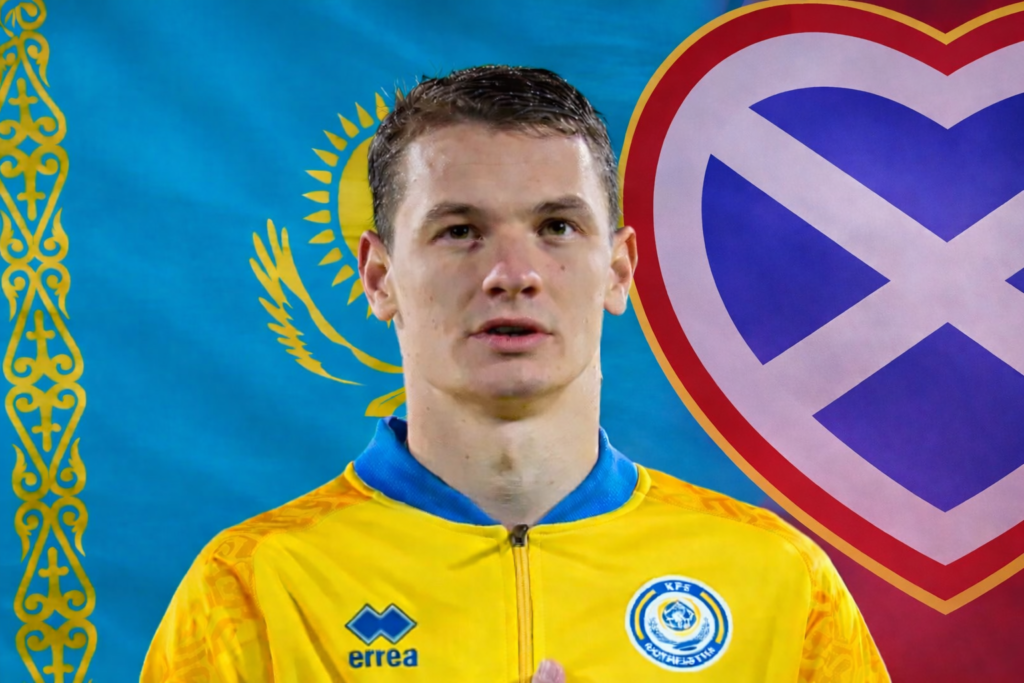
Talks about one of Kazakhstan’s leading footballers moving to Europe had been ongoing for quite some time. Options in Poland, Hungary and Turkey were discussed. From April last year, Hearts began to emerge on the horizon — alongside another Scottish club, Celtic, and Portugal’s Boavista. The interest was natural. Chesnokov had already proven everything at home, both at club level and with the national team. With Tobol, he won the Kazakhstan Cup twice, lifted the Super Cup once, claimed league medals and even finished as the league’s top scorer. He has also become an integral part of the national team. Earlier in his career, Chesnokov spent time in the Belarusian league — a competition known for its physical intensity and emphasis on strength — and managed to hold his own there as well.
In general, Chesnokov is a true fighter. He was not spoiled growing up, having been raised by his grandmother, whom he treats as a mother. He found his way into football thanks to his uncle, former footballer Igor Chesnokov, who took him to a youth academy to keep him away from bad company. One of Islam’s core principles is to keep moving forward. He has repeatedly encouraged young players to move abroad in order to develop. Therefore, a move to one of Europe’s stronger leagues was only a matter of time for the 26-year-old.
The most persistent contender turned out to be Hearts. The club wanted Chesnokov as early as the summer of 2025, but an agreement could not be reached. The Scottish side decided to wait, save money and eventually sign the player as a free agent.
Chesnokov’s move to Europe is important for Kazakh football as a whole — first and foremost from the standpoint of self-affirmation. By the end of 2025, only one Kazakh footballer was registered with a top-division European club outside the post-Soviet space: young Shakhmurza Adyrbekov at Slovakia’s Trenčín. Yes, Chelsea acquired the rights to Dastan Satpayev, but due to his age he remains at Kairat for now. In addition, several players returned home last summer: Galymzhan Kenzhebek left Slovakia’s Košice, Ramazan Orazov came back from Denmark’s Silkeborg, Georgy Zhukov departed Poland’s Puszcza, and Abat Aymbetov left Turkey’s Adana Demirspor.
Against this backdrop, a Kazakh player in the Scottish Premiership sounds both significant and timely. The words of Chesnokov’s agent, Yaroslav Zvarich, are also encouraging: he describes Scotland as just one step on the road to the English Premier League.
Analysis
Hearts view Islam Chesnokov as a “here and now” player, which is reflected in the relatively short contract — just two years. However, this does not mean he will immediately secure a guaranteed place in the starting XI. Let’s take a closer look.
Over the course of the season, Hearts have effectively failed to establish a stable first-choice option on the right flank. Specialist wingers Sabah Kerjota and Alan Forrest have been used sparingly. Kerjota mostly appeared as a substitute in league matches and logged less than 100 minutes in total. Forrest accumulated around 260 minutes, also largely outside the starting lineup. In a number of matches, the right-sided role in a 4-4-2 system was filled by nominal left-back Harry Milne, then by forward Braga, or even by central midfielder Magnusson. This points to a lack of attacking effectiveness on the right rather than simple rotation.
It should be noted that Chesnokov is likely arriving at Hearts with a different functional profile. While he is formally listed as a right winger, in terms of his playing style he is closer to an inside forward or a second striker operating from the flank. Standing at around 185 cm, he regularly attacks central zones and operates inside the penalty area rather than hugging the touchline. In attack, he is versatile, effective in aerial duels and active in crowded penalty-box situations. This aligns closely with one of Hearts’ key attacking weapons. The statistics support this: among the club’s top scorers, alongside the forwards, are centre-backs Stewart Findlay (4 goals) and Craig Halkett (4), underlining the importance of box presence and set pieces.
From a tactical perspective, Chesnokov represents a logical reinforcement for Hearts under Derek McInnes. The team often operates in a 4-4-2 or variations thereof, with an emphasis on vertical play, crosses and pressure in second-ball situations. In such a model, the right midfielder is required not only to provide width, but also to make timely runs into the box, attack the far post, contest rebounds and contribute on set pieces. Chesnokov fits these requirements better than a classic touchline winger, as his game is built on positioning and finishing rather than constant one-v-one isolation.
Chesnokov’s physical profile also reduces the risks associated with adaptation to the Scottish Premiership. He is capable of handling a high volume of duels, does not disappear under intense pressing and can be effective in matches played in tight spaces. For Hearts, who regularly face opponents defending in a low block, having a wide player who consistently appears in the box and adds numbers to the attack has clear practical value.
In McInnes’ tactical framework, a key structural element is the 4-4-2 with a clear division of roles between the forwards. Lawrence Shankland often operates as a striker who drops deeper to link play, while Braga acts as a penalty-box forward, aggressively attacking space and finishing chances, frequently working through the half-spaces. In this context, an attacking wide player who naturally moves inside becomes especially valuable.
Against top opponents, Hearts have also demonstrated the pragmatic side of this model. In an autumn match against Celtic, the team scored following a cross into the box, then added a goal through an individual action by a winger shooting from an inside channel, and later converted a penalty. Three different attacking mechanisms within a single match — without the need to dominate possession or patiently break the opponent down. This profile suits Chesnokov well.
That said, Chesnokov’s move to Scotland is not without risks. The speed of decision-making in the Premiership is higher than in Kazakhstan or Belarus, which will require quicker one- and two-touch play. In addition, McInnes places heavy demands on off-the-ball work from wide midfielders. The right-sided player is expected to regularly drop into the defensive line, provide cover for the full-back and maintain high intensity throughout the match. These aspects will be decisive in determining Chesnokov’s role — whether as a starter or a rotation option.
In the short term, Chesnokov is likely to begin with limited minutes. However, competition on the right flank does not appear particularly fierce. If he maintains his scoring efficiency — particularly through set pieces and his work inside the penalty area — he could break into the regular rotation fairly quickly and become a functional alternative to the current options. He has already won a penalty for his new team in his debut cup match.
