
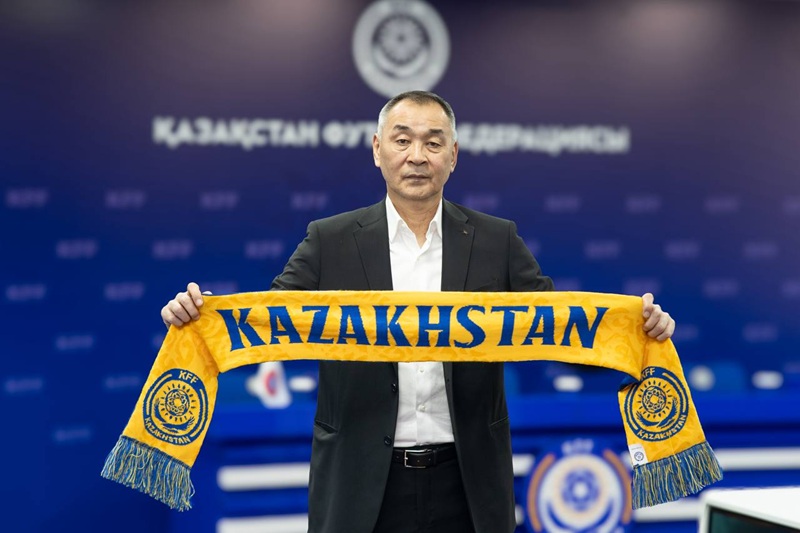
Kazakhstan have officially confirmed Talgat Baisufinov as head coach of the national team for a third spell, ending months of speculation over a possible foreign appointment.
The Kazakhstan Football Federation (KFF) had explored overseas options, with a number of well-known names linked to the role — from former Spartak Moscow coach Massimo Carrera and ex-Wales manager Chris Coleman to Slovakia’s Vladimir Weiss and Bulgarian title-winner Stanislav Stoilov.
Weiss and Stoilov were not unknown quantities in Kazakh football: Stoilov previously coached Astana, while Weiss worked at Kairat. In the end, however, the federation opted for continuity rather than another costly overseas hire.
From France humiliation to Belgium revival
Baisufinov returned as interim head coach last September, replacing Ali Aliev when Kazakhstan’s World Cup qualification campaign was already effectively over.
He was widely seen as a short-term solution while KFF sounded out foreign candidates. But the mood shifted after three late results: a 4–0 win over Liechtenstein, followed by 1–1 draws with North Macedonia and Belgium.
The point against Belgium — one of Europe’s leading sides — strengthened the case for Baisufinov to be confirmed permanently, while some of the earlier foreign names faded from discussion.
It also helped reframe memories of the 8–0 defeat by France — the heaviest loss in Kazakhstan’s history and the result that had ended his previous spell.
A familiar appointment
Confirming Baisufinov is also a bet on stability. He previously led the national team in 2016–17 and again in 2020–22, with neither spell delivering sustained progress.
His second stint proved particularly difficult. During the 2021 World Cup qualifiers Kazakhstan went eight competitive matches without a win — three draws and five defeats — including the record-breaking home loss to France. Baisufinov accepted responsibility publicly despite the obvious gap in quality. His final match in that cycle was a friendly victory over Tajikistan.
Working with limited resources
Few coaches know the inner workings of the squad better. Baisufinov is widely regarded as a strong motivator — a manager capable of extracting results from limited resources.
Those limitations remain the central issue. Kazakhstan’s problems are not only tactical but structural: a shallow talent pool and heavy dependence on a small group of players.
Bakhtiyor Zaynutdinov (Dinamo Moscow) remains the standout for quality and versatility but has struggled with injuries. Islam Chesnokov is on the books at Scottish Premiership side Hearts, offering rare European exposure, yet he has not secured regular minutes. Nuraly Alip (Zenit St Petersburg) has been among the more reliable performers, while Anarbekov (Kayrat) has shown promise in patches.
There is excitement around younger prospects — notably Dastan Satpayev (Kairat, set to join Chelsea in the near future) — but raw talent does not automatically translate into senior reliability without fitness, form and match sharpness.
That is why the idea that a foreign coach could instantly transform the national team is often overstated. A new manager can improve organisation, discipline and game management, but cannot produce top-level players overnight. Eligibility rules also limit quick fixes through naturalisation, leaving the ceiling defined by the available player pool.
A longer-term structure
KFF may also be looking at a broader framework. One scenario under discussion involves Vladimir Cheburin — another Kazakh coach and a proven club specialist with a strong trophy record in Lithuania — taking charge of the Under-21s.
That could allow for a more coordinated approach between senior and youth sides, with clearer pathways for players moving through the system. The aim would be to reduce reactive call-ups driven by injuries and short-term form, and instead build a pipeline with shared selection principles, monitoring and scouting.
There are no quick solutions. Talk of club reform and privatisation is growing in Kazakhstan, but if it leads to stronger academies, infrastructure and domestic competition, the impact will be measured in years rather than months.
Until then, the national team will continue to operate under constraints — and in that context, clarity, coordination and realistic expectations may matter as much as big foreign names.
