
The Center of Islamic Civilization is opening in Uzbekistan. Eurasia Football could not overlook such a significant event, and the project’s author, a member of the World Society for the Study, Preservation and Popularization of Uzbekistan’s Cultural Heritage, Alexander Troitsky, visited the Center and drew his own conclusions from the perspective of a football observer.
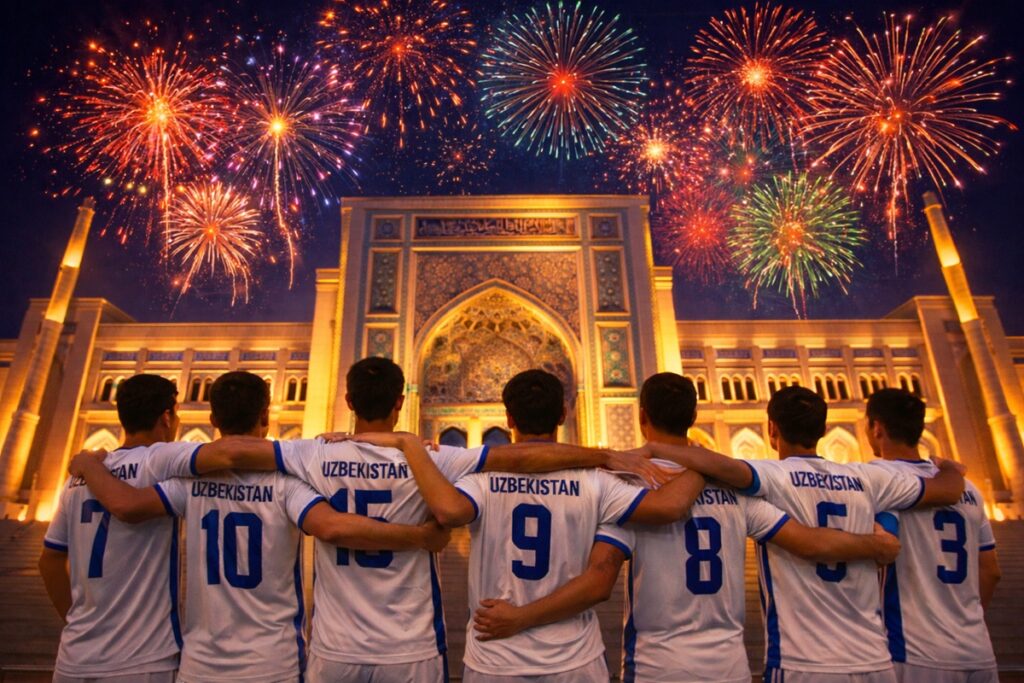
When a visitor enters the Center of Islamic Civilization in Tashkent, they are guided along a timeline familiar to Uzbekistan: the pre-Islamic era, the First Renaissance, the Timurid period, the khanates, the early 20th century, and modernity. Qurans, manuscripts, miniatures, architecture, the “golden age” of science, and the hall of the Third Renaissance — everything is in its place.
But if one looks at the exhibition through the eyes of both a football columnist and a member of the World Society for Cultural Heritage, a quiet, almost unaccented connection begins to emerge — between the timelessness of museum displays and the passion of stadium stands. From Mahmud Kashgari and the Jadids to the Third Renaissance and Uzbekistan’s first World Cup appearance, the exhibition can be read as suggesting a long cultural line, especially as the national team has recently become one of the key drivers of football development in Central Asia.
“Tepik”: The First Touch
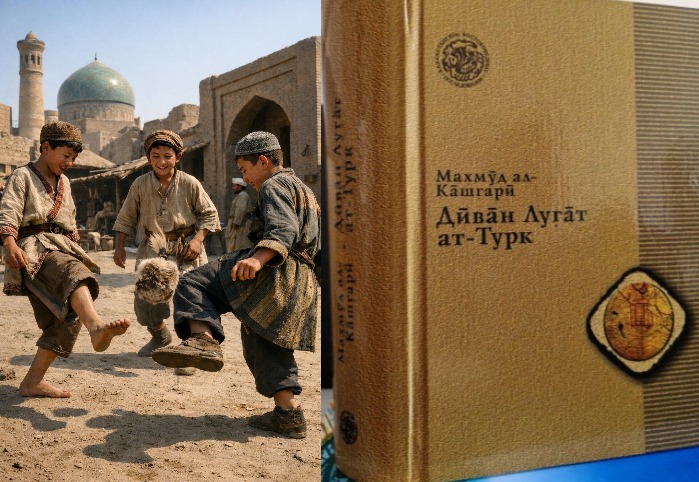
In the hall of the First Renaissance, which tells the story of a time when Transoxiana was one of the intellectual centers of the Islamic world, one could imagine a modest exhibit: a piece of lead wrapped in goat wool — a lyanga. Next to it, a quote from Mahmud Kashgari’s famous Dīwān Lughāt al-Turk describing the game tepik (or tepük).
In this 11th-century dictionary of Turkic languages, Kashgari records how boys kicked the lyanga to one another using their feet. The debate over whether tepik can be considered an early form of football has continued for years. Researchers usually formulate it cautiously: it is “a game in which the feet perform the function of rackets” — something between badminton, juggling, and modern football. From today’s perspective, Kashgari’s description can be read as one of the earliest textual traces of football-like practices in the Turkic world.
A Sense of the Team
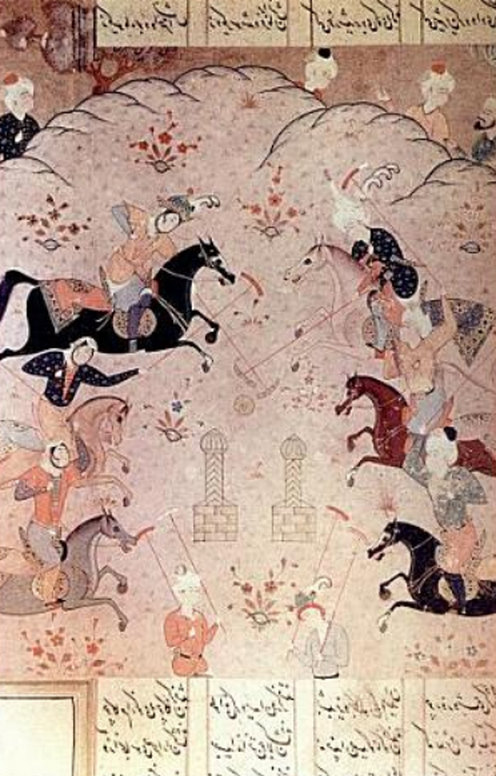
If we shift the focus slightly away from tepik, a broader historical context becomes visible. Medieval Eurasia knew many forms of team-based games. At the courts of the Timurids and later dynasties, equestrian sports were popular — most notably chovgan, a precursor to modern polo. In Persian and Turkic miniatures from the 15th–16th centuries, riders rush across the field, trying to direct a ball toward a target zone.
Another example is kupkari and related games. Here, instead of a ball — a goat carcass; instead of marked lines — a cauldron; instead of stands — hillsides filled with hundreds or thousands of spectators. In some versions, riders divide into teams and try to deliver the “object” into the opponent’s zone as many times as possible. In essence, this is a large-scale team game with physical contact and a defined scoring point.
These sports were not merely entertainment but a way of organizing space, time, and people. In this sense, chovgan and kupkari invite comparison with football as distant structural relatives, while tepik can be read as its more informal, everyday variant.
The Jadids: The Ball Is in Your Court
The Jadid movement occupies a special place both in the Center of Islamic Civilization and in Uzbekistan as a whole. Films are made about these reformers, books are written, and they are presented as role models for younger generations.
Let us move to Kokand in the early 20th century. In 1912, the football club Muskomanda — the “Muslim team” — appeared. Many historians and local researchers consider it the first football team in the region created by local residents.
The Kokand team regularly played against Russian garrison sides, which had introduced football to the region. According to club chronicles and local publications, the Kokand players eventually began not only to compete but also to win — sometimes by large margins, and in front of large crowds. These victories attracted attention. Later Soviet-era Ferghana press would write: “The new game attracted merchants and the intelligentsia — football became a fashionable urban spectacle around which people with money and influence gathered.”
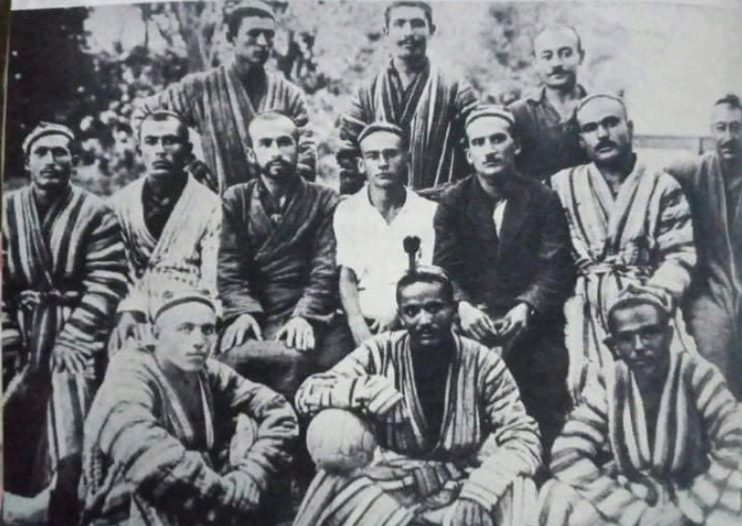
An unexpected figure in this story is Obidjon Mahmudov, a prominent representative of the Jadid movement. His biography is well documented: the first mining engineer among the local population, a graduate of St. Petersburg University, an entrepreneur connected to oil fields in the Caspian region and the Ferghana Valley, and the owner of a private printing house in Kokand. In 1914, he launched one of the first Uzbek-language newspapers in the region, Sadoi Farg‘ona (“Voice of Ferghana”), and later participated in publishing Jadid newspapers such as Tirik So‘z, El Bayrog‘i, and the Russian-language Ferganskoye Ekho.
On one of the popular local history pages dedicated to old Uzbekistan, a group photograph of Muskomanda from 1912 has been published. In some local history communities, Mahmudov is identified in the image and described as a likely founder of the team.
Was it a coincidence that a man who printed newspapers was also investing in football? Within the Jadid worldview, this seems unlikely. Football can be read here as part of a broader project of enlightenment: creating a society in which people read newspapers, see themselves as citizens, engage in sport, and support their peers. According to researchers, the writer Abdulla Avloni encouraged physical activity and even set up a sports ground in his yard so that children would grow up healthy — and it is very likely that football was played there as well.
The Development of the Story
Fayzulla Khojaev, another key figure of that generation and a prominent representative of the Jadid movement, embodied these ideas at the political level. Born into a wealthy Bukhara family and educated in Russia, he became one of the leaders of the Young Bukharans and later headed the government of the Bukharan People’s Republic and the Uzbek SSR.
Khojaev thought in terms of “progressive forces,” supported modernization, and promoted a new way of life — urban, dynamic, and open to the world. For such political figures, sport and physical culture became part of the language of modernization. Through mass events, competitions, clubs, and associations, a “new person” was to be formed.
In the 1920s, when Khojaev held key positions, physical culture and football began to develop systematically in the republic. The first sports societies were established, and city and republican competitions were held. In 1924, a sports complex was opened in Bukhara, where official football matches were played — effectively one of the first state-supported sports infrastructures of its kind in the region.
Pakhtakor
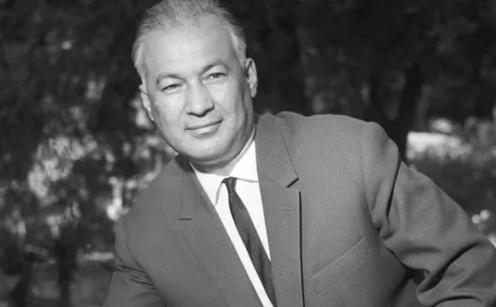
One of the main sporting symbols of Uzbekistan is the football club Pakhtakor. Sharof Rashidov, whose figure is prominently represented in the Center of Islamic Civilization, personally supported the club, closely followed its results, and secured funding and privileges for the team. For Rashidov, Pakhtakor’s victories were a matter of prestige.
The tragedy of 1979, when almost the entire main squad of the Tashkent club died in a plane crash, remains a deep scar in the memory of football fans. Today, many players of the Uzbekistan national team are graduates of Pakhtakor’s academy and take pride in it. At the same time, football culture extends far beyond Tashkent: in Samarkand, Ferghana, Nukus, Khorezm, and Karshi, local clubs have their own histories and loyal supporters.
From Exhibition to Stands
In this broader perspective, football is more than a game — it can be read as a language of the modern era. In recent years, Uzbekistan has reached new heights in the sport. President Shavkat Mirziyoyev shows a strong personal interest in football, attends matches, and supports the national team.
The Center of Islamic Civilization, conceived under his initiative, is designed as a space where history is read as a continuous whole — from early inscriptions to digital exhibitions of the 21st century. In the hall of the “Third Renaissance — New Uzbekistan,” there is already an exhibition dedicated to Uzbek athletes representing the country on the international stage.
What emerges from this perspective is a long historical line: from tepik and lyanga, through the team games of the Timurid era, the Jadid-era Muskomanda, and Pakhtakor — to the Olympics and the World Cup.
