
The former Spartak Moscow and Russia midfielder speaks to Eurasia Football about Samarkand’s new private club Azur, Dinamo’s rising talents, Fabio Cannavaro’s national team and why Uzbek football still needs more physical intensity.
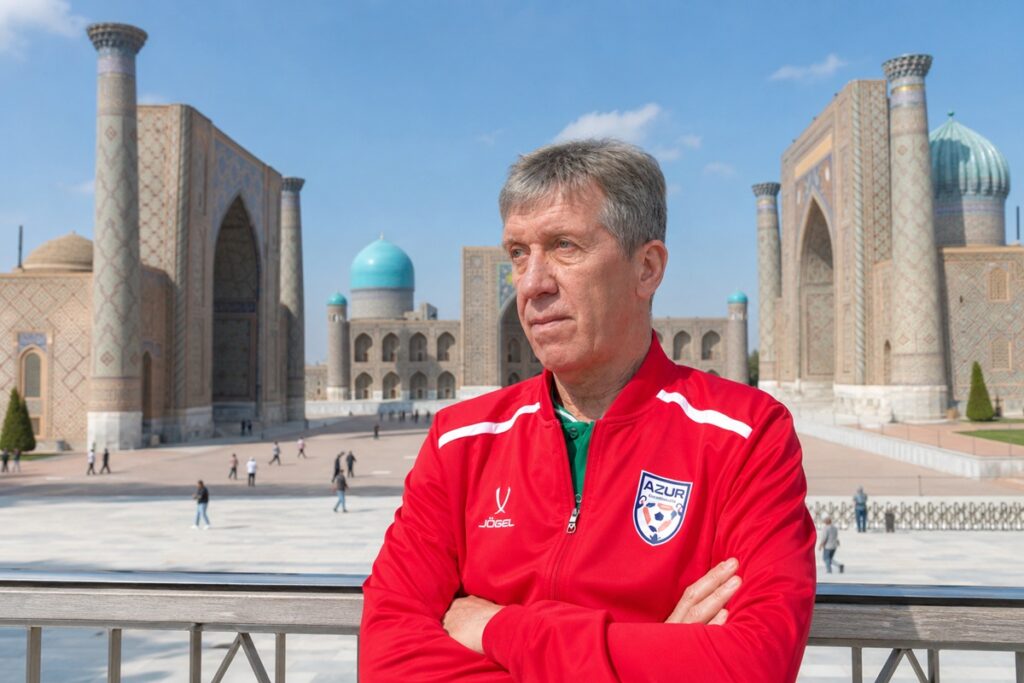
Samarkand’s Azur is a new private football club that has entered the 2026 Uzbekistan First League, the country’s third tier, in the West Zone. The team has already made a solid first impression, performing well in the qualifying round of the Uzbekistan Cup and picking up its first league victories.
Azur are coached by Andrey Pyatnitsky — one of the most recognizable figures connecting Russian and Uzbek football.
Pyatnitsky was born in Tashkent and played as a midfielder for Pakhtakor, CSKA Moscow and Spartak Moscow. He represented the national teams of the Soviet Union, the CIS, Uzbekistan and Russia, and played at the 1994 FIFA World Cup. After ending his playing career, he worked as a coach in Russia, including in the systems of Spartak Moscow and Arsenal Tula. Before joining Azur, he built and successfully coached the youth team of Samarkand’s Dinamo from scratch.
In an interview with Eurasia Football, Pyatnitsky spoke about leaving Dinamo, working with young players, Firdavs Abdurakhmonov, the Azur project, the problems of Uzbek football, the Uzbekistan national team and why Uzbek players sometimes struggle to establish themselves abroad.
“The project interested me because youth development and results are what I live for”
— How did you end up at Azur?
— I met one of the club’s executives almost three years ago. Back then, we organized a match between Azur and a team of bloggers at Dinamo Stadium. A good crowd came to watch. One of the current executives asked me to train the bloggers and his friends. It was no problem for me — we trained for two days. Since then, we have stayed in touch.
Eventually, in late December or early January, we had a conversation. At that point, it was not yet about me taking charge of the team. We discussed the club: the ambition to take the team to a higher level, the fact that they had a school and young players.
When the question became more concrete, the project interested me. I liked it because developing young players and getting results with the first team has been my goal for the last 20 years. This is what I live for. So I did not think for long before agreeing.
— Azur have now made their First League debut and are third in the table. You also started well in the Uzbekistan Cup qualifying round, although you fell just short of reaching the main draw. What was missing?
— Most of the players had not played at this level before. Besides, by the time the cup matches began, I had been working with the team for just over a month. Even with a Super League team, it is very difficult to come into a new squad and build something major in one month. Here, we did what we could in the time available. In my opinion, we performed quite well. We lacked just a little.
At the same time, I know the squads of the teams we played against. These were already experienced teams with experienced players. Strategically, it was easier for them to reach the next round. Our task was to play as many matches as possible in Tashkent in order to prepare for the league.
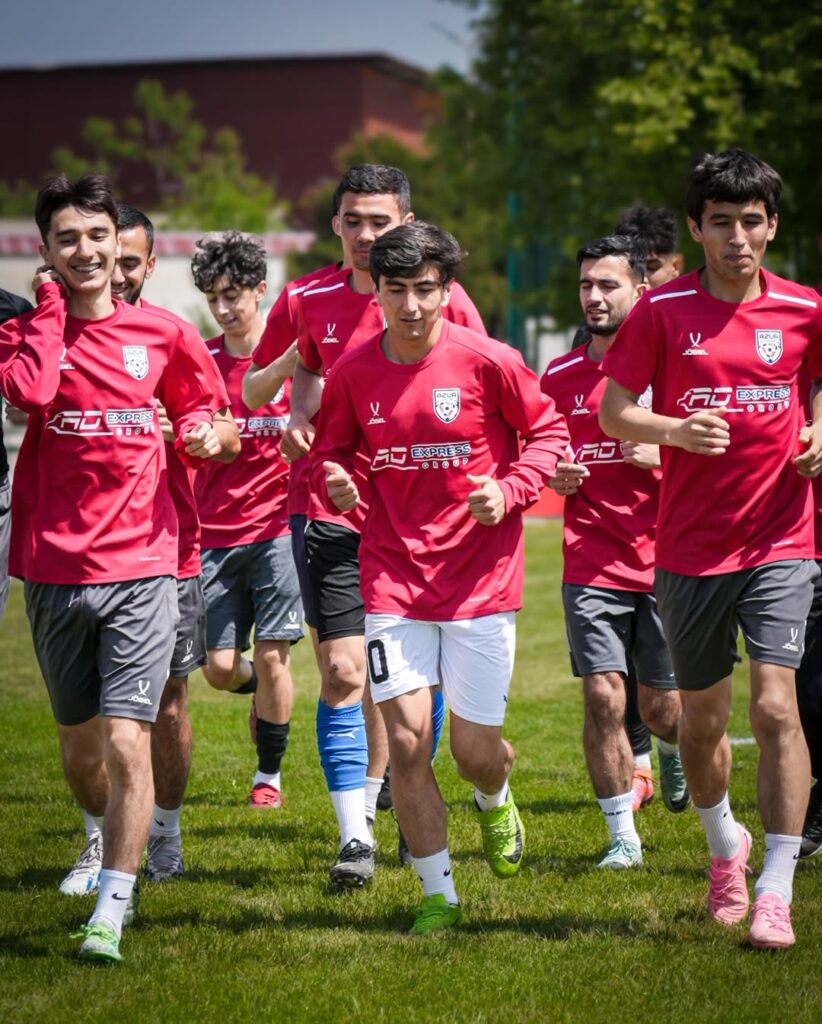
— In terms of infrastructure, is Azur already a fully functioning football club? Is there a base, academy and school?
— We are attached to the school. We have players to choose from, players to pay attention to, and a place to work. We are one whole structure.
As for everyday issues, during my time here I have not faced any serious problems. If something came up, it was resolved quite quickly.
— Do the players live together at a base or in apartments?
— Most of the players are from Samarkand and the Samarkand region. There are three or four players from other cities in Uzbekistan. The club rents an apartment for them. They also rent an apartment for me, since I am a coach from outside the city.
— So the absence of a shared base does not affect the team? Is it normal for players to live at home?
— It is normal. Moreover, I think local players are additionally motivated by playing for their city and their region. In that sense, they have even more motivation.
— Are there any foreigners in the team?
— No. I jokingly call players from other Uzbek cities “foreigners”.
“The task is to show that Azur is not a one-day team”
— If we speak about Azur’s goals and squad-building, are there players in the team with Super League or Pro League experience?
— We do not have such players. In terms of recruitment, there was not enough time. But I already understand the level. I have something to compare it with. I worked with Dinamo’s reserve team and helped Vadim Abramov with the first team. Now I have played a number of league matches with Azur and three cup matches, and I have seen the First League opponents. They are quite different.
There are clubs clearly aiming for the Pro League. There are not many of them, but they are obviously stronger than the rest. Then there are teams of roughly the same level: newcomers, clubs whose recruitment options do not allow them to invite expensive players.
We understood where our problem areas were in different lines, but there was not enough time to look at players and invite anyone. I think this will happen during the working process. Closer to the end of the first round and the transfer window, we will be able to work more precisely.
— Is promotion to the Pro League a target for Azur?
— Formally, that target has not been set. But the task is to make ourselves known. To show that we are not a one-day team: here today, gone tomorrow.
— If you manage to take the team to the Pro League, would the management be pleased? Not everyone is ready to play at a higher level — it requires resources.
— Of course. That would not just be good, it would be very good. But we understand that this is our first year in the First League. Rome was not built in a day. The season has only just started, so everything is possible. I do not rule that scenario out.
— You played against Gulistan, who look like a team with a clear objective.
— Exactly. We lost to Gulistan in the Cup. I will not hide it: in that match we played as the second number, we were weaker and did not create unsolvable problems for the opponent.
But through defensive organization — both in the line and as a team — we managed to keep our goal intact for 87 minutes. Then there was an unfortunate goalkeeper mistake: he held the ball in his hands for more than eight seconds. A corner kick was awarded, and they scored from that corner.
This is also a consequence of lack of experience, youth, and the fact that the players had not competed at this level before. There is still a difference between the Second and First Leagues. Besides, the players understood that the opponent was playing with a serious objective. Somewhere there was nervousness and tension. We need to gain that experience.
— Do you see potential in the team? Or is strengthening the squad essential for serious objectives?
— To fight for the objective that has generally been discussed, we need to strengthen.
— For example, another Samarkand club, your rivals Sherdor, have players with Super League experience.
— Yes, they have players who have already played at a good level. Every team needs a core, and then the wings grow around it. We also need to strengthen in order to solve serious tasks.
— Which positions are the most problematic?
— Midfield. We do not have playmakers — players who can conduct the game.
— So you need a creative central midfielder?
— Yes. We have already played enough official matches, and we often did not have more possession than the opponent, nor did we have a territorial advantage. We lack a creative player who can open a defense with one pass.
But this is not only Azur’s problem. It is a problem in world football. Today there are almost no players like Zico or Platini. Instead, there is universality. Just as the whole world moves forward, football develops together with technology.
— Perhaps you could bring in Russian players?
— I think that at First League level we are capable of finding quality local players.
— Do you already have anyone in mind? Maybe someone from Dinamo-2 whom you recommended?
— So far, I have not seen a player whom I could immediately go to the management about and say: “I need this footballer.” I have not noticed such a player either in the Cup or in the league.
“Uzbekistan is not just a familiar country for me — it is my homeland”
— How do you feel in Uzbekistan now? Can this be called a return home? First Dinamo, now Azur — two projects that were effectively built from scratch.
— I do not speak Uzbek very well, although Uzbekistan is my homeland. I was born here and lived here for 24 years. But back then, perhaps, the language issue was not as important.
At Dinamo’s reserve team, there were more Russian-speaking players. Besides, I had an assistant who spoke both Russian and Uzbek well, so there were fewer problems. Here it is a little more difficult: there are fewer Russian-speaking and Russian-understanding players.
But football is the same everywhere. Football language is the same in Italy, Spain and Uzbekistan. So for me, there is no problem working in Russia or Uzbekistan. What matters is that I am in football, I am working, I live inside a team that has goals and objectives.
— There are coaches from Russia who consciously build their careers in Asia. How ready are you to build your career here? For example, if Azur reach the Pro League and then the Super League.
— Uzbekistan is not just a familiar country for me. It is my homeland. But for me, the main thing is the team’s goal and objective. It does not matter to me where I work — Italy, Russia, Spain, Brazil or Uzbekistan. What matters is the goal.
Uzbek football
“Uzbek football lacks battles and duels”
— In Uzbekistan, there is now a strong emphasis on youth football. Across Central Asia, there is a trend toward developing young players. You have worked with youth for many years — at Spartak, Arsenal Tula and Dinamo Samarkand. How do you see young Uzbek players? How ready are they for modern football?
— From what I saw at Dinamo and here, Uzbek football has a fairly good level. There are good players — footballers with a capital F. The only thing Uzbek football lacks is battles and duels.
When there is tight, aggressive marking, players do not always cope well with it. I tried to instill this at Dinamo’s reserve team, and I will continue doing it. If contact football is taught from childhood and youth level, then this problem does not arise when players move into adult football.
Another issue is gadgets. Many young footballers want to play football, but phones and everything connected to them distract them. Instead of watching football and analyzing how a player in your position acts, they spend their attention on unnecessary things.
I explain to my players: you may have household matters and other things, but right now the main goal is football. Everything secondary must move into the background.
— Does the problem of physical duels also apply to the Super League?
— In general, yes — both to the Super League and the national team. During two years at Dinamo, we went to training camps and played against Super League teams. Many Uzbek clubs play matches against teams from Russia’s First League. And Russia’s First League is physical football.
I cannot remember many matches where an Uzbek team confidently beat a Russian First League team or looked head and shoulders stronger. Although the level of Uzbek football is good.
— At the same time, Uzbek clubs sometimes play quite well against Russian Premier League teams.
— Often this is because RPL teams field their second squad, or because Russian players have a different level of motivation. It was the same in my time at Spartak Moscow: players would approach such matches casually, then start getting nervous when something did not work.
When I became a coach, I understood that with this attitude, players simply ruin the training session for the coaching staff. Coaches want to see something, test something, work on something — and the players only create disappointment with their attitude.
Now the Uzbekistan national team is coached by an Italian, and Italian football is known for tight play.
— Under Srečko Katanec, Uzbekistan also tried to play compactly in midfield.
— He tried to instill that. But do not forget that Uzbekistan played most of its matches against Asian teams, which have the same problem.
— What about Iran? Their players are physically strong.
— Physical strength is not the only criterion. What matters is playing under tight contact. If you pay attention, you will understand.
“At the World Cup, no one will play casually”
— At a recent tournament, Uzbekistan played Gabon and Venezuela, and earlier Egypt. How useful are such matches before the World Cup?
— Such experience is useful for both players and coaches. But it must be understood that coaching staffs often experiment at these tournaments. Venezuela, for example, probably knew little about the Uzbekistan national team.
— Could that become Uzbekistan’s trump card at the World Cup?
— It could. But most teams that have reached the World Cup finals will not allow themselves to play casually. At the World Cup, every point is worth its weight in gold. Still, the experience of such matches is certainly important.
— It seems that under Fabio Cannavaro, the players have started behaving more freely. Under Katanec there was more order. Now there is more improvisation.
— I agree. Under Katanec there was stricter discipline. It seems to me that if a player allowed himself too much, he might not make the lineup for the next match.
Under Cannavaro, perhaps the players are positioned in a way that allows them more creativity and more room to show their individual qualities. But everything comes down to results. If a team leads 1-0 or 2-0, the players start feeling more comfortable. So far, I see that the players are coping well enough with the tasks set by the opponent.
Dinamo players
“Jakhongir Urozov is a national-team-level player”
— What can you say about Jakhongir Urozov? Did you work with him at Dinamo? Could he be a national team player, especially given Abdukodir Khusanov’s injury and other defensive issues?
— In my opinion, he is a national-team-level player. But he has one shortcoming. When the ball is on the other flank, he may think: “The pass will not come here, the ball will not reach this area, I will not run after the player.” Although he does not allow himself that in the national team. His full potential is in central defense. But this concentration issue sometimes appears.
— The US Embassy published a photo of Uzbekistan national team players receiving visas. Anvar Khodzhimirzaev was among them. Apparently, he is in the extended squad. Has he earned a national team call-up? What does he need in order to go to the World Cup?
— He is a player who can decide a match on his own. If the World Cup had been last year, I would have had no doubt that they would take him. Unfortunately, the World Cup is this year. And the numbers Anvar is showing at the club now — goals, assists — are holding him back a little. Competition in the national team’s attacking group is very serious. But he is a footballer who, even in poor form, can decide a game with one action.
— Uzbekistan are now calling up Sherzod Temirov. He played for a long time in Hong Kong, was the top scorer there, and now plays in Iraq. How important is it for the national team to search for options at centre-forward, given the age of Eldor Shomurodov and Igor Sergeev?
— I cannot say anything about Temirov. I do not know what football qualities he has and how he can fit into the national team. Maybe he can become a starting player, or maybe he is an emergency option. It is difficult to judge.
The same applies to Khodzhimirzaev: one coach may value a player who follows instructions for 90 minutes, even if he does not score. Another coach may value a footballer who can come on for 10 minutes and decide an episode. Everything depends on the coach, his vision of the game and tactics.
“Firdavs said through tears: ‘No, I will play’”
— One of Dinamo’s brightest players right now is Firdavs Abdurakhmonov. Can it be said that you prepared him for the first team?
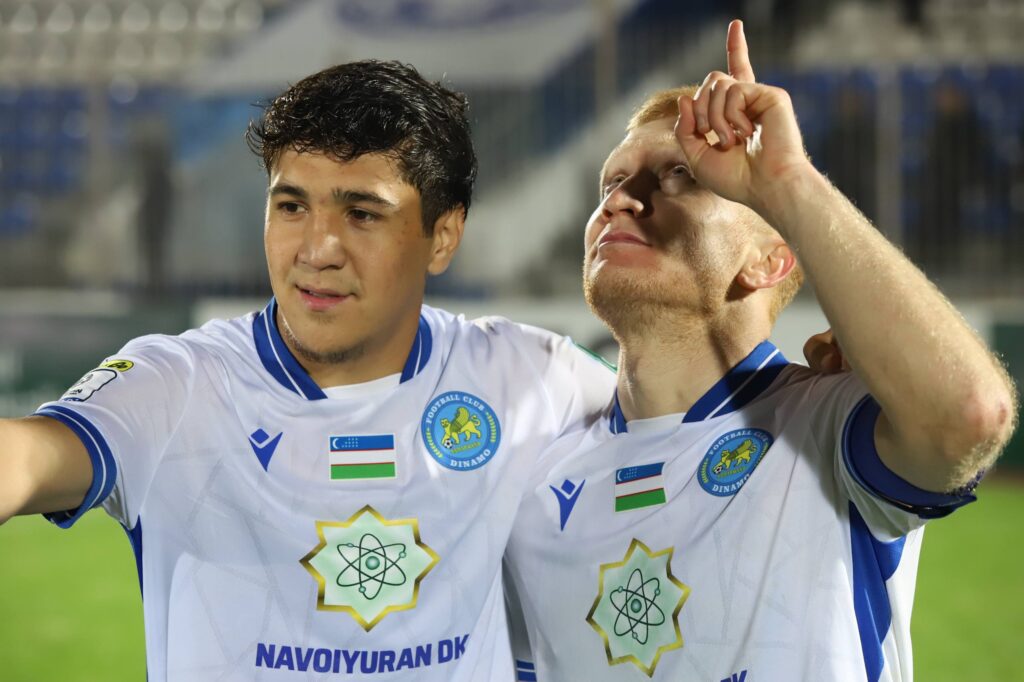
— I do not know. That is probably for specialists to assess. When we were building Dinamo’s reserve team from scratch — because Dinamo Samarkand had been promoted from the Pro League and there was no reserve team at the time — Firdavs came to a trial match. Something did not go right for him: maybe he slightly pulled his hamstring, or perhaps it was another minor injury. We could not fully assess him.
But even in the 15 minutes he played, he left a good impression. I liked how he opened up and how he worked with the ball. So we invited him to a second match. And there was another incident: a duel, a collision, a minor injury. It seemed we were going to substitute him and, roughly speaking, write him off, but through gritted teeth and tears he said: “No, I will play.”
In the end, we took him into the team. We looked at him, started working with him. And literally six months later, he was already among the 20 players in the first-team list. Now, in my opinion, he is a starting-lineup player. Moreover, I think he will soon become one of the leading players.
— Is Abdurakhmonov capable of making Uzbekistan’s World Cup squad?
— I would put it this way: if a footballer has natural ability, football education and technical equipment, then in one or two years he can be brought to a high level — to Super League level. I think Firdavs is capable of taking one more step in the time remaining and possibly going to America — to the World Cup.
— Who else from the youth team came through your hands and caught attention?
— Most of them are now in the team. And I think that if Dinamo Samarkand do not need them, then in the near future three, four, maybe five players will appear at other Super League clubs.
— So these are already ready-made players?
— I say this with confidence because serious work was done: theoretical, tactical and technical. All areas that affect a player’s growth were involved to the maximum.
— People also say you are a strong specialist in psychology.
— There is something to that. But this includes communication on the football pitch and communication in everyday life.
— So you know how to find a common language with players, reach them and unlock their strengths?
— I can get to the very essence.
Uzbek players abroad
“Russian clubs probably do not yet see an Uzbek player they can immediately put into the lineup”
— In the 2025/26 season, for the first time in a long while, there are no Uzbek footballers in Russia’s top two divisions — the Premier League and the First League. Why is that?
— I will try to guess. It seems to me that salaries in the UAE, Qatar and other countries in the region are now comparable to what is offered in Russia. And for an Uzbek footballer, it is probably more convenient to go there — or even stay in Uzbekistan.
There is another point. If a Russian club signs a foreign player, he has to be stronger than the players already in the team. Uzbek football is at a good level, and I like the individual quality of the players. But perhaps Russian clubs do not yet see an Uzbek footballer they can take and immediately put into the lineup.
At the same time, I cannot say that Russian football is now at some extraordinary level. The national team and clubs are not participating in international tournaments, so it is difficult to compare. Plus, the economic situation in Russian clubs has become worse than in the years when they played internationally. Salaries in Arab countries are now higher than in Russia.
— But there were examples when Uzbek players went to Russia even for less money: Abbos Fayzullaev to CSKA, other players to Akron or Khimki. Yet many did not establish themselves. Why?
— I think such players may have had problems precisely with contact, physical football — the issue we discussed earlier. This applies less to Fayzullaev, because he is quick and fast; it is difficult to catch him in a duel, except by fouling him. But other players most likely had difficulties precisely with the physical component.
— So Uzbek players want to try themselves abroad, but not everyone manages to establish themselves.
— Yes. But there are also clubs in Uzbekistan with good salaries. In some teams, two or three players can earn serious money. If a player has the opportunity to earn more in Russia, of course he tries. But not everyone succeeds in settling there.
— Is this a decline? Or simply a specific moment?
— Right now in Uzbek football there are clear leaders, then a layer of strong teams, and the majority of clubs are at roughly the same level. Many teams rely on Uzbek footballers, and anyone can beat anyone. That is also a positive: the domestic league is becoming tighter. But to move abroad, a player has to be ready for different demands — above all, for a tougher, more physical game.