
Ukrainian goalkeeper Orest Kostyk is leaving Muras United after the 2026 season. Speaking exclusively to Eurasia Football, the former Metalist goalkeeper reflects on how a promising season unravelled, why he chose Central Asia over the European lower leagues, and why he would like to stay in Kyrgyzstan. He also discusses Maksim Shatskikh’s coaching prospects and Erbol Atabaev’s move to Croatia.
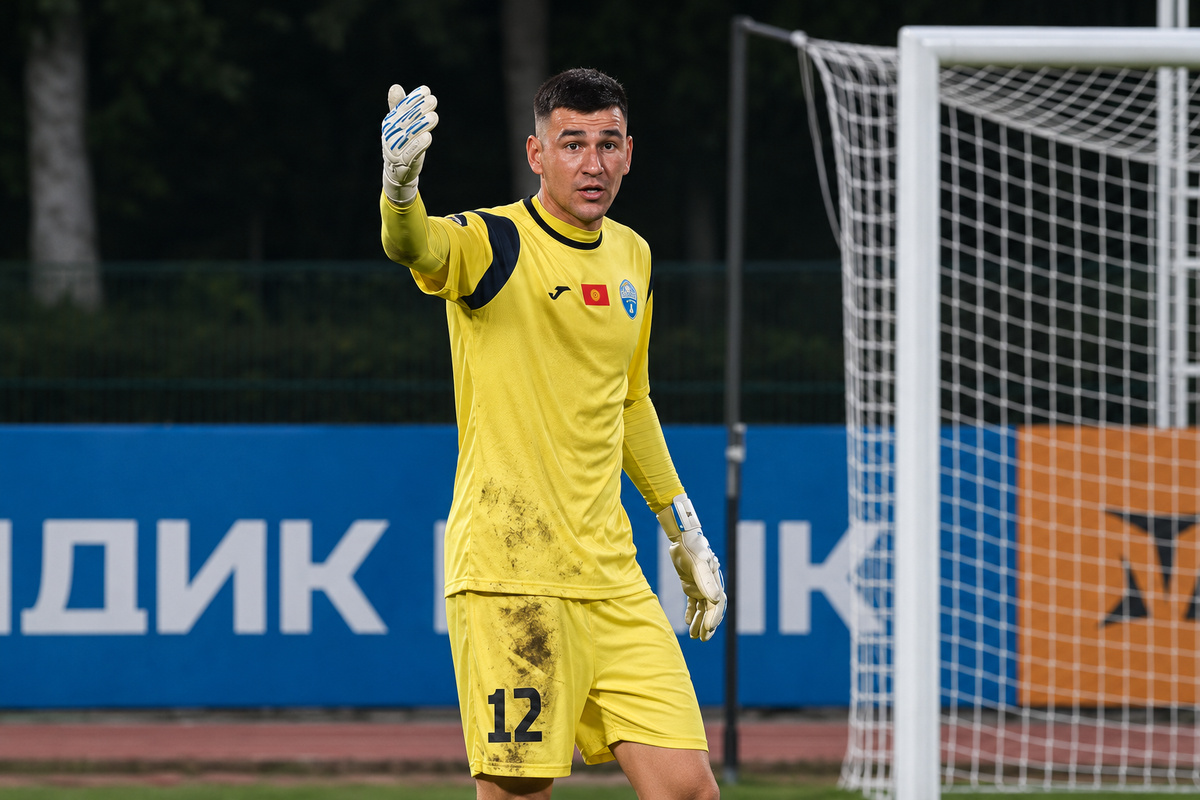
— You once competed with Oleksandr Rybka and became Metalist’s first-choice goalkeeper. How did you end up playing in Kazakhstan and then Kyrgyzstan?
— I knew exactly how difficult the competition at Metalist would be. I’ve got a huge amount of respect for Sasha Rybka. He’s a great person and he always helped me. He made a real name for himself in Ukraine, playing in the Champions League, for the national team, Shakhtar and Dynamo Kyiv. I am also particularly grateful to Andriy Dykan, who made sure there was a good atmosphere between the keepers. The message from day one was clear: there was only one place in goal, and whoever was playing best would get the shirt.
— Some of the lads even joked that I wouldn’t get a single game. Everyone knew who Rybka was. Then Sasha got injured and I got my chance. I played well in my first match and went on to play every remaining game that season. Dykan put his trust in me and I didn’t let him down. What I’m particularly grateful for is that when Rybka recovered, Dykan sat us both down and explained that I was playing well and would keep my place as long as I deserved it. That’s healthy competition, and I’ve never been afraid of it.
— Did Rybka accept losing his place?
— Absolutely. We supported one another whichever of us played. We still speak. I keep in touch with Dykan too; he even congratulated me when my daughter was born.
— Did Dykan think moving to Central Asia was a step backwards?
— Not at all. After the war began, I moved to Lithuania and then to Kazakhstan. Dykan saw it as a new experience worth trying. He supported the decision completely.
— You could have stayed in Europe. Why take the offer from Kazakhstan?
— I could have stayed in Lithuania, and I had an offer from a lower-league club in Poland. But playing in Germany’s fourth or fifth tier, training three times a week and taking it easy just isn’t for me. I want to improve, work and experience something different. My wife and I discussed Kazakhstan and decided to try it.
— What did you know about Kazakhstan before you arrived?
— Very little. Once my wife and I were walking in a park in Taldykorgan and saw donkeys. We were astonished! What really stuck with me, though, was how welcoming people were. I am still close to people I met there, including Muzhikov, Boltobekov and Dairov. We’ve stayed in touch as families and met up even after I left.
— You were surprised by an animal-sacrifice ritual before a football match. How did you come to see it later?
— It was all very strange to me at first. I didn’t go to the first one, but the second time I decided to watch. I even sent a video to friends back in Ukraine. They couldn’t understand why it was happening right there on the pitch either. But here’s the funny thing: this season at Muras we went through a spell when we just couldn’t win. Before one game I suggested it myself. We spoke to the coaches, everyone agreed and we won! Can you imagine? A few years earlier in Kazakhstan I’d found it all so strange, and there I was in Kyrgyzstan suggesting we do exactly the same thing.
— A placebo effect, perhaps?
— You could call it that. The important thing was that we won.
— Why did it not work out at Zhetysu despite a promising pre-season?
— I just didn’t have the coach’s trust. Pre-season had gone well and even my team-mates thought I’d start the season as first choice. But the coach went with another goalkeeper, who started playing well, and I hardly got a chance after that. I’m not the sort of player who goes knocking on the coach’s door asking why I’m not playing. I just get on with my work. If the other keeper is playing well, why would the coach change things? I’d never cause trouble in the dressing room because I wasn’t in the team. But it was a really difficult time for me. I played effectively a game and a half in a whole year. I’d never experienced anything like that before.
— Would you go back to Kazakhstan?
— Certainly. It is a considerably stronger league. I still follow it and would happily consider a good offer.
— What have you made of Temirlan Anarbekov’s Champions League performances?
— I am delighted for him. He was at Zhenis when I was playing in Kazakhstan. I worked with Denis Ivankov, who played an important part in his development. I’ve watched almost every Champions League game he’s played. For a goalkeeper, consistency and the coach’s trust are essential. One or two mistakes in a season are very different from making them every week.
— Kazakh clubs compete in UEFA competitions, whereas Kyrgyz clubs play in Asia. Did that put you off joining Muras United?
— I just wanted to be playing again. I had barely played in Kazakhstan and wanted to change that. I knew Muras had Ukrainian players and a Ukrainian coach, and that would make settling in easier. I’d heard it was a well-run club with big ambitions. I knew it would be easier to settle in, get back into shape and start playing. Having so many Ukrainians around really did help.
— Who actually brought you to Muras: Serhiy Puchkov or Oleksandr Poklonskyi?
— I joined while Poklonskyi was in charge. My agent called with the offer and I accepted. I did not know the other Ukrainian players personally before I arrived.
— Was it mainly about money?
— In the European leagues we’re talking about, you’d be looking at around two or three thousand a month. The financial terms in Kyrgyzstan were better, although my salary in the first season was below five thousand. The club’s ambitions mattered too. I thought I could have a strong season and later return to Kazakhstan or try Uzbekistan.
— You worked under four Ukrainian coaches at Muras: Poklonskyi, Popov, Puchkov and Edmar. Did that help?
— There were seven or eight Ukrainian players when I arrived. We understood the coaches and their methods, so communication was straightforward. That environment helped the local players as well.
— Who did you enjoy working with most?
— Probably Poklonskyi. We had a great dressing room. I still think sacking him was a major mistake. We came from behind to beat Neftchi away 2–1, returned home, and two days later he was dismissed. It shocked everyone.
— Do you know why he was dismissed?
— We were never told why. Under him we were a really tough side to play against, and there was healthy competition: a brilliant performance one week did not guarantee you would start the next. I liked that.
— What role did the Ukrainian scout at Muras play?
— He brought in almost the entire squad under Poklonskyi. After he left, we often spoke about how many good players he had brought in and how much they had helped raise the standard.
How Muras United’s season unravelled
— You sustained a serious injury before the 2026 season. What happened?
— I had just extended my contract when I tore my meniscus before the team’s training camp in Turkey. I needed an operation and went to Serbia for rehabilitation. A little over a month later, I was back training with the group.
— Muras reached the AFC Challenge League semi-finals in April, beating Al Ansar 3–0 and then losing 2–1 to Al Kuwait. What stopped you reaching the final?
— I thought we played reasonably well, but Al Kuwait had stronger individual players. It hurt to lose in front of a full Central Stadium in Bishkek. We scored first, then conceded an awkward goal just before half-time and another from a corner. We could not respond.
— Muras finished only fifth in Kyrgyzstan after taking second place the previous year. Where did the campaign unravel?
— One of the decisive moments was Erbol Atabaev’s departure in the summer. He was the player through whom much of our football went. He could create a chance from nothing. When he left, things started falling apart and we began to have disagreements within the squad.
— I would not call them outright conflicts. There was some friction, including among the coaching staff. Edmar would say he was leaving, then he’d end up staying. Things kept changing and there was no stability. Of course, the results suffered. That’s how important Atabaev was to the way we played.
— So losing Atabaev was central to the decline?
— Absolutely one of the biggest factors. Our results started to deteriorate after his departure.
— The attack had already been weakened by Richard Romario’s injury. Were you short of strikers?
— Yes. Romario got injured not long after joining, then a young forward played some games and sat out others. We never really had a reliable centre-forward. We led the league early on but dropped too many points against teams near the bottom, often drawing games we should have won. I think our finishing cost us points.
— How do you explain the surprise AFC Challenge League qualifying defeat to Bangladesh’s Fortis?
— It was another turning point. We knew the heat would be difficult because we were playing in the middle of the day, but I will not use that as an excuse; Fortis faced the same conditions. We missed a penalty and other chances, while they had chances of their own. After we came back from Bangladesh, we dropped more league points, and the problems kept piling up.
— Were you surprised that Muras extended Edmar’s contract?
— Yes, but that is the club’s decision. The head coach is responsible for results, of course, yet it would be unfair to blame everything on him. We lost an important player, had injuries, failed to win matches we should have won and lacked stability.
— Will you stay at Muras?
— No. I have made my decision. I am leaving.
The rise of Kyrgyz football and Atabaev’s move to Croatia
— How much has football in Kyrgyzstan changed during your time there?
— A great deal. New stadiums and training centres are being built, there are more clubs and better pitches. I feel at home here and I’d like to keep improving as a player as Kyrgyz football develops.
— What is the main gap between the Kyrgyz league and those of Kazakhstan or Ukraine?
— Organisation, first of all. At Metalist we had people who took care of every practical detail, from our kit to our boots. You could turn up on matchday with just your phone and headphones and focus entirely on the game. Kyrgyz clubs still need more specialists with experience of running teams at that level. The tempo of matches is different too.
— What should Kyrgyzstan do to raise standards further?
— Improve youth coaching. Stadiums alone are not enough. You need qualified coaches who know how to work with children. Take Erbol Atabaev, who spent time in Barcelona’s system in Spain. You can see the benefits of that upbringing in his approach to training, his team-mates and his own development.
— Will the new academies, including Barcelona-linked projects, deliver results quickly?
— You cannot open an academy today and expect results tomorrow. It can easily take ten years to build a proper system. Muras have pitches, a gym and good facilities for children; that is a start, but development has to be consistent.
— What impressed you most about Atabaev?
— His professionalism. He never behaved as if the team had to revolve around him. He just worked. For young Kyrgyz players, he is an excellent example. I would put him among the best professionals I met there.
— Are you in touch with him now that he plays for Lokomotiva Zagreb?
— Yes. The language, culture and new surroundings were hard at first, but he’s starting to earn the coaching staff’s trust. I watched one of his cup games when he started; we watched it together and were cheering him on. Erbol had long dreamed of playing in a stronger league. He is happy, and I believe he can become an important player for Lokomotiva.
— Which other Kyrgyz footballers stand out?
— The experienced pair Kairat Zhyrgalbek uulu and Mirlan Murzaev of Bars. They show younger players that you can still challenge for trophies at their age. Among the younger ones, Yryskeldi Madanov stood out: he spent just four or five months in Slovakia, but came back a different player, with a completely new approach to training.
— Do big-name arrivals such as Solomon Kvirkvelia and Valon Ahmedi help the league?
— Definitely, especially in marketing. A player of Kvirkvelia’s standing makes people notice a league they might otherwise ignore. Experienced footballers have spent years building their reputations. Those reputations help attract attention and other players.
Shatskikh, FC Asia and what comes next
— You nearly joined Maksim Shatskikh at FC Asia when he was putting the squad together. Why didn’t the move happen? Muras were very keen to keep their Ukrainian players, weren’t they?
— I was approached when Asia were putting their squad together. I knew Mykola Tyshchenko, who had worked with Shatskikh at Andijon. There were some complications with the move at the time, though, and in the end it didn’t happen.
— I know Maksim well. We were neighbours in Bishkek, lived in the same building and met often. I think he is a very good coach, and Kyrgyz football benefits from bringing in people like him.
— How do you rate the fourth-place finish of a team built almost from scratch, just a point short of third place?
— Building a competitive side from nothing is extremely difficult. Shatskikh and his staff did a remarkable job. I was surprised his contract was not extended. I don’t know what was agreed with the club’s management, but I was really impressed by the way FC Asia played.
— Is Shatskikh ready to manage in the Ukrainian Premier League?
— Absolutely. He knows Ukrainian football inside out: the market, the people and the league itself. For a long time he was the Ukrainian Premier League’s leading goalscorer. Ukraine has effectively become his second home. I know he’s ambitious, and given the right project, time and trust, I think he could do very well.
— What about Dynamo Kyiv? Is he ready for that challenge?
— Why not? He knows the club extremely well, spent most of his playing career there and understands how it works. As far as I know, his name has been discussed. Of course, that’s a different level of responsibility. Dynamo are one of Ukraine’s biggest clubs. One or two defeats can completely change the way people see the manager. But it’s an interesting challenge, and I think he’d relish the opportunity.
— How have you and your family settled into life in Bishkek?
— We feel really at home here. Bishkek has become a second home for me and my family. Our daughter was born here. We feel safe, we love the city and the people, and I’m very grateful for the way we’ve been welcomed. I’d love to carry on living and playing here.
— You’ve even considered taking Kyrgyz citizenship, haven’t you?
— Yes, it was suggested to me, but things stalled. It’s not as easy to get citizenship now as it used to be. I wouldn’t rule it out, though. I could easily spend another few years here. In theory, I’d even be interested in having a go at international football with Kyrgyzstan, although I know there’s competition for places there too.
— Does leaving Muras mean leaving Kyrgyzstan?
— No. I’ve already had some interest from other clubs, and I would like to stay. I also have to consider offers elsewhere. Above all, I want regular football; I do not want another season like the one I had at Zhetysu.
— You are close to Oleksii Shchebetun, who now plays for Istiklol in Tajikistan. How is he getting on?
— We are friends and still speak. We got to know each other in Lithuania, moved to Kazakhstan at around the same time, and later took different paths. He had injury problems, played for Zimbru in Moldova and also in Uzbekistan before joining Istiklol. He speaks highly of the team, although adjusting to a new country takes time.
— Istiklol went out of the AFC Challenge League group stage, and Shchebetun has struggled for goals. Have you discussed that?
— Not recently. Goals are vital for a striker, but I know how hard Oleksii works. He is always professional. Something may be holding him back from showing what he’s capable of.
— Does that say something about the quality of defenders in Tajikistan?
— Both Tajikistan and Kyrgyzstan are harder leagues than outsiders imagine. Some players come here thinking they’ll put up great numbers and then move on to a stronger league. In reality there are good local footballers and strong foreign players. You need time to adapt to the club, the league and the coach’s demands. Having the coach’s trust makes a huge difference, especially when you’re a goalkeeper.
— Would you return to Ukraine if a Premier League club called?
— Of course I would consider it. Playing in Ukraine again is a dream; I had some good spells at Lviv and Metalist. But my wife and daughter come first, and I have to take their safety and peace of mind into account given the war.
— So is going home your overriding priority?
— I want to return, but I wouldn’t say it comes before absolutely everything else. I cannot make this decision only for myself now. I have a family.
— What about an offer from Poland, Slovakia or Croatia?
— I have never been afraid of competition. I enjoy challenges, but I’d look at the club, its ambitions, the length of the contract and what the move would mean for my family. If my wife and daughter feel safe and happy, I can concentrate completely on football. I’m open to offers and ready for a new challenge.