
Uzbekistan reached the World Cup for the first time but lost all three matches. Alexandr Troitskii, founder of Eurasia Football, looks at Cannavaro’s role and explains why pride should not hide hard questions.
“We were not inferior to Spain in terms of class and, at the very least, could have drawn the match,” Timur Kapadze said after Uzbekistan lost 2–1 to Spain at the 2024 Olympic Games in Paris.
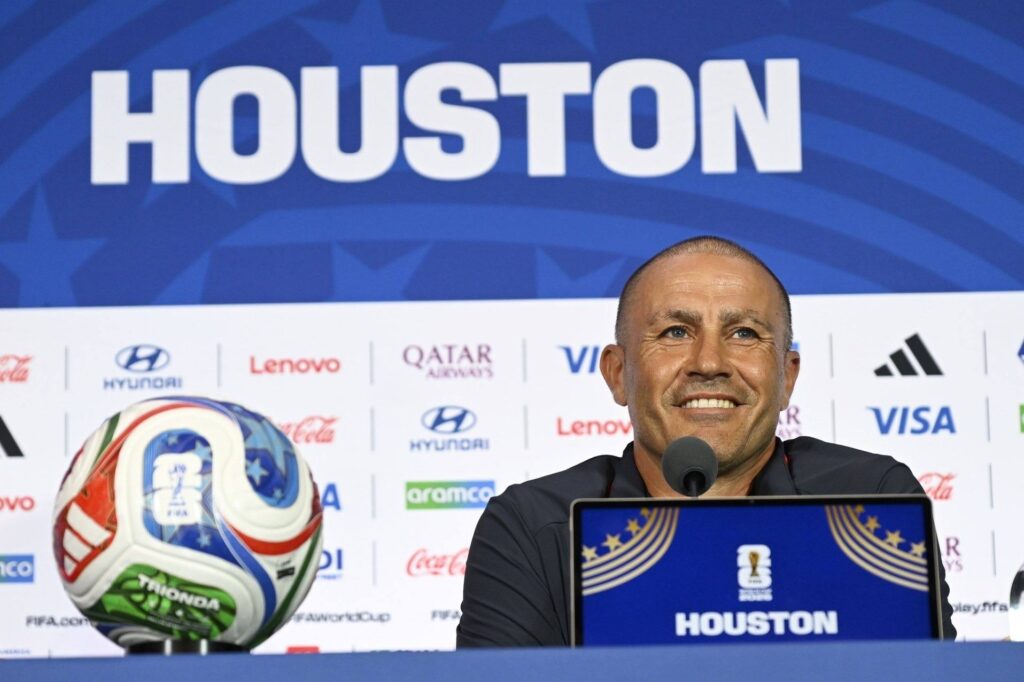
“I am proud of my team,” Fabio Cannavaro repeated during Uzbekistan’s 2026 World Cup campaign.
Between these two statements lies the central problem in how Uzbekistan’s national team is now being discussed.
Kapadze’s Olympic campaign was quickly labelled a failure by many at home. Cannavaro’s World Cup, in which Uzbekistan lost all three group-stage matches, is now being presented by some almost as a source of pride and valuable experience.
Of course, Uzbekistan’s qualification for the World Cup was a historic achievement. The country had never reached the tournament before. The players, coaches, clubs, academies and supporters all have the right to be proud of finally seeing Uzbekistan at the World Cup.
But there is a crucial distinction. One can be proud of qualifying for the World Cup. That does not mean one must pretend that the performance at the World Cup was also a success.
If those two things are mixed together, the result is a comfortable but dangerous formula: participation matters more than performance, results are secondary, and every defeat can be hidden behind the phrase “it was our first time”.
Uzbekistan qualified for the World Cup partly because the tournament expanded to 48 teams. Asia received eight direct places plus one intercontinental play-off spot, instead of the old 4+1 format. This does not erase Uzbekistan’s achievement, but it does change the scale of it. With such quotas, previous generations of Uzbek football — from Mirjalol Kasymov to Maksim Shatskikh, from Server Djeparov to Odil Akhmedov — might well have made Uzbekistan a regular World Cup participant much earlier.
Even during the current qualifying campaign, Uzbekistan did not look like a side that had suddenly become an Asian powerhouse without caveats. There were two draws against Iran, a draw with the UAE, a defeat to Qatar, and difficult wins over Kyrgyzstan and DPR Korea. Uzbekistan deserved its place at the World Cup, but it did not arrive as a team ready to say: now we can compete with everyone on equal terms.
Still, the team had a real foundation.
That foundation was built by Srečko Katanec. The Slovenian gave Uzbekistan structure, discipline, compactness and the habit of suffering without the ball without falling apart. When illness prevented him from continuing, the team was taken over by Timur Kapadze, a coach who already had rare tournament experience for Uzbekistan: he had led the Olympic team to Paris 2024.
Yes, the Olympic results were disappointing. Uzbekistan lost to Spain, lost to Egypt and drew with the Dominican Republic. But context matters.
Against eventual Olympic champions Spain, Uzbekistan lost 2–1. They were not destroyed. That Spanish team included Pau Cubarsí, Alex Baena, Eric García, Joan García, Marc Pubill, Fermín López, Pablo Barrios, Miguel Gutiérrez, Juan Miranda, Adrián Bernabé and other players of serious European pedigree. Five of them were later part of Spain’s World Cup squad. Fermín López, who missed the World Cup through injury, has been valued at around €100 million.
Against that level of opposition, Uzbekistan competed. They fought, pushed the match into uncomfortable territory for Spain and had reasons to believe they could have taken more. Kapadze’s statement about not being inferior in class was bold, perhaps even exaggerated, but it was not absurd. It came after a match in which Uzbekistan did not look out of place.
The defeat to Egypt was painful, but it looked more like a brutal accident than a true reflection of the balance of play. Uzbekistan were not inferior, had more possession, attacked more and lost after an early goal to a side that would later beat Spain and reach the semi-finals. The draw with the Dominican Republic was also not a catastrophe: by the third match, Uzbekistan had already lost any chance of progressing, and the game became an experiment born out of necessity — an opportunity for Kapadze to give Olympic minutes to his reserves.
Now compare that with Cannavaro’s World Cup.
Uzbekistan lost 1–3 to Colombia, 0–5 to Portugal and 1–3 to DR Congo. Three matches, zero points, two goals scored, eleven conceded, last place in the group — and the feeling that the team never fully understood how it was supposed to play at this level.
The Colombia match was probably Uzbekistan’s best period of the tournament. The team tried to hold a compact block, close the centre, suffer without the ball and look for quick transitions. After the break, Uzbekistan became braver, scored their first-ever World Cup goal and, for a few minutes, genuinely returned to the match.
But that was also where the first systemic problem appeared. Cannavaro’s team could not manage the emotional moment after equalising. Uzbekistan made it 1–1 — and almost immediately conceded again. When they tried to play through the middle, they lost the ball and opened space for Colombia’s transitions. Cannavaro later said the team understood when to suffer, when to control possession and when to switch the play. The result suggested otherwise: at this level, a correct idea means little if it collapses under pressure.
Against Portugal, the problem became a disaster.
On paper, Uzbekistan were supposed to rely on three central defenders and a heavily populated defensive line. But a structure only helps if it works dynamically. Portugal constantly stretched Uzbekistan through the flanks and half-spaces. Nuno Mendes and João Cancelo pushed high. Vitinha controlled the rhythm. Bruno Fernandes found passes between the lines. Cristiano Ronaldo and his teammates attacked the penalty area with ease.
Uzbekistan could not close the wings, protect the half-spaces or play out under pressure. The team dropped too quickly towards its own penalty area, but without becoming truly difficult to break down. That is the worst version of defensive football: you have little possession, offer almost no threat on the counterattack, and still allow chances.
Yes, Azizjon Ganiev had a goal disallowed at 0–2. Yes, that moment may have affected the team psychologically. But it does not explain 0–5. Defeats like that are not about one VAR decision. They reveal a gap in speed, organisation, decision-making and reaction to changes in tempo.
And then came DR Congo.
This is where the argument about “the opponent was too strong” stops working. DR Congo are a good, physical, athletic team. But they are not Spain, not Portugal and not Colombia. This was the match in which Uzbekistan had to do more than “gain experience”. They had to play for a result.
More than that, Uzbekistan took the lead. Eldor Shomurodov scored, and the team had a real chance to finish the tournament with some dignity. Instead, after the goal, Uzbekistan did not take control of the situation. They retreated deeper and deeper. DR Congo took the ball, loaded the flanks, pushed their full-backs high, pinned Uzbekistan back and eventually turned the game around.
Cannavaro himself said after the match that the team had shown a “fear of winning”. He said he wanted Uzbekistan to keep a higher tempo, hold a higher defensive line and attack the space behind Congo’s wide players. But little of that appeared on the pitch. Players repeatedly dropped towards the ball, received it with their backs to goal, lost it under pressure and ended up defending again.
This was no longer simply about the opponent’s individual quality. It was about coaching influence.
If a team leads in the match that is supposed to save its tournament image, then fails to understand how to manage that advantage, the problem is not only psychological. It is also about preparation. What do you do after 1–0? When do you accelerate? When do you keep the ball? When do you go longer to escape pressure? When do you stop forcing passes through a crowded centre? When do the wing-backs drop, and when do they press higher?
Uzbekistan had no convincing answers.
And this leads to the key question: what exactly is Cannavaro proud of?
If he is proud of the players, that is understandable. They played at the World Cup for the first time, faced Colombia, Portugal and DR Congo, lived through pressure, made mistakes, suffered and kept fighting. A coach must protect his players in public, especially after a tournament like this. In that sense, saying “I am proud of my players” is a normal human reaction.
But if we are talking about Cannavaro’s own work, the reasons for pride are much harder to find.
What was his personal coaching contribution at this World Cup?
The team had been taken to the tournament by Katanec and Kapadze. The playing foundation — compactness, discipline, structure without the ball — had been laid before him. The key players were not discovered by Cannavaro either: Shomurodov, Abdukodir Khusanov, Abbos Fayzullaev, Oston Urunov, Otabek Shukurov and others had long been part of the national team system. Even Bekhruz Karimov, one of the newer names, had gone through Uzbekistan’s youth national teams.
Cannavaro did not inherit a blank slate. He received a World Cup squad with a ticket already secured, a formed core, a serious preparation programme and maximum institutional trust. He was given time, friendlies, staff, authority and a team whose place at the tournament had already been secured. His task was not simply to speak beautifully about a first experience. His task was to add quality.
Where did that quality appear?
Uzbekistan did not become more reliable defensively: eleven goals conceded in three matches. They did not become braver with the ball: the team lost possession too often in dangerous areas and struggled to build attacks under pressure. They did not become more tactically flexible: after the goal against DR Congo, Cannavaro himself admitted he had asked the team to play higher, faster and attack space, but the players continued to drop towards the ball and receive it with their backs to goal. They did not become psychologically stronger: in the match where they needed to save face, they took the lead and still failed to hold the situation.
The picture is strange. When Uzbekistan lost, Cannavaro spoke of pride. When the team made mistakes, he spoke of experience. When the players did not follow his instructions, he spoke of fear of winning. But if players do not carry out the head coach’s instructions in a key World Cup match, that is not only a problem for the players. It is also a question for the coach: why were those ideas not communicated, trained and implemented?
Cannavaro deserves some respect for not throwing his footballers under the bus after the 5–0 defeat to Portugal. He took responsibility, and that was the right thing to do. But responsibility is not an achievement. It is the minimum duty of a head coach after such a result.
Fabio Cannavaro was a great player. A World Cup winner, a Ballon d’Or winner, a symbol of Italian defensive excellence. But coaching is a different profession. Before Uzbekistan, he had not completed a successful cycle with a national team. He had not led a side through a major international tournament as head coach. There was no clear evidence that he could quickly raise a national team to a new level.
What he did have was a famous name. And at some point, it seems the name became more important than the substance.
On paper, his plan was understandable. Uzbekistan were supposed to stay compact, close the centre, suffer without the ball and look for moments through Shomurodov, Fayzullaev, Urunov, wing overloads and set pieces. At times, it worked. But the World Cup is not a tournament of isolated moments. At this level, a team must survive for 90 minutes, manage pressure, change rhythm, stay calm after scoring and avoid collapsing after mistakes.
Uzbekistan did not show that.
Under Katanec, the team could be pragmatic, sometimes dull, sometimes too cautious. But it had a frame. Under Kapadze, that frame remained. Under Cannavaro, Uzbekistan seemed caught between ideas. They wanted to be braver, but looked afraid. They wanted to defend compactly, but conceded too much. They wanted to play out through passing, but lost the ball in dangerous zones. They wanted to be proud of participating, but ended up with a result that cannot be covered by elegant words.
The phrase “I am proud of my players” is not wrong in itself. The players did fight. They did care. They did suffer. Nobody should accuse them of indifference.
But when that phrase is repeated after every defeat, it stops being protection and starts becoming a curtain. Behind it, the difficult questions disappear.
Why was the team not ready for Colombia’s pressure after 1–1? Why did Portugal stretch Uzbekistan so easily? Why could Uzbekistan not play more maturely after taking the lead against DR Congo? Why did a team that had spent years building defensive order concede eleven goals at the World Cup? Why did a coach who was given everything he could reasonably ask for fail to add visible quality?
Pride should not cancel ambition.
Uzbekistan can be proud of reaching the World Cup. It can be proud of a generation that is now being watched in Europe. It can be proud of Khusanov, Shomurodov, Fayzullaev, Urunov, Karimov and those who will follow them. It can be proud of the work done over many years by coaches, clubs, academies, officials, players and families.
But it cannot call successful a tournament in which the team lost every match, conceded eleven goals and failed to protect a lead against an opponent it should have been able to compete with.
If Uzbekistan wants to become a real World Cup participant rather than a team merely happy to be there, it needs more than pride. It needs a clear standard — and measurable expectations.
Before Cannavaro, Uzbekistan’s ambitions were measured by results. Kapadze’s Olympic campaign was called a failure despite a competitive match against Spain and a tournament full of context. But once a famous foreign coach arrived, the language changed. Defeats became “experience”. Tactical problems became “lessons”. A 2–11 aggregate score became something to wrap in the word “pride”.
That is the problem. It looked as if the standard had not been raised for Cannavaro, but lowered for him. Uzbekistan did not appoint a World Cup-winning legend to make three defeats sound more respectable. It appointed him to make the team better.
On the evidence of this tournament, Cannavaro did not deliver that.