
Alisher Aminov is an international expert on football governance, an economist and a former candidate for the presidency of the Russian Football Union.
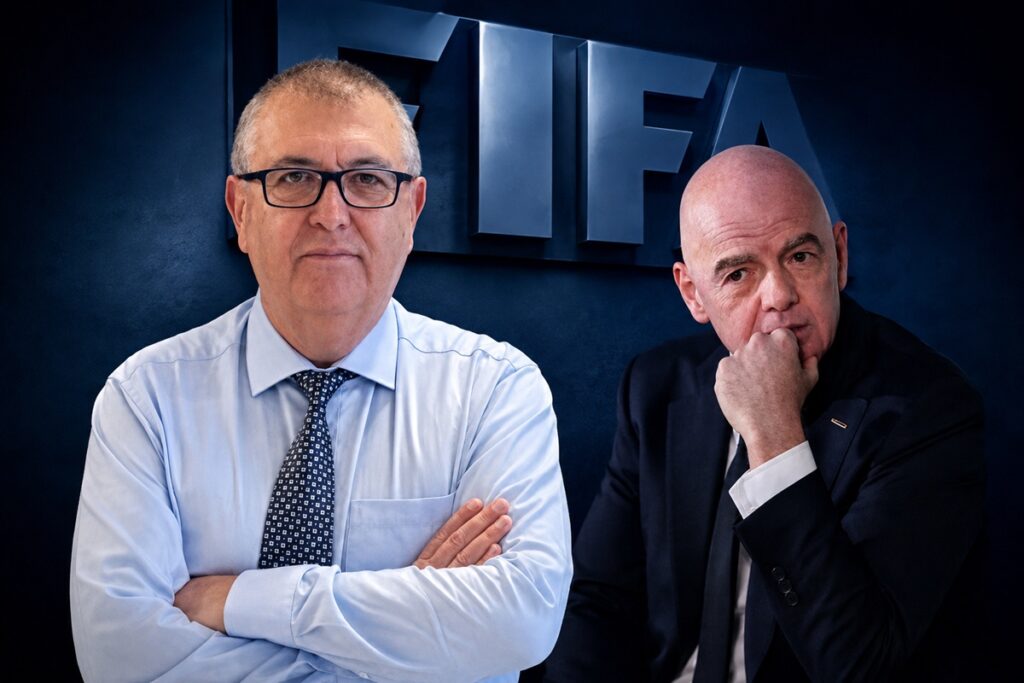
By deciding to establish FIFA Forward Enterprise, transfer a substantial share of FIFA’s commercial operations to the new company and open its capital to private investors, FIFA President Gianni Infantino attempted professional suicide.
The proposal provoked an extraordinary backlash across the global football community and triggered FIFA’s biggest crisis in years.
What exactly drove the head of world football to take actions so far beyond the bounds of common sense remains unanswered. For now, at least. There is no shortage of people determined to find, formulate and substantiate an answer.
I have spent many years studying global football governance, corruption scandals and the conduct of FIFA’s leadership. I have participated in related court proceedings in Europe, published dozens of articles about Infantino and long been one of his consistent, albeit distant, opponents.
Yet even I did not expect the organisation’s president to attempt an operation so brazen and cynical.
The football world had barely recovered from the 2026 World Cup when, on the evening of 28 July, a letter of just over four pages, personally signed by Infantino, was emailed to FIFA’s 211 member associations.
As usual, it began with Infantino praising his own work and listing FIFA’s achievements during his ten years in power. He then presented another grandiose idea and described the financial benefits it was supposedly going to bring to world football.
In the final section, entitled “What Happens Next”, the national associations were effectively presented with an ultimatum.
Infantino explained that the final decision rested entirely with FIFA’s members. If a majority approved the proposal, the organisation would gain access to a $10 billion package from 1 January 2027, with each association eligible to receive up to $40 million.
If the majority voted against it, the total package would fall to $2.7 billion, while payments to individual associations would be reduced to approximately $10 million.
The letter also contained a separate mechanism for punishing those who dared to take a principled stand. Any federation that voted against the proposal but found itself in the minority would receive $20 million less than those that supported it.
Responses were required by 19 September.
In other words, FIFA’s 211 members were given just 53 days to examine and approve an entirely opaque multibillion-dollar transaction.
One can talk endlessly about democratic procedures, freedom of choice and majority rule, but what matters is not the terminology. It is the substance.
I would call it an ultimatum.
The scheme was extremely simple, yet uniquely cynical in its simplicity: vote “yes” if you want free money. Vote “no” and accept the consequences.
The associations were being asked to consider not only the future of world football and the deal’s long-term implications, but also the prospect that their neighbours and competitors could receive $20 million more.
Denmark, England, Mexico, Senegal, Honduras or the Cook Islands Football Association could vote against the proposal. But if they ended up in the minority, they would automatically lose an enormous sum of money.
Infantino was not merely proposing a new commercial model.
He had set a price for dissent.
Forty Million Dollars for the Right Vote
Between 2027 and 2030, every association was supposed to receive $20 million instead of the previously planned $8 million. Those supporting the project were also promised an additional one-off payment of $20 million.
Funding was then expected to rise to $22 million for the 2031–2034 cycle and $24 million for 2035–2038.
Over 12 years, or three funding cycles, each national association could have received approximately $86 million.
For comparison, before Infantino’s election, associations received roughly $3 million over a similar period.
At first glance, this looked like an extraordinary development programme for world football.
In reality, the FIFA president was making little effort to conceal an attempt to buy the loyalty of football’s elites, particularly the smaller and poorer federations for which tens of millions of dollars represent a fortune.
Where would that kind of money go in Nauru, Tuvalu, the Marshall Islands or the Cook Islands?
Would they start playing with diamond footballs and scoring into goals made of gold?
Hardly.
In countries with weak oversight and virtually no professional football, a significant share of the money would inevitably end up under the control of local officials, contractors and affiliated organisations.
Those officials would then express their sincere gratitude by voting for the man who had secured their financial prosperity.
The principle of equality among FIFA’s members is correct in itself. Germany, Brazil and England each have one vote, just like Guam, Vanuatu and San Marino. That is what makes FIFA a universal international organisation.
Equality, however, becomes an instrument of manipulation when the leadership exploits the financial dependence of smaller associations to remain in power.
FIFA’s politics have long been built on a culture of automatic approval that guarantees access to the organisation’s largesse.
Under Infantino, this model has reached perfection.
National associations receive ever-increasing amounts of money, gradually lose their financial independence and become completely dependent on decisions made at headquarters.
FIFA’s distributions have become a form of opium for them, and it is extremely difficult to come off the drug.
Double standards, the absence of genuinely independent judicial bodies, corruption scandals, criminal prosecutions and the arrests of confederation and national association leaders have long been part of everyday life in global football.
Today, more than 30 senior officials serving on the FIFA Council receive princely compensation. Infantino himself earns around $6 million a year, while the other members of the 37-person Council receive up to $250,000.
They may have the best jobs in the world: attend several meetings a year in luxurious surroundings and politely nod in agreement with Infantino, whatever he proposes.
It was precisely another collective nod that the FIFA president expected when he sent out his letter.
At the heart of the project was the creation of a subsidiary called FIFA Forward Enterprise, with a declared valuation of approximately $20 billion.
FIFA’s commercial assets connected to the World Cup and other tournaments were to be transferred to the company, while roughly 20% of its shares would be sold to private investors for $4.2 billion.
The immediate financial benefit may seem obvious, but the simplest logic and mathematics expose the problem.
According to preliminary estimates, the 2026 World Cup alone generated around $10 billion for FIFA. The tournament in Qatar four years earlier brought in approximately $6 billion.
That means the entire new structure was valued at roughly the revenue generated by two and a half World Cups.
The investors would not have been acquiring limited rights to a single tournament or a temporary licence. They would have obtained a permanent stake in the company controlling world football’s most important commercial asset.
Anyone investing $4 billion today would, within a few years, own an asset whose value could multiply several times over.
Future revenues from the men’s and women’s World Cups, club competitions, sponsorship agreements, television rights, ticket sales and licensing would far exceed the initial investment.
Infantino intended to exchange football’s future for quick money.
FIFA itself had no need for that money. The organisation has no debts, earns billions from every tournament cycle and controls enormous reserves.
The funds were not required to save world football. They were required to reinforce the political system built around its president.
FIFA would receive several billion dollars immediately, distribute some of the money among national associations, receive expressions of gratitude for its unprecedented generosity and secure the votes Infantino needed.
Other people would be left to deal with the long-term consequences.
Officially, FIFA claimed that it would retain control of FIFA Forward Enterprise.
But a private investor putting in $4.2 billion would not calmly watch football officials dispose of that capital as they pleased.
An investor needs profit.
That investor would therefore have an interest in expanding tournaments, increasing the number of matches, creating new competitions, adding more advertising breaks, raising ticket prices and commercialising the calendar to the greatest possible extent.
Today, there is talk of expanding the World Cup to 64 teams.
Tomorrow, the proposal to hold it every two years will return.
The day after tomorrow, the Club World Cup will be expanded again.
Every such decision would increase the value of FIFA Forward Enterprise shares.
Formally, outside investors might not have had the right to alter sporting regulations directly. In practice, their commercial interests would inevitably begin determining the number of teams, matches and competitions.
Eventually, they would control almost everything, from scheduling and advertising breaks to the selection of hosts and even the rules of the game.
FIFA would gradually cease to be the owner of the World Cup and become the service provider for its own commercial partner.
It is important to understand that this idea did not appear suddenly.
As early as 2018, Infantino attempted to sell FIFA’s central commercial rights, acting behind the scenes and bypassing the normal decision-making process.
The proposal involved a group of investors assembled by the Japanese company SoftBank and linked to capital from the Gulf states.
They were prepared to invest approximately $25 billion in a new holding structure whose chief executive, naturally, was supposed to be Infantino himself.
The scheme became public and collapsed.
Yet the dream of gaining complete control over football’s money did not disappear.
In the years that followed, Infantino pursued world football like a vampire searching for new sources of capital.
The proposal to hold the World Cup every two years, the expansion of the club tournament and support for initiatives resembling the European Super League were all part of the same policy.
There had to be more matches, not because footballers or supporters needed them, but because every additional game generated additional profit.
The Kushners, Trump and Infantino’s Own Future
The lead investor in FIFA Forward Enterprise was supposed to be Thrive Capital, headed by Joshua Kushner.
His brother Jared Kushner is the son-in-law of US President Donald Trump.
One could argue that family ties prove nothing in themselves and that this was merely a commercial transaction.
Yet coincidences on this scale are rare in big business, politics and international sport.
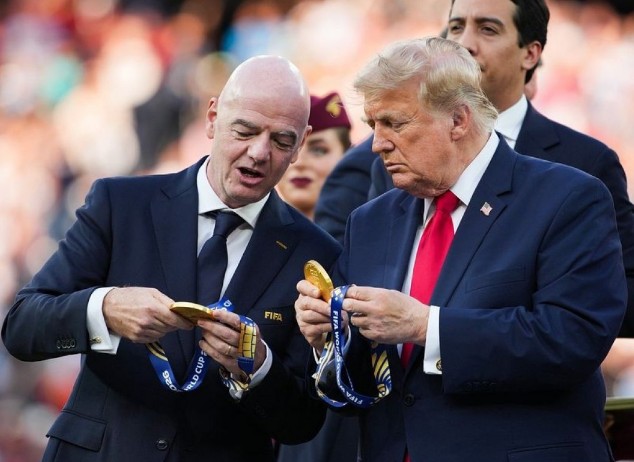
Infantino has long maintained an unusually close relationship with Trump. Part of FIFA’s administration has been based in the United States in recent years.
The organisation’s president has constantly appeared alongside the American leader and, according to available information, even discussed the possibility of creating FIFA’s own cryptocurrency in private conversations.
Now a fund connected to the Kushner family was supposed to acquire a stake in the most valuable sporting product on the planet.
This was no longer simply business.
Geopolitics was clearly at play.
Infantino effectively intended to transfer part of world football to American capital connected to Trump’s inner circle.
In return, he would receive money, political protection and a new platform for his own future.
The World Cup would become a commodity, FIFA a commercial holding company, national associations recipients of dividends and supporters mere consumers.
The only remaining question was who would lead this system.
There is information suggesting that Infantino was preparing a position for himself similar to that of the commissioner of America’s National Football League, which he would assume after completing his term as FIFA president.
The NFL commissioner earns approximately $64 million a year, around ten times Infantino’s current FIFA income.
Infantino’s own role in FIFA Forward Enterprise was, of course, not explained in the letter sent to national associations.
They were told about football development, new financial opportunities and tens of millions of dollars in assistance.
What went unmentioned was the possibility that the company’s creator could take charge of it after completing his final term under FIFA’s statutes, thereby retaining effective control over world football.
Under the current term limits, Infantino’s FIFA presidency is supposed to end in 2031.
Yet a man accustomed to absolute power was clearly not planning simply to leave his chair.
FIFA Forward Enterprise would have solved that problem.
Infantino could formally step down as FIFA president while retaining control over commercial rights, tournament organisation and the main financial flows.
He was attempting to create a state within a state and become its ruler for life.
Infantino may have expected UEFA to issue another harsh statement, several major associations to express dissatisfaction and the majority of FIFA’s members then to take the promised money and vote exactly as required.
This time, however, the system malfunctioned.
UEFA announced almost immediately that the FIFA president had crossed a red line.
In Europe, discussions went beyond merely blocking the deal. Officials began talking about the need to remove the man who had turned the leadership of world football into a private clique.
The transaction had been prepared behind closed doors.
Confederations and national associations had not been given an opportunity to examine the terms in advance, while many senior employees within FIFA itself learned about the project from the media.
UEFA reminded Infantino of his own words before the 2016 election.
At the time, he had promised transparency. He had said FIFA’s money belonged to the national associations, not to the president, and should be used exclusively for football development.
He broke both promises.
The deal he prepared was opaque, while the organisation’s funds were being used as an instrument of personal political power.
UEFA was prepared not only to oppose the project but also to demand Infantino’s resignation, including by initiating a vote of no confidence.
Launching such a procedure requires the support of 43 of FIFA’s 211 members.
UEFA has 55 member associations and, judging by the initial reaction, all of them were prepared to go all the way.
Significantly, several associations that had initially been interested in receiving tens of millions of additional dollars quickly changed their positions once it became clear that the project might collapse.
Even compliant and relatively poor Latvia, which had initially viewed the financial prospects positively, hurried to join the European majority.
Infantino’s biggest mistake, however, was failing to anticipate resistance outside Europe.
CONCACAF, representing 41 countries and territories in North America, Central America and the Caribbean, opposed the project.
Its leadership expressed deep concern about the absence of proper procedures and said it had learned about the nearly completed multibillion-dollar transaction through the media.
For Infantino, this was a particularly painful blow.
The confederation that had just hosted the World Cup and was supposed to serve as the foundation of his American strategy felt deceived.
The Asian Football Confederation soon issued a similar statement.
It expressed disappointment that a matter of such magnitude had been made public before AFC members had been given an opportunity to examine and discuss it through established governance channels.
The Asian confederation reminded FIFA of the need for transparency, proper governance and meaningful consultation.
When even the AFC starts lecturing the FIFA president about governance, the situation must be extraordinary.
Dissatisfaction with Infantino’s actions has also existed for years in Africa, where FIFA’s constant interference in the affairs of continental football has caused growing irritation.
In the end, Europe opposed the plan, CONCACAF felt deceived, Asia felt humiliated and Africa had accumulated a long list of grievances of its own.
Infantino believed he was controlling the chaos.
In reality, he had opened the floodgates with his own hands.
The opposition began moving towards the 106 votes required not only to stop the project but also to replace the president at the next election.
Most damaging of all was the revolt inside FIFA itself.
The organisation’s senior adviser Carlos Cordeiro resigned in protest.
Chief operating officer Kevin Lamour accused the leadership of misleading employees.
General Secretary Mattias Grafström came out firmly against the deal.
It emerged that even some of the most senior people in the organisation had known nothing about the most important project in FIFA’s history.
The plan had been prepared by a narrow circle of loyalists.
Everyone else was expected to learn about it after the fact and then pretend that a collective decision had been made.
This is Infantino’s signature style.
He long ago removed independent specialists who might object, discredited FIFA’s once influential Ethics Committee and surrounded himself with sycophants capable of bowing their heads at the right moment and repeating that the president had once again saved world football.
Good leaders are not afraid of strong, critically minded people.
They employ specialists who may one day become better than they are, value well-founded criticism and are capable of admitting mistakes.
Infantino built the opposite kind of system, one in which disagreement is treated as disloyalty and criticism as a personal insult.
The scandal quickly spread beyond football’s governing bodies.
EU Commissioner for Sport Glenn Micallef said that the uncontrolled commercialisation of football was having destructive consequences and demanded that those responsible take their hands off the game.
British Prime Minister Andy Burnham stressed that the World Cup was not a commodity: once you sell part of the tournament, you sell yourself.
The German government issued a separate statement calling for the world’s largest sporting events to remain accessible and retain their public significance.
Serious questions were also being asked in the United States.
Prosecutors in two states opened investigations into the opaque distribution of tickets for the 2026 World Cup, while Democratic members of the House Judiciary Committee demanded that FIFA disclose details of Infantino’s contacts with Donald Trump.
The FIFA president had become accustomed to treating his closeness to Trump as an insurance policy.
Now that policy threatened to become the subject of political and legal investigations.
To some extent, the situation resembled the European Super League affair.
That project was destroyed by the combined resistance of UEFA, supporters and politicians.
The current crisis, however, was far more serious.
The Super League had been proposed by the owners of several of the richest clubs.
This time, the person who decided to sell part of world football was the man whose official responsibility was to protect the interests of the entire game.
Under pressure from the confederations, national associations, politicians and his own administration, Infantino announced that the project had been abandoned.
FIFA’s website said the organisation had listened carefully to the views expressed and concluded that the divisions surrounding the proposal no longer corresponded with its original purpose.
This is standard bureaucratic language for capitulation.
It would be wrong, however, to assume that Infantino has surrendered permanently.
He separately announced that he intended to hold another meeting of all interested parties in the near future to discuss football’s future.
Knowing his character, one can assume that the same scheme will eventually return under a different name, with revised terms, new investors and more attractive promises.
That is exactly what happened after the 2018 project.
Infantino knows how to retreat, wait, regroup and return.
It is therefore not enough to stop FIFA Forward Enterprise.
The author of the project himself must be stopped.
The Self-Proclaimed Phoenix and the 2027 Election
Infantino likes to portray himself as the man who saved FIFA after the fall of Sepp Blatter, a self-proclaimed phoenix rising from the stinking ashes of the old system.
He fails to notice what Icarus was eventually forced to learn: the closer you fly to the sun, the faster your wings melt.
The origins of Infantino’s rise to office, or his election, if you prefer, have a rather dirty backstory.
Michel Platini, who was regarded as Blatter’s natural successor, was removed and denied even the opportunity to run.
Infantino appeared in the resulting vacuum.
The presidents of many Asian and African associations primarily saw a dollar sign when they looked at him.
He promised to increase development programmes, expand funding and make all FIFA members richer.
He kept those promises: there was more money.
At the same time, the associations became increasingly dependent on the man distributing it.
Infantino arrived at the world federation as a man on a bicycle and soon moved on to a private jet.
He found himself on a throne for which he had never been prepared and surrounded himself with advisers and friends who convinced him of his own genius and historic mission.
Over time, he began believing every piece of flattering nonsense they fed him.
Infantino’s fundamental problem as a leader is that he does not understand the criticism directed at him and is incapable of critical self-analysis.
People who genuinely cared about him tried to help
They pointed out his limitations and shared their experience in areas where he lacked the necessary knowledge and competence.
He ran away from them.
Infantino was born into a family of Italian immigrants and is, in a sense, a second-generation immigrant himself.
At school, he was bullied because of his freckles.
All our problems come from childhood.
I see him as a man who never overcame his inferiority complex.
Once such a person acquires absolute power, he begins demanding constant confirmation of his own importance.
He needs presidents, flags, private jets, applause and people around him who are prepared to repeat that he changed the world.
Infantino should have remembered the little boy who was bullied at school and the strength of character he needed to survive in a Switzerland that was not always welcoming to immigrants.
He should have practised the humility taught by his religious upbringing.
Instead, he created a system in which no one dared to tell the president “no”.
Until this summer.
The next FIFA presidential election will take place in March 2027.
Infantino intends to seek another term, although under the statutory limits this mandate is supposed to be his last.
Before the scandal, those around him claimed that the incumbent president enjoyed almost universal support.
That picture is now beginning to fall apart.
A vote of no confidence can be initiated with the support of 43 of FIFA’s 211 members.
UEFA represents 55 associations, meaning it formally has the minimum number required.
Beginning the procedure, however, would be much easier than securing final victory.
Removing the president would require a stable majority, and Infantino can still rely on numerous small associations that have become accustomed to receiving money from FIFA.
The promised tens of millions of dollars were intended precisely for them.
The coming months will show whether the opposition can remain united or whether the professional panhandlers who populate the global football system will once again sell their votes.
Should UEFA, CONCACAF, the AFC and dissatisfied representatives of Africa reach an agreement, Infantino will be driven out of football.
Should the current scandal once again end with a handful of angry statements and a compromise negotiated behind closed doors, Europe will have to consider extreme measures, including sabotaging the World Cup.
European associations hold only around a quarter of the votes at the FIFA Congress, but their real strength is not determined by the number of ballots they control.
Europe is home to the biggest leagues, the richest clubs, the main television markets, the leading sponsors and most of the world’s best footballers.
A World Cup without Spain, France, Germany, England, Italy, the Netherlands, Portugal and other European national teams would lose a substantial share of its value.
The tournament could be expanded to 64, 100 or 143 teams, but without Europe it would not even make it as far as the pub.
Infantino understands this.
UEFA therefore remains the only organisation capable of stopping him once and for all.
This time, Europe cannot simply issue another furious statement, secure a few cosmetic changes and go home.
The FIFA president crossed the red line.
Then the black line.
Then the brown line.
He attempted to transfer part of the World Cup to a business group connected to Donald Trump’s inner circle.
He attempted to buy the consent of national associations by promising them tens of millions of dollars.
He attempted to create a structure that would allow him to retain power after formally stepping down as FIFA president.
Infantino was certain that no one would dare to object.
He was wrong.
The question now is whether world football has the will to finish what it has started.
My position was formed long ago:
Gianni Infantino must disappear from football.
Otherwise, football itself will disappear.