
Fabio Cannavaro has made one thing clear after Uzbekistan’s first World Cup: qualification cannot be treated as the end point. If the national team is to close the gap on Europe’s best, he believes more of the country’s leading players must leave the comfort of the domestic game, and past achievements will no longer guarantee anyone a place in his squad.
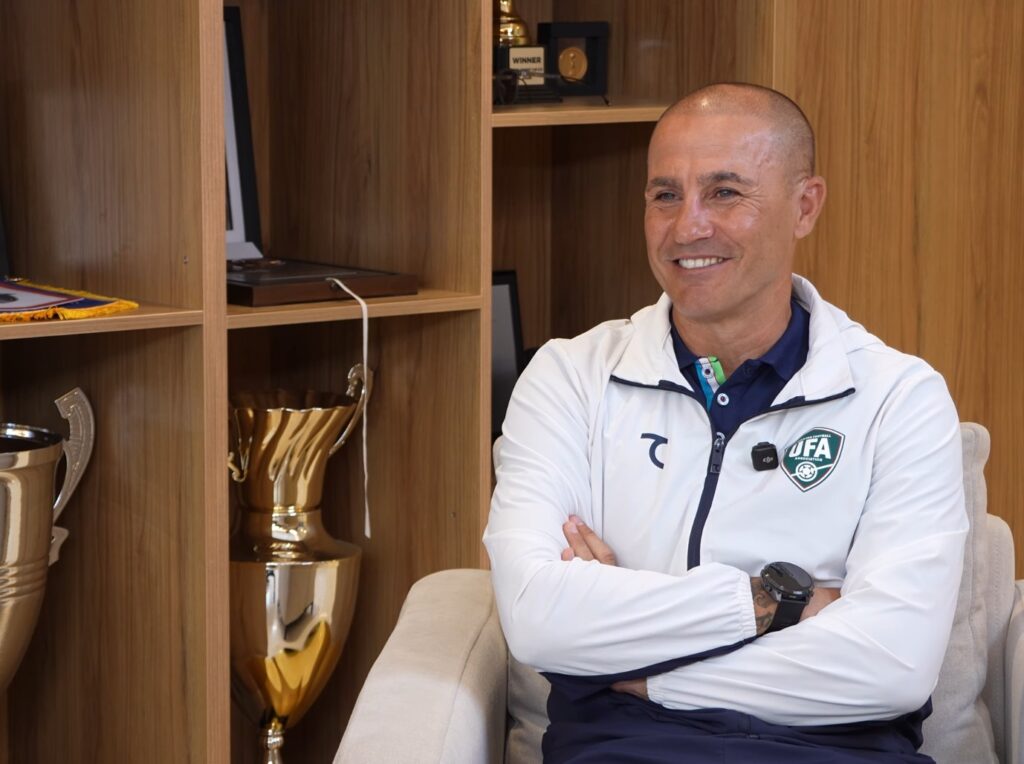
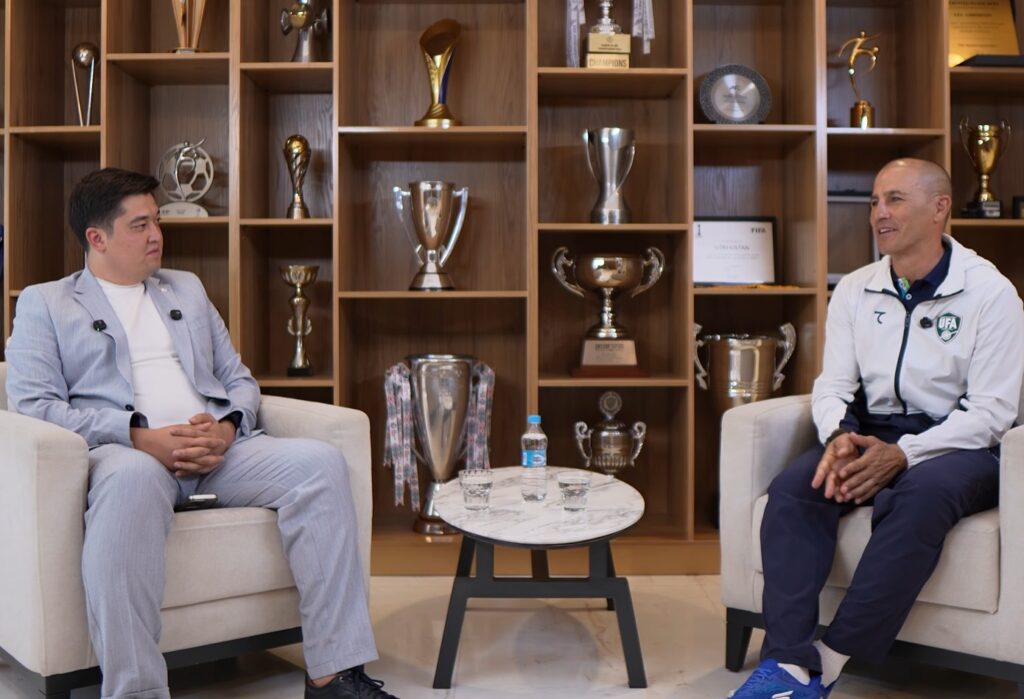
In a wide-ranging interview with sports journalist Yahyokhoja Ulugkhojaev for Kun.uz, the Uzbekistan head coach spoke openly about the difference in intensity between the Super League and European football, the obstacles preventing players from moving abroad and how he intends to reshape the national team after the tournament.
The conversation also moved well beyond the pitch. Cannavaro rejected claims that FIFA president Gianni Infantino helped secure his appointment, dismissed reports that he earns €4 million a year and returned to one of the most intriguing issues surrounding the team: the source of information leaks from inside the national-team camp.
Asia is still undervalued in Italy
Cannavaro believes the route he took into management has worked against him in his home country.
Rather than beginning in Italy’s lower divisions, the former Ballon d’Or winner started his coaching career in Asia, working in Saudi Arabia and China before later returning to Europe. He feels achievements made there have not always carried the same weight with Italian clubs.
“In Italy, there’s a certain attitude towards coaches who return from Asia, their achievements there are often undervalued.”
His spell in China included a domestic league title with Guangzhou Evergrande and a run to the AFC Champions League semi-finals. Yet after returning from China, he says he went around 18 months without receiving an offer from an Italian club.
At one stage, he was offered the Poland national-team job. Cannavaro turned it down while hoping an opportunity with Italy might eventually emerge, coaching his country had long been an ambition, but that call never came.
Instead, he joined Serie B side Benevento in 2022. It proved a difficult spell amid injuries and wider problems at the club, and he was dismissed after less than four months.
His next Italian opportunity came at Udinese in 2024, where he was appointed with the club fighting relegation. Cannavaro considers that spell far more successful: Udinese survived in Serie A after taking charge for the final five matches of the season.
He says he was not retained because the club’s president had already reached an agreement with another coach before the campaign ended.
A short spell at Dinamo Zagreb followed. Cannavaro says the sporting director who brought him to Croatia subsequently left the club, and although he was asked to remain, he chose to move on.
Uzbekistan’s approach came next.
“After that, the Uzbekistan national team made me an offer, and I hardly hesitated.”
Cannavaro believes attitudes in Italy have failed to keep pace with the development of football elsewhere.
“Many people in Italy simply don’t understand how quickly Asian football is developing. It has made enormous progress over the last 20 years, and I’m convinced its future is very promising.”
In his view, Italian coaching careers are still expected to follow a traditional path – Serie C, then Serie B, a smaller Serie A club and eventually something bigger, leaving experience gained elsewhere easier to dismiss.
Did Infantino help Cannavaro get the Uzbekistan job?
Cannavaro’s appointment also produced suggestions that FIFA president Gianni Infantino, with whom he has a close relationship, had personally recommended him to the Uzbekistan Football Association.
He dismissed that version of events.
“Do you think, with all the things and problems he has himself, he is going to call someone just to get me appointed as head coach?”
Cannavaro said the appointment instead came from his discussions with the UFA leadership, with both sides sharing ideas about the World Cup, the Asian Cup and identifying the country’s next generation of players.
“Our ideas coincided, and that’s why I became head coach. I don’t think Infantino called anyone and recommended me.”
‘I don’t want the same thing to happen in Uzbekistan’
One of the biggest differences Cannavaro noticed after taking charge was the speed of the domestic game.
He already knew the level of Uzbek players from his time with China, having faced Uzbekistan at an international tournament. What surprised him more was the gap in tempo and decision-making compared with European football.
“Compared with Europe, the difference is very big, especially in the speed of decision-making. European footballers think faster. Unfortunately, our training sessions here also don’t always reach the necessary intensity.”
That has shaped one of his clearest demands as national-team coach: Uzbekistan needs more players testing themselves abroad.
“I constantly ask one thing of Uzbek footballers: go abroad, become foreign-based players and get used to the European pace and intensity.
“Of course, not everyone can be Abdukodir Khusanov. But after the World Cup, Behruz Karimov went to Lugano and Jakhongir Urozov to Rubin. We need more players like that.”
The conviction comes partly from his experience with Guangzhou Evergrande, then one of Asia’s strongest clubs.
Cannavaro remembers wondering why some of China’s leading players had little interest in moving to Europe. After a year, he felt he understood the answer: many were already earning enough at home that there was little incentive to leave, accept a more difficult environment and fight for their place.
“I don’t want the same thing to happen to Uzbek footballers. I want every player to dream of going to Europe.”
Japan is the model he prefers.
With much of the national-team pool based in European leagues, Cannavaro sees the regular exposure to a faster training and match environment as a major part of Japan’s progress.
“You can have excellent academies and great coaches, but if a player doesn’t work and play every day at European speed, it isn’t enough.”
‘After 20 minutes, I already understand’
Cannavaro’s assessment of the domestic game was particularly blunt when he was asked how long he could watch a major Uzbekistan Super League match if he were not the national-team coach.
“In the first 20 or 25 minutes, I can already understand whether the coach has prepared something specifically, whether the team is working on certain things or is simply playing. After that, it isn’t difficult to imagine what will happen.”
He also linked Uzbekistan’s tendency to concede late in matches to declining physical condition and concentration.
Moving players abroad, however, brings its own difficulties.
Some Uzbek clubs, themselves operating under financial pressure, can demand transfer fees that make a move difficult. European restrictions on non-EU players can create another obstacle.
Cannavaro has discussed potential solutions with the Uzbekistan Football Association, including clubs accepting a smaller initial fee in return for a percentage of any future sale.
“An Uzbek club might not receive a large sum from the first transfer, but it can include a percentage of the player’s next sale. Then the club can earn from that transfer later.”
The €4m claim and the ‘rat’ inside the national team
Cannavaro’s relationship with parts of the Uzbek media has become increasingly tense since the World Cup.
He says much of the criticism itself did not bother him, but what did frustrate him was information he considered false or disrespectful.
One example was the claim that he earns €4 million a year as Uzbekistan head coach.
“That is completely untrue. My salary is much, much less.”
He also criticised reports about his coaching staff and said some journalists had particularly close relationships with individual players, leading to information being published from inside the national-team environment.
That concern has already led to tighter media access.
Cannavaro said journalists had previously been able to visit the national-team base, speak freely with players and conduct interviews, but he now wants clearer boundaries.
“The rules I introduced were not designed to fight the press. That is how it works across Europe.
“I just want to protect my players and I don’t like them being constantly distracted.”
The most intriguing part of the dispute remains his earlier suggestion that there could be a “rat” inside the national team leaking information.
Asked whether he could narrow down who that person might be, Cannavaro refused.
“You have your secrets too. You don’t tell me who you speak to or where you get your information from. So I can’t tell you either.”
Pressed on whether the source had been identified or punished, he again declined to answer.
“Let it remain a secret.”
His frustration appears to centre particularly on team selection.
Cannavaro says he often has only seven or eight players firmly decided in advance, with the remaining positions settled on the morning of the match. Even the players themselves do not learn the final starting XI until he posts it in the dressing room shortly before kick-off.
“Until then, nobody knows the line-up.”
He suggested previous national-team regimes may have handled such information differently, but said he expects his own methods to be respected.
Past achievements will no longer guarantee selection
The World Cup has also changed how Cannavaro intends to select his squads.
He accepts that players can suffer a drop in form after a tournament of that scale, particularly when returning to domestic football, but insists the national-team door remains open regardless of age.
Uzbekistan also have a growing group of younger players pushing for places. Cannavaro says he has personally spoken with almost everyone left out of the latest squad to explain his decisions, describing the turnover as a natural process rather than a complete changing of the guard.
What will change is the weight given to past achievements.
“Before the World Cup, we gave a certain amount of credit to the players who helped the team qualify. We took some players to the tournament without regular match practice, and some after injuries.
“We overlooked those things because of what they had achieved before. That won’t happen anymore.
“The national team will be made up of players who are in optimal condition and playing regularly.”
Khusanov’s ‘intelligence’, Shomurodov the ‘leader’
The interview became lighter towards the end, with Cannavaro asked to describe several Uzbekistan internationals in a single word.
Abdukodir Khusanov was “intelligence”, Otabek Shukurov “professor”, Jaloliddin Masharipov “professional” and Eldor Shomurodov simply “leader”.
Oston Urunov was described as “very shy”, while Aziz Ganiev was associated with “intensity” because of how hard he works.
The most expansive answer was reserved for Abbosbek Fayzullaev.
“Positive. Always smiling. I don’t think he fully understands himself just how much strength and potential he has.”
‘I treat them like my sons’
For all the tension surrounding the World Cup and its aftermath, Cannavaro insists there was one aspect of the criticism he welcomed: most of it was directed at him rather than his players.
“I was happy about that. Do you know why? Because all the criticism and all the attention was directed at me, not the players. That is the job of a coach.”
He says that responsibility extends beyond the footballers currently in his squad.
“My players have the right to make mistakes. I will always support them, care for them and protect them. That applies both to those who are here now and those who weren’t called up this time.
“I won’t let anyone touch my players. I treat them like my sons.”
During the World Cup, he noticed players reading criticism on Instagram and occasionally wanting to respond.
His instruction was simple.
“Don’t pay attention. Our only response has to be on the pitch. One day, we will answer with results.”