
A year ago, Bekzod Sulaymonov was only beginning to find his feet in senior football. Today, the 20-year-old Andijon academy product has established himself as a regular first-team left-back, handled competition from far more experienced teammates and become one of the clearest examples of the club’s growing trust in young players.
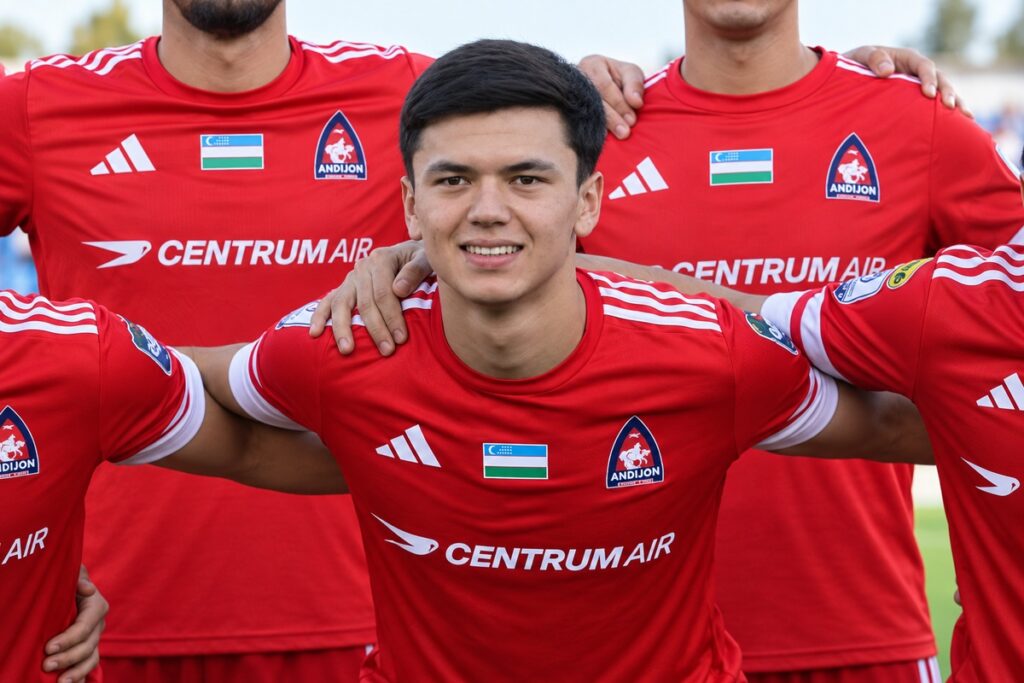
Sulaymonov made his first senior appearances under Maksim Shatskikh. The step up from youth football was not easy: the pace was higher, the demands greater and mistakes were punished much more quickly.
“It was difficult. I stayed patient and kept working on myself. Now you can see the result,” Sulaymonov told Eurasia Football.
Under Samvel Babayan, however, the youngster almost disappeared from the first-team picture. Sulaymonov does not look for excuses when speaking about that period.
“I think I simply wasn’t good enough at the time. The squad changed as well, strong players came in, and I got a little lost among them.”
His next opportunity came after Islom Akhmedov took charge in April. The Andijon head coach previously told Eurasia Football that he had watched Sulaymonov with the reserve team before bringing him back into the senior squad and had noticed clear progress.
“You could see that he had improved. He was moving well and working hard in training. So we had no hesitation about putting him into the team. I saw the potential and knew we could trust him,” Akhmedov told EF.
Sulaymonov’s breakthrough coincided with a sharp improvement in Andijon’s results. Babayan left after seven league games, with the team having collected just six points from two wins and five defeats. Akhmedov started with a draw away to Kokand-1912 and then led Andijon to three straight victories over Bunyodkor, Dinamo Samarkand and Xorazm. After 22 rounds, Andijon sit eighth with 30 points. They have taken 24 points from 15 league games under Akhmedov — seven wins, three draws and five defeats.
Sulaymonov has grown into the team during the same period. By 20 September, he had made 14 Super League appearances under Akhmedov and registered two assists. He has also played four Uzbekistan Cup matches, scoring once against Havokand and setting up Rustam Turdimurodov in the recent tie against Olimpik MobiUz. That gives him 18 competitive appearances, one goal and three assists since Akhmedov took charge.
The league has already recognised his progress. After Andijon’s 3-0 win away to Xorazm in May, Sulaymonov was named the Uzbekistan Professional Football League’s best young player of Matchday 11. He also made the league’s team of the round.
For Bekzod, the coach’s trust has been crucial.
“There is no pressure under Islom Akhmedov. He gives me more freedom and trusts me. I try to repay that trust.”
Breaking into this Andijon side has hardly been straightforward. Dragan Ceran, Nemanja Čalasan, Azizbek Turgunboev and Islom Tukhtakhujaev are among the experienced players in the squad. Sulaymonov has not been overwhelmed by the level around him and sees working alongside such teammates as part of his education.
“It is a pleasure to play with them. They guide you, help you and give advice. They tell you where you made a mistake and where you should have made a different decision. They help during matches and speak to you afterwards as well.”
Čalasan has also spoken positively about his young teammate in conversation with Eurasia Football, while Akhmedov has repeatedly stressed the need to give talented youngsters a route into senior football.
The left flank is perhaps the best example of how that process has worked.
For much of the season, Sulaymonov shared that side of the pitch with Mahmud Mahamadjonov, the more experienced left-back who joined Andijon before the 2026 campaign. They were not simply competing for one position. Akhmedov often used them together, with Mahamadjonov operating deeper and Sulaymonov given more freedom to push forward. Both started, for example, against Nasaf in the Uzbekistan Cup in May and against Sogdiana in August.
Akhmedov himself has described Sulaymonov as a player capable of working both ways down the flank — defending when required but also providing forward runs. That versatility allowed the coach to use the two left-sided players as a pair rather than treating them simply as rivals for the same spot.
By September, the situation had moved on. Mahamadjonov, who had been one of Andijon’s regular starters and made 22 appearances for the club in all competitions, left for Russian Premier League side Dynamo Makhachkala.
His departure did not leave Andijon having to rebuild the left side from scratch. Sulaymonov had already been playing regularly for several months, had started matches alongside Mahamadjonov and had shown he could handle the level. From a squad-planning point of view, having a 20-year-old already trusted by the coach made it much easier for Andijon to move on from the more experienced player.
Sulaymonov has since continued to start important matches. He was in the XI for the Uzbekistan Cup tie against Olimpik MobiUz on 15 September and again five days later against Nasaf in the Super League.
The broader picture at Andijon is similar. Akhmedov regularly brings players from the reserves and U19s into first-team training. The idea is simple: young footballers should work every day alongside Ceran, Čalasan and the other senior players, see how experienced professionals prepare and gradually become accustomed to the demands of Super League football.
“If young players are ready, you should not be afraid to bring them into the first team and play them,” Akhmedov previously told EF.
Sulaymonov says there are already more players behind him waiting for the same opportunity.
“There are four young players training with us at the moment. I think two or three of them can already help the team.”
Andijon are also beginning to see players move beyond Uzbekistan. Mahamadjonov’s transfer to Dynamo Makhachkala is one example. Another is 18-year-old Sayfiddin Sodikov, who moved to Portugal and joined Braga’s system after featuring for Andijon in the Super League.
A move abroad is one of Sulaymonov’s ambitions as well.
When asked to choose between a hypothetical salary of $15,000–20,000 in Uzbekistan and $5,000–6,000 in Portugal or Belgium, his answer was immediate.
“Money is not important. For me, the main thing is playing time.”
That view is particularly interesting alongside Čalasan’s recent interview with Eurasia Football. The Serbian, who spent several years in Portugal, argued that relatively high salaries at home are one reason Central Asian players do not always rush to Europe. If a footballer is already well paid in Uzbekistan or Kazakhstan, accepting a smaller contract in a stronger league is not always an obvious decision.
Sulaymonov has different priorities at this stage of his career. At 20, he wants minutes, development and the chance to keep moving forward.
His style also explains why Akhmedov has been comfortable using him higher up the flank. Sulaymonov names pace, acceleration and his left-footed delivery among his strongest qualities.
His football idol therefore comes as little surprise.
“Gareth Bale.”
What does he like about Bale’s game?
“His runs, his crossing, his shooting. His left foot.”
Sulaymonov also has a specific club he would one day like to represent. When the conversation turned to possible destinations outside Europe’s top five leagues, he chose Turkey.
More specifically, Fenerbahçe.
Istanbul is still a long way off. But Sulaymonov has already cleared the first major hurdle. He is no longer an academy player being handed occasional minutes to see whether he can cope with senior football. He has become a regular part of an Andijon side that recovered sharply after a poor start to the season, has contributed at both ends of the pitch and has already seen a more experienced player from his own flank move on to the RPL.
At 20, Bekzod Sulaymonov is no longer waiting for his chance. He is already using it.