
Serbian defender Nemanja Calasan has now seen Central Asian football from both sides: first through Kazakhstan, and now through Uzbekistan. In an interview with Eurasia Football, he explained how he first joined Elimai and then Andijon, what changed after Islom Akhmedov became head coach, why Central Asian players are not always in a rush to move to Europe, and how football in Kazakhstan and Uzbekistan differs.
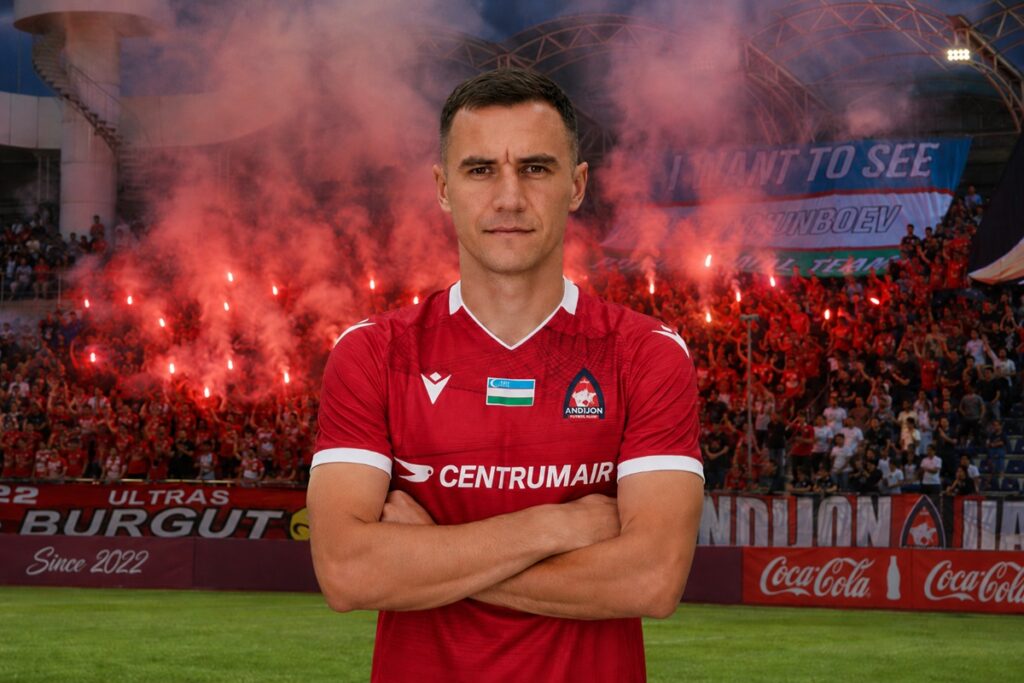
Calasan is currently Andijon’s most valuable player according to Transfermarkt, with an estimated market value of €700,000. He joined the club this winter from Kazakhstan’s Elimai, where he helped the team qualify for the UEFA Conference League. Andijon’s start to the season was difficult, but after changes in the coaching staff the situation improved. Calasan has remained a key player both in Kazakhstan and Uzbekistan.
— How did you end up in Central Asia?
— Before moving here, I had played only in Europe. My last club was Spartak Subotica in Serbia. I still had one year left on my contract, but when the option from Kazakhstan appeared, I asked to terminate the deal. I explained that I wanted to try a new league and a new region.
I was the captain and an important player for the team, but Spartak understood my position. That is how I joined Elimai. I adapted quickly, and we had a good season. We qualified for European competition — for the UEFA Conference League qualifiers. The fans were happy, and that made us happy too.
In general, I felt comfortable there. Football in Kazakhstan is also good, but there are some issues with infrastructure. There are many artificial pitches, and for me that matters — both in terms of the quality of football and in terms of health.
I played in Portugal for five years. There, football is about passing culture, about playing through the ball. In Kazakhstan, it is a bit different: more fighting, less football through passing. I think that has a lot to do with the pitches and the weather.
— Is Uzbekistan more comfortable for you in that sense?
— Yes. The infrastructure is better here, and the pitches are better. Almost everywhere there is natural grass. We played only one match on artificial turf — against Khorezm. For me, that makes a big difference.
When you have a good pitch, you can play football: build attacks through passing, keep the ball, create your game. That is why I feel comfortable in Uzbekistan.
I think I could play here for many years. There are good conditions here, good football, good infrastructure. All of that is important for me.
— If you compare the Kazakh and Uzbek leagues, where is the level higher? Kazakhstan is in UEFA, Uzbekistan is in the AFC. Do you feel the difference?
— In Kazakhstan, I think the foreign players are stronger. The foreign-player limit is more liberal there, so clubs can bring in more foreigners. That automatically affects the level of the league.
But if we are talking about local players, in my opinion Uzbek footballers are better prepared right now than Kazakh players. The football school in Uzbekistan is better at the moment. There are more players here who can play with the ball, think on the pitch and make decisions.
Overall, I think the quality of football itself is higher in Uzbekistan. There is more football here. In Kazakhstan, there is more fighting.
— So the quality of football in Uzbekistan is higher?
— I think so. In Kazakhstan, there are objective difficulties: pitches and climate. It is cold for two or three months at the start of the year, and then cold again at the end of the season. The period with good football weather is not very long. Summer is good, but it is limited.
In Uzbekistan, you can play football almost all year round. Yes, it can be hot, but the pitches are good and the conditions are decent. That helps teams play through the ball.
— If Uzbek clubs played in European competitions, could they be competitive? For example, Andijon, Pakhtakor or Neftchi?
— Yes, I think they could. Of course, European competition is a different level, but Uzbek teams are capable of looking good there. There is quality here.
— There are many Balkan players in Central Asia. Dragan Ceran has been playing in Uzbekistan for many years and has become a legend here. For Balkan players, that probably shows that you can come here, stay for a long time and build a career. Did you speak to anyone before moving to the region?
— Yes, there are many Balkan players here. And if a player spends many years in Uzbekistan and keeps showing a high level, it means you can adapt here and play for a long time.
Actually, Uzbekistan could have appeared in my career earlier. When Samvel Babayan was working at Navbahor, he called me two or three times. I was playing in Portugal then. I wanted to come, but I had a contract, so it did not work out at that time.
Back then, Jovan Djokic was playing for Navbahor. I called him and asked what football was like here, what the conditions were like, whether salaries were paid on time. He said everything was good: the money was on time, the football was good and fast. After that, I thought: if another opportunity comes, I want to come and play here.
In the end, I am here. I am happy with how everything worked out.
— What went wrong for Andijon at the start of the season under Samvel Babayan? The team actually started well.
— Yes, the start was good. We won 4-0 in the first round, and everyone was saying the team was ready. We had a training camp in Turkey, the process was normal, everything looked good.
Then something went wrong. Honestly, it is difficult for me to name one reason. I cannot say there was a problem with fitness or with the atmosphere. Everything was normal: we had chances, we worked, but the results did not come.
— What changed after Islom Akhmedov arrived? Why did the team start gaining momentum?
— Now we transfer better into matches what we do in training. We work a lot with the ball, on starting attacks from the goalkeeper, on playing out through passing.
For a central defender, that is important. When the team builds from the back, you are more involved in the attack and you work more with the first pass. Now we are trying to play that way.
— So before there were more long balls, and now there is more combination football?
— Yes, now there is more football through the ball, through short and medium passes. We train it all the time, and in matches it has started to work better.
— Andijon are the current Uzbek Cup holders. Through the Cup, the club reached an Asian tournament for the first time. In the league, after dropping points at the start, it will be difficult to fight for the top three. Is the Cup now becoming the main target?
— The Cup is very important. We want to go as far as possible. There are no easy opponents here. You have to prepare for everyone as if you were playing Pakhtakor.
For me, every match is important. I want to win, I want trophies, I want achievements. That is my character.
— Are defeats especially painful for a defender?
— Yes. When a team loses, people usually look at the defenders and the goalkeeper first: who made a mistake, who was late, who did not close down. Forwards often avoid that kind of criticism.
That is why defenders feel defeats especially strongly. I do not like losing.
— Uzbekistan will play at the World Cup for the first time this year. Will you support the team?
— Of course. I play here now, I live here, so I will support Uzbekistan.
— No Andijon player was included in Uzbekistan’s expanded squad ahead of the World Cup. Aziz Turgunboev played in qualifying before and scored important goals. Do you think he could still get a chance?
— Until the final squad is announced, there is always a chance. In training he works well and he is in good shape.
In any case, a footballer must be ready. The decision belongs to the national team head coach, but if the opportunity appears, you have to use it.
— Under Islom Akhmedov, young players have started to appear more often at Andijon. Do you see good local potential in the team?
— Yes, we have good young players. For them, the most important thing is to give 100 percent every day. You need work, discipline and the right attitude. The first step in professional football is always the hardest. The road is not easy, but if a player has character and discipline, he can grow.
— Serbian footballers are in demand all over the world. Can Uzbekistan eventually reach a similar level in terms of exporting players?
— I think it can. There are many quality footballers in Uzbekistan. But there is one important point: players earn very good money here.
If an Uzbek footballer earns €10,000–15,000 a month at home, and a club from Portugal offers him half of that, why would he leave? Here he is at home, close to his family, with good conditions and more money.
I played in Portugal, and I know that salaries in Europe are not always big. I was earning around €5,000. That is not much. Mid-level European clubs often pay less.
It is similar in Kazakhstan. I asked players there: why don’t you go to Europe? They answered: “Why, if we have good money here — 8,000, 10,000, 15,000?” That is reasonable logic.
— So for players to move abroad more often, the domestic league needs stronger competition?
— Yes. Competition is very important. When there are more strong foreign players, local players have to fight for their place, grow faster and become stronger.
If a footballer has no competition, he can stay at home, earn good money and not take the next step. But when competition is higher, a player develops faster and becomes ready for Europe, for stronger leagues and serious challenges.