
Istaravshan are one of the oldest clubs in Tajikistan and one of the most consistently supported at the local level. In recent years, however, the club has struggled with stability. The arrival of Uzbek coach Sherali Bobokulov is beginning to address that — not through short-term results, but through structural change.
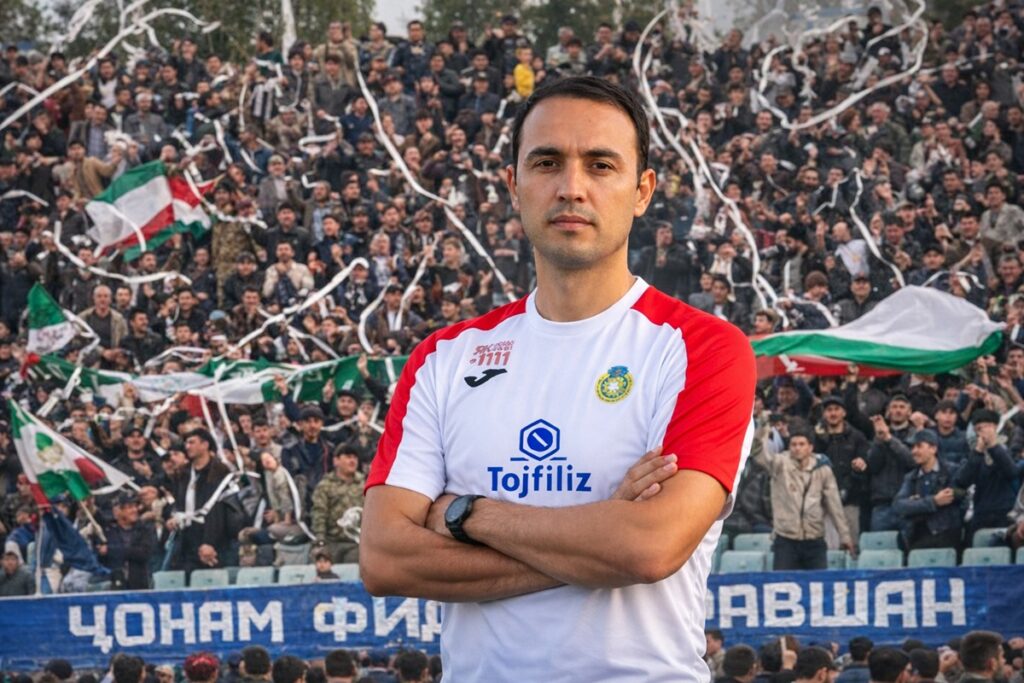
The former head coach of Uzbekistan’s women’s national team took over in late 2025 with a clear objective: keep the team in the Tajikistan Higher League.
Founded in 1938, when the city was still known as Ura-Tyube, Istaravshan have a long history. The club was among the stronger sides at the republican level during the Soviet period, remained competitive after independence, and finished as runners-up in 1995. More recently, they reached fourth place in the league.
At the same time, the club has experienced repeated disruptions. It ceased operations several times and was later revived, which prevented long-term continuity. Even after returning to the top flight in 2024, results remained inconsistent.
Despite this, support has remained constant. According to Tajik media, around 87,000 spectators attended Istaravshan’s matches during the 2025 season — one of the highest attendance figures in the league.
Bobokulov arrived with limited resources and little margin for error.
In his first match, Istaravshan produced a surprise win over CSKA Dushanbe, a result that not only secured important points but also influenced the title race. That victory played a decisive role in ensuring the club’s survival.
His background is unusual for this level. Bobokulov built his reputation in women’s football, managing both the Uzbekistan national team and Sogdiana-W. In 2021, he was named Uzbekistan’s best women’s coach. His teams won domestic titles and the AFC Women’s Club Championship.
For Bobokulov, Istaravshan represents his first experience in men’s football. Early signs suggest that he is treating it as a structured, long-term project — and building it accordingly.
Analysis
The most noticeable change is structural.
After three matches, Istaravshan do not look like a team searching for solutions. They look like a team working within a defined system. This is not yet fully reflected in results, but it is clearly visible in the team’s behavior.
In their opening games, Istaravshan consistently maintained a balanced share of possession. They had 55% against Parvoz (2–2), 53% against Khosilot (0–0), and 49% against Khujand (0–1), despite playing most of that match with ten men after an early red card.
They were not dominated. Even in defeat, the gap in chances remained limited — 4 shots on target to Khujand’s 6.
These numbers point to a clear shift in approach.
Istaravshan now build attacks through controlled possession. Players are more comfortable on the ball, rely on short combinations, and avoid forcing direct play. The tempo is more measured, and decisions are more deliberate. This is no longer reactive football — it is controlled football.
This is not always typical for Tajik football, which is often associated with higher tempo and direct transitions. Former national team coach Petar Šegrt once described Tajik players as “Central Asian Croatians.”
If we follow that line, a significant part of Istaravshan’s current squad could be described differently — closer to “Central Asian Serbs”: Uzbek players more accustomed to structured, combination-based football.
Babur Kosimov plays a central role in midfield, setting the rhythm of the game, while Maradona Safarov adds work rate and balance. In total, seven Uzbek players are integrated into the system — not as individuals, but as parts of a single structure.
Tactically, the framework is clear.
Istaravshan operate in a 4-3-3 shape. Full-backs provide width, wingers move into half-spaces, and the holding midfielder supports build-up while maintaining balance. The team prefers to play out from the back rather than rely on long balls.
Transitions and pressing are part of the structure, although not yet consistently executed.
There are still weaknesses. The team can be exposed by quick switches of play, particularly into the space behind advancing full-backs. This is a natural consequence of their current approach.
However, the key point is that these issues exist within an organized framework. This is no longer a team reacting to games — it is a team imposing a structure on them.
Players
Player development is another indicator of change.
Shahzod Inoyatov has become a regular starter this season after previously playing a limited role. His progression reflects the coaching staff’s willingness to work with local players rather than rely solely on short-term solutions.
Maradona Safarov’s case is different. After leaving OshMU, he faced a difficult period and needed to rebuild confidence. At Istaravshan, he is gradually returning to form. His involvement in possession has increased, his movement is more consistent, and he is becoming one of the team’s key players. This is not a short-term uptick — it is a player being reintegrated into a system that demands and supports his role.
It is still too early to draw firm conclusions after just three matches.
Istaravshan remain a team with limited depth and external constraints. Consistency will be tested over time.
However, the direction is already visible. Bobokulov has completed his initial task by securing survival. The next step is more demanding: turning Istaravshan into a team that is not only competitive, but structurally consistent.
For now, the early signs suggest that this process is already underway.