
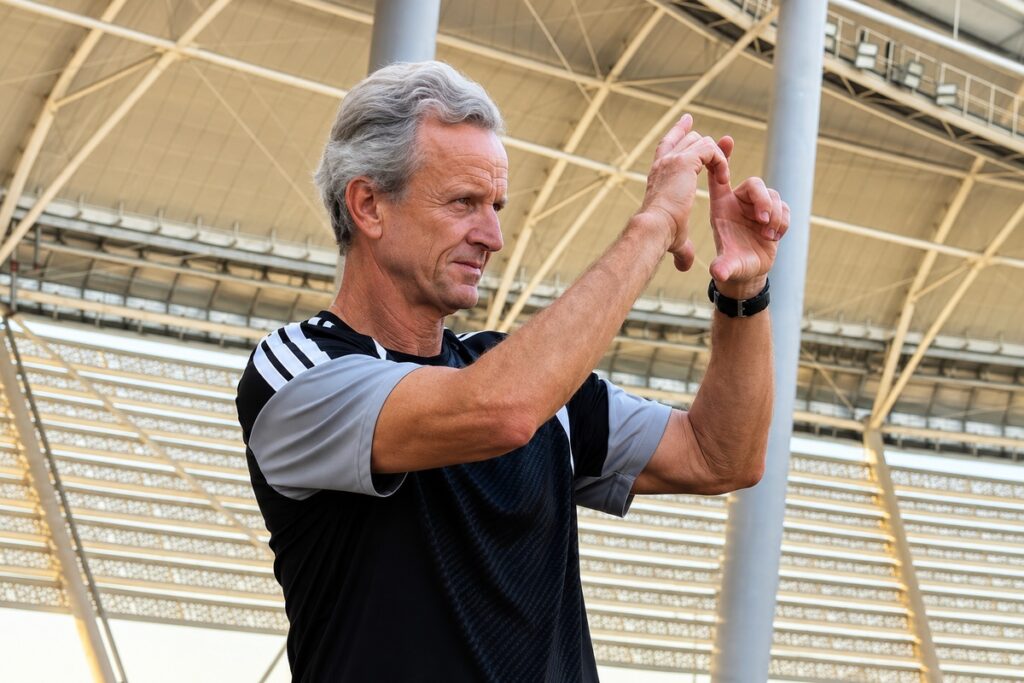
Italian fitness coach Alessandro Sarocco, who has worked with Diego Maradona, spent the season with Kattakurgan and also took charge of the team on an interim basis for two matches during the campaign.
In an interview with Eurasia Football, Sarocco reflected on his first season in Uzbekistan, assessed the country’s players and their prospects in Europe, explained where Uzbek football still needs to improve and recalled Fabio Cannavaro, whom he knew from Napoli’s youth system.
— How did the opportunity to come to Uzbekistan and join Kattakurgan come about?
— A long-time acquaintance of mine, whom I met in Dubai, told me that a club was looking for a fitness coach. At the time, I was at home because my mother had undergone surgery.
I said I would come, take a look, speak to the coach and then make a decision. I arrived in March, the club made a good impression on me and I decided to stay.
— What did you know about Uzbek football before arriving, and how different was the reality from your expectations?
— I knew there was good football here, but that it still needed to develop.
The federation has good facilities and there are many promising young players in the country. If Uzbekistan continues moving in this direction, I think its football has a very good future.
The national team has qualified for the World Cup for the first time, which is already a major achievement.
— You arrived as a fitness coach but later had to take temporary charge of the team. Was that your first experience as a head coach?
— My profession is fitness coaching, not being a head coach.
The club changed coaches during the season and, during one of those periods, the new coach had not yet arrived. The management asked me to help, so I took charge for two matches.
It was useful experience. I already knew that being a head coach was difficult, but when you actually find yourself in that position, you understand much better how hard it is to manage everyone in the team and make decisions.
I have worked as a fitness coach since 1987, and that is what I will continue to do.
— Did those two matches make you want to become a head coach permanently?
— No. I am not going to continue my career as a head coach. I will remain a fitness coach.
— You worked with three head coaches during the season — Yorkin Nazarov, Yuri Utkulbaev and Ilyas Zeytullaev. How different were their approaches?
— It was very easy for me to work with the first coach. We had good communication, he is a very good person and our cooperation worked extremely well.
I spent much less time with the other two. One had his own coaching staff, while the other preferred to do many things himself. I respect that. These things happen in football.
— What did you personally learn from working with them?
— You can learn from every coach.
There is always something useful: how a coach prepares a team for a match, how he manages players, how he organises training and how he communicates within the staff.
You can learn something from everyone.
— How difficult is it for a fitness coach when a club changes head coaches several times during a season?
— It is genuinely difficult.
It was very easy and comfortable for me to work with the first coach. With the other two, the situation was different: one had his own staff and the other wanted to do many things himself.
But that is normal in football. I always try to help, but if you are not given the opportunity to do so, you simply cannot.
— There are now more Italian specialists around the team. Does working with people from a similar football culture make things easier?
— When you go to work in another country, your experience and football education from Italy obviously matter. But the most important thing is adapting.
Every country has its own habits, lifestyle, food and its own characteristics in the training process.
I have worked in Switzerland, Iran, Romania, the UAE and Uzbekistan. You bring your own ideas, but you always have to adapt them to the country where you are working.
— After a full season with Uzbek players, what can you say about their physical qualities?
— There are many good young players here.
They still need to keep working, but physically there are some very good footballers among them. They can handle serious workloads and work in the same way as players in Europe.
They are not lazy, they are ready to work, and I was very pleased with that.
— Is the main difference between Uzbek players and footballers in Europe’s leading leagues physical, or is it more about technique and decision-making at higher intensity?
— In Europe there is a certain development system.
Players go through football schools from childhood and learn many things the right way. At the same time, there are good academies here too.
In the Pro League, I saw some very interesting young players with good technical and individual qualities.
— What did you notice about the professional habits of Uzbek players — training, discipline and recovery?
— Uzbekistan is a former Soviet country, so there is still a strong sporting culture here.
People are used to working hard and paying attention to recovery. Of course, a lot depends on the individual player. Some are completely focused on their profession, others less so.
But overall, the sporting mentality here is good. I watched children’s competitions, volleyball and weightlifting — people really do work very hard.
— You have worked in Iran and the UAE as well. How would you compare the sporting culture?
— The attitude towards sport here is very good.
Sport is becoming increasingly important, and the state is trying to encourage people to take part, especially young people.
Iran also has a very strong sporting mentality. People there are used to working extremely hard and at very high intensity.
— Where do you see the biggest difference between Uzbek and European football?
— In the Pro League, I saw players with good individual and technical qualities who are also quite well prepared physically.
If you compare it with Italy, for example, the biggest difference is in tactical preparation and the overall quality of the game.
European football is still different, but the Pro League has the potential to improve significantly.
This season I saw four or five well-organised teams with quality players. There are also some very interesting young prospects.
— Kattakurgan are aiming for promotion to the Uzbekistan Super League. Is the team ready for that level?
— Kattakurgan is a young club, practically a new club.
This was only the team’s first season in the Pro League, but it is a serious club and it has a development plan.
The infrastructure is being developed, a stadium and a gym are being built, but all of this takes time.
You cannot expect a new club to win promotion in its first season. The organisation, the team and the mentality all need time to develop.
— If Kattakurgan earn promotion, what would they need to improve to be competitive in the Super League?
— The club needs to develop organisationally and continue working on the team and the mentality.
But it is a very good club with a serious owner. I was happy here and had a really good season.
— Have you seen players in Uzbekistan who you believe could play in Europe?
— Yes, there are some quality young players here.
If they move to Europe at 17 or 18, or even earlier, and join a club with a good academy and high-quality infrastructure, they can improve significantly.
They have the desire to develop and reach a high level. The country’s youth national teams are also doing good work.
— Can you give an example of where good youth development is taking place?
— There are good academies here.
Bunyodkor, for example, have many interesting young players. A significant part of their first team is made up of graduates from their own academy.
That shows that some clubs in Uzbekistan are doing genuinely good work with young players.
— What is the biggest obstacle preventing more Uzbek players from moving to Europe?
— It is very important to move to Europe at the right age.
If a player leaves at 17 or 18, joins a good club and a strong academy, and gets the right conditions for development, he can make serious progress.
The young players here have quality and the desire to achieve more.
— You knew Fabio Cannavaro when he was 17 and part of Napoli’s youth system. What do you remember about him?
— In 1987, I was working as a fitness coach in Napoli’s youth system, and Cannavaro was there.
From the very beginning, you could see how serious and professional he was as a footballer.
Everyone knows what he went on to achieve. He played for some of the biggest clubs in the world and became a world champion.
He always had the right mentality.
— When you look at Cannavaro now as a coach, do you recognise the same qualities?
— Yes. He always had a good mentality and a professional attitude towards his work.
— How do you assess his work as head coach of the Uzbekistan national team?
— Coaching is a very difficult job.
Cannavaro is continuing to gain experience. I hope he can achieve a good result with Uzbekistan at Asian level.
He is a very professional person, so I wish him all the best.
— Cannavaro is in charge of the national team, Zeytullaev has a strong Italian football background, and more Italian specialists are appearing in Uzbekistan. Can we already talk about Italian influence on Uzbek football?
— In the past, the Italian school was famous above all for its defenders and tactical preparation. The country had many talented footballers.
Now the situation has changed. Even defenders are no longer receiving the same kind of education as before.
A lot has changed, and Italian football itself also needs to change today and, to a certain extent, restart its system.
At the same time, when you work in another country, it is not enough simply to bring your own ideas. You need to understand the local football and adapt to its characteristics.
— After this experience, would you like to continue your career in Uzbekistan? And do you see Central Asia as a region where you could work again?
— Yes, I could continue working here.
It is a good and safe country, the football is interesting and there are many young players.
But only as a fitness coach. That is my profession, that is what I studied and what I have done all my life.
The two matches as head coach were a good experience, but that is not my job.