
Serbian coach Milan Milanović knows Central Asian football from the inside. After working in Europe and Kazakhstan, he is now in Tajikistan, where he leads Khujand — one of the country’s most recognisable clubs — in its 50th anniversary season.
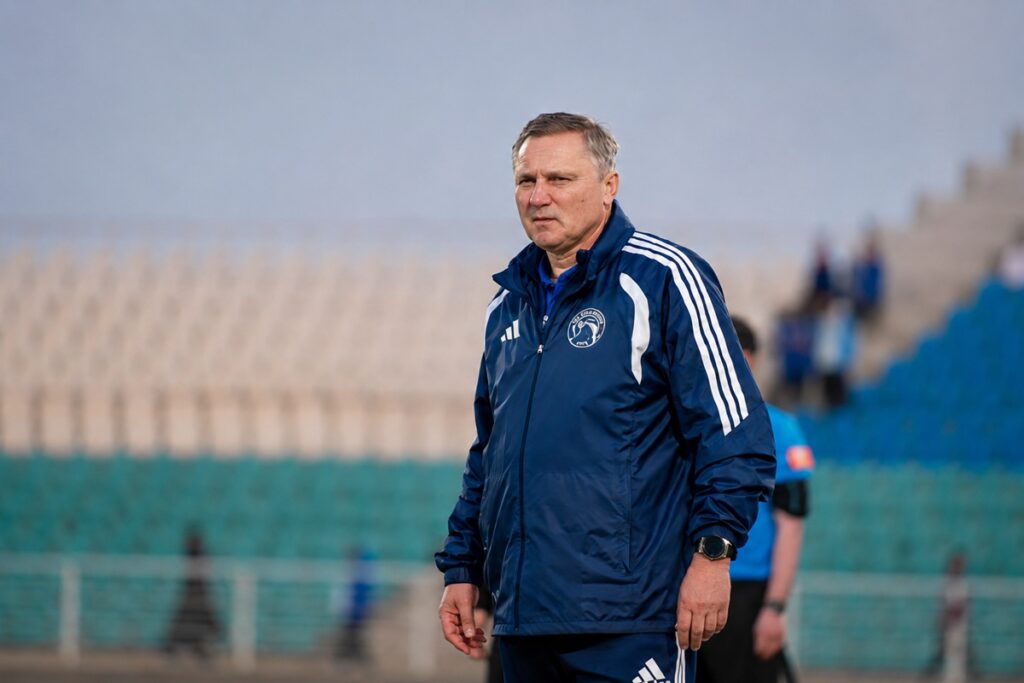
Khujand started the campaign well, but then went through a difficult spell: five matches without a win and three defeats in a row. Milanović does not call it a crisis. For him, it was a temporary dip with specific reasons — and the team’s recent 4–1 response showed that the situation could be corrected.
In an interview with Eurasia Football, Milanović spoke about Khujand’s current situation, the need for younger Tajik players, the future of the Tajikistan national team, his conversations with Goran Stevanović, Igor Angelovski’s appointment, the Balkan football school, his experience in Kazakhstan with Tobol and Irtysh, and why results must always come before PR.
— Khujand went through a difficult spell after a good start. How do you assess the situation now?
— I would not call it a crisis. It was a dip in form, and there were specific reasons behind it. Those reasons have now been addressed.
The players are training at full intensity again, and you can see the response on the pitch. We needed a win not only for the table, but also psychologically. Now the important thing is to continue.
When results are bad, people often separate attack and defence. I do not look at it that way. If we defend well, everyone is involved. If we concede too much, it is also a collective problem.
At the start of the season we were compact and allowed very little. Then, for a short period, we lost that balance. We understood the reasons inside the team. I do not want to discuss everything publicly, but the reaction in training was important: the attitude changed, the energy came back.
— What does Khujand need to become more stable?
— Balance. We have quality, including foreign players, but a serious team cannot be built in a few months.
Khujand is a big club, and expectations are always high, especially in its 50th anniversary year. But expectations and reality are not always the same. If you want to fight consistently for trophies, you need time, structure and the right profile of players.
For us, one important thing is to become younger and faster. We need fresh local players who can bring energy, intensity and competition. Not just one player — several.
— Do you see that kind of player in Tajik football?
— Yes, I see them. There are interesting local players in the league.
The question is who you can realistically bring, on what conditions and for which positions. That is something the club has to discuss internally. But the potential is there.
For Khujand, it is not only about signing one or two foreign players. We also need young Tajik players who can grow with the team. That is the way to build something more stable.
— Khujand brought in several Serbian players. Were they signed to fight for trophies immediately?
— I chose players who could help us. I still believe they have quality.
But you cannot build a title-winning team in a few months. A serious team needs time — two or three years, sometimes more.
There are expectations, of course. Khujand is a big club, and this is the club’s 50th anniversary season. But to create a team that can consistently fight for trophies, you need more than names. You need structure, time and balance.
— How did the move to Tajikistan happen for you?
— Through an agent, as usually happens in football. Ivan Iosović, who had played in Uzbekistan, was in contact with Khujand’s director. That is how the conversation started.
Before Khujand, my last job was in Slovenia. The club had tradition, but later it went bankrupt and disappeared from the league. After that, this opportunity came.
I had already worked in Kazakhstan, so Central Asia was not something completely unknown to me. But I did not come to Tajikistan only because I knew the region. I came because of the project, the club and the conversations we had.
— You also spoke with Goran Stevanović, who worked with the Tajikistan national team. What did you hear from him about football in the country?
— We know each other from childhood. After I came to Tajikistan, we met and spoke several times.
It is important to say one thing: when he left the national team, it was not only about financial conditions. He wanted to improve the working conditions around the team. That matters in football.
People often think everything is about money. But for a coach, the structure, preparation, staff and daily working environment are also very important.
— Tajikistan will now go to the Asian Cup with Igor Angelovski. Do you know him?
— I do not know him personally, so I cannot say much about him.
But the national team has potential. The important thing is to create the right conditions around it. At international level, details matter: preparation, organisation, staff, recovery, analysis. If you want results, you have to give the team a professional environment.
— Balkan players are becoming more visible in Central Asian football. Why is that happening?
— Serbian and Balkan players have always gone abroad. In the past, they mostly moved to Germany, France, Italy and other European countries. Now Central Asia has also become a destination.
If we speak honestly, players go where the conditions are good — including financial conditions.
Balkan players also have a certain football education. They understand discipline, tactical work and what a coach demands. That helps them adapt. But the main reason is simple: if the offer is good and the project is serious, players will consider it.
— So Central Asia is now a real market for Balkan footballers?
— Yes. And this did not start yesterday. Balkan players have been coming to this region for years.
For clubs here, it can be a good market. You can find players with experience, mentality and football education. But names are not enough. A player has to fit the team.
— Can Central Asia become something like the Balkans — a region that produces and exports talent?
— The potential is there. But the most important thing is the football school.
I see talent here. Children play football everywhere. They love the ball. But talent alone is not enough.
Academies must become more professional. The person who teaches children football is extremely important. I call him not just a coach, but a teacher. A good teacher must be respected — and paid properly.
The goal should not be only to win at U-13 level. The goal should be to develop a footballer for the future.
— What does Central Asia still lack compared with the Balkans?
— Tradition and structure.
In Serbia, clubs like Partizan and Red Star have a long history of developing players. I am not saying everything is perfect. We also have problems. But the culture of working with young footballers exists.
Here, the talent is clear. But the system around that talent has to become stronger: academies, coaches, methodology, competition and patience.
— Many countries in the region want their young players to leave abroad at 18 or 19. Is that the right target?
— Not always. A good footballer should first play five or six years for his home club.
He has to become a real player at home — physically, mentally, tactically. Then he can move to a stronger league.
Today, many players leave too early. Some succeed, but many get lost. Sometimes the people around the transfer benefit more than the player himself.
— Is this also a problem in Serbia?
— Yes. Agents come early. Players leave at 16 or 17. By the time they are 19 or 20, many are no longer in Serbian clubs.
For some, it works. For others, it is too soon. The right step at the right time is very important.
Leaving abroad is not automatically success.
— Let’s talk about Kazakhstan. You worked there with Tobol and Irtysh. How do you look back on that period?
— I had a very good experience in Kazakhstan.
At Tobol, we had a very strong group of players: national team players, experienced foreigners, serious quality. I liked the club, the professional level and the league.
Pavlodar also left a strong impression on me. At Irtysh, we had a good team. We played well, and in my opinion we deserved to stay in the league. What happened later was very sad for me.
— How do you look at Irtysh now, after the club returned to the top division?
— I am happy that Irtysh is back. For Pavlodar, this club is very important.
When Irtysh was removed from the league, I felt sorry for the team. We had a good side, we were playing decent football. From inside, I did not see problems that should have led to such an ending.
Later, I spoke with the new management that was trying to rebuild the club. I am glad they managed to bring Irtysh back. There are still difficulties, but the return itself is a good thing.
— Would you consider returning to work in Kazakhstan if there was an offer?
— Yes, of course. Kazakhstan is interesting for me.
I worked there, I know the league, I know the people, and I have good memories. If there was a serious project, I would consider it.
— You still follow Kazakhstan. What do you think about the current direction of Kazakh football?
— I still follow the league. I love Kazakhstan.
In the past, many players from this region mostly moved to Russia. Now we see players from Central Asia going to Western Europe as well. That is a positive sign.
Kazakhstan had important European moments before: Shakhter Karagandy, Astana, other clubs. But now the movement of young players towards Western Europe is especially important. It shows that the market is opening.
The key is readiness. A player must be prepared when the chance comes.
— In Kazakhstan, several clubs have tried to attract attention with big-name veterans. Aktobe signed Victor Moses, Kaysar brought in Nani. Is that a good strategy?
— Big names bring attention. That is normal. If a player had a great career in Europe, people will talk about it.
Nani and Moses were fantastic players. I am not speaking against them. But the question is always the same: what can this player give the team now?
If a club signs a famous player only for attention, that is not enough. Results must come first. PR comes after.
— So publicity has to be supported by what happens on the pitch?
— Exactly.
If you have results, you can build good PR around them. But if the result is not there, one famous name cannot solve everything.
A strong team needs balance: experienced players, players in their prime and young players with potential. That is how you build properly.
— After Kazakhstan and Tajikistan, how do you see Central Asian football overall?
— The region has potential. There are talented players, there is interest, and more people are paying attention.
But potential has to be organised. Clubs need structure. Young players need good teachers. Coaches need proper conditions. Teams need time.
Football is not built in one transfer window. If Central Asia wants to become a serious football region, it has to invest not only in players, but in the whole system around them.