
Uzbekistan head coach Fabio Cannavaro has suggested there may be a “rat” inside the national team who has been spreading false information about his work and the environment around the squad.
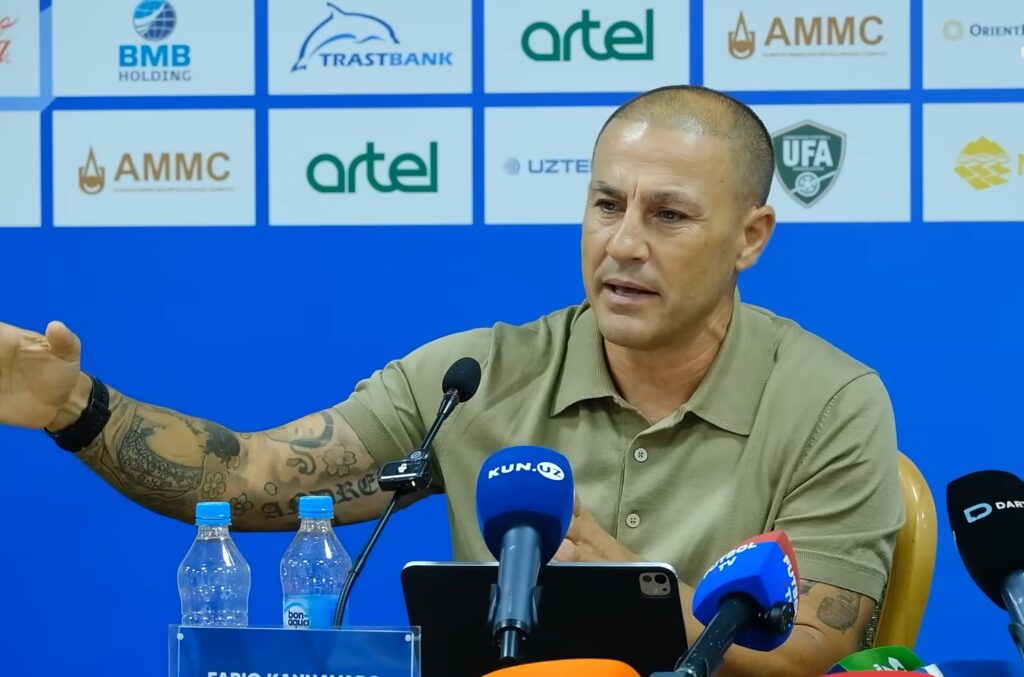
Speaking at a lengthy press conference following Uzbekistan’s 2026 World Cup campaign, the Italian hit back at reports about his salary, his staff, restrictions imposed on players and his decision to leave for Italy rather than return to Tashkent with the team after the tournament.
“I don’t know why someone gives the wrong information about my salary, about the players, about everything,” Cannavaro said.
He then went further.
“Maybe you have some rat inside of the team,” Cannavaro said in English.
Cannavaro used the word “rat” himself; it was not a translation or description added by local media. The interpreter immediately rendered it into Uzbek as kalamush, which has the same literal meaning.
His remarks came after weeks of criticism following Uzbekistan’s first World Cup appearance.
Questions were raised over his squad selection, extensive rotation, management of the goalkeeping position and whether his staff had succeeded in relieving the psychological pressure on a team making its debut on football’s biggest stage.
Among those who missed the final squad were Alisher Odilov, Khusain Norchaev and Umarali Rakhmonaliev. Norchaev’s situation was complicated by injury, while the omission of other in-form players generated debate before the tournament.
Cannavaro also rotated heavily during the three group matches, using almost his entire squad. At the press conference, he defended his philosophy of giving opportunities to a wider group of players and revealed that he had initially wanted all three goalkeepers to receive World Cup minutes.
One of the most debated decisions concerned the goalkeepers.
Experienced Utkir Yusupov started the opening 3-1 defeat to Colombia. Cannavaro then replaced him with Abduvokhid Nematov against Portugal. Uzbekistan lost 5-0, but Nematov remained in goal for the final group match against DR Congo.
Cannavaro admitted the decision may have been wrong, although he defended the reasoning behind it.
“When you make some decisions, they can be right or wrong. Maybe changing the goalkeeper was wrong,” he said.
The Italian explained that Yusupov had spent a significant period recovering from injury, while Nematov had impressed in friendlies and training.
“If you remember against Egypt, against Iran, against all the friendly games we did, his performance was amazing. In training Nematov was much better,” Cannavaro said.
The psychological state of the team also became a talking point.
Before the World Cup, Cannavaro had spoken about taking pressure off players ahead of the biggest matches of their careers. During the tournament, however, Uzbekistan often appeared cautious at important moments and became more aggressive only after falling behind.
Cannavaro acknowledged that his team had been too conservative at times. He said Uzbekistan played cautiously in the first half against Colombia and that against DR Congo he wanted his players to push forward and press higher, but they were afraid to do so.
He also identified declining concentration and a lack of communication between players as recurring problems.
Another source of criticism was Cannavaro’s decision not to return to Tashkent with the national team after the World Cup.
Following the tournament, the Italian announced that he would fly directly from New York to Italy while the squad returned to Uzbekistan.
“We have been with the national team for two months, and now we all need a little rest. I will fly from New York to Italy and see you in September,” Cannavaro was quoted as saying on June 29.
At the August press conference, Cannavaro pushed back against suggestions that he had simply abandoned the team and gone on holiday.
He stressed that he stayed with the players in New York until the end and was the last person to leave the team hotel. He said he travelled home during a break in the Uzbek league and returned once domestic competition resumed.
“No one escaped. I was there until the last day. I was the last one to leave the hotel,” Cannavaro said.
His explanation did not entirely remove the controversy, given that he himself had spoken about the need for “a little rest” immediately after the tournament.
Cannavaro devoted a significant part of the press conference to challenging what he described as false or misleading stories around the team.
He rejected claims that players had been subjected to excessive restrictions and said the rules introduced by his staff represented standard practice in European football.
“Everything we did was not because I like it. It is because teams around the world and in Europe usually follow this protocol. It’s not Cannavaro’s protocol. It’s not only my ideas,” he said.
He also dismissed suggestions that players had been tightly controlled during their free time, joking that he was not standing over them “with a gun”.
Cannavaro’s frustration was also directed at members of the Uzbek media.
Towards the end of the press conference, he noted that several journalists who had been among his most vocal critics were not in the room.
“Most of the journalists who spoke about me are not here today. They don’t have the courage to be in front of me. It is easy to speak when someone is not there,” Cannavaro said.
“I respect you, and you need to respect me and my players. When you give some news, the news should be 100 per cent right.”
Another major topic was Jaloliddin Masharipov.
Cannavaro defended his efforts to take the experienced midfielder to the World Cup despite the player having gone months without competitive football.
“I think I was the only stupid coach who could call Masharipov,” Cannavaro said.
The Italian said he had met the player in Dubai and Rome and involved specialists in an attempt to get him ready for the tournament. Masharipov’s eventual problem, according to Cannavaro, was not his knee but a back injury.
Cannavaro admitted that continuing to pursue his recovery may have been a mistake, but questioned why the decision attracted so much scrutiny when other injured Uzbekistan internationals received far less attention.
“I don’t understand if you criticise me because I’m a foreigner or because you are a friend of Masharipov,” he said.
Cannavaro also rejected reports that he earns €4 million per year as Uzbekistan head coach.
“My salary is not four million a year. But you still push that my salary is four million,” he said.
He added that he personally covers part of the cost of the foreign specialists brought into the national-team setup and said some had accepted significantly reduced salaries to work with Uzbekistan.
Beyond the controversies, Cannavaro again pointed to intensity as one of the fundamental weaknesses of Uzbek football.
He stressed that only one member of the national team plays in one of Europe’s five major leagues and revealed that some locally based players had asked the national team’s fitness coach for additional work because they felt they were not receiving enough intensity at club level.
“Intensity is the key. It is the most important thing,” Cannavaro said.
Changes are now expected following the World Cup.
Cannavaro admitted that some players were taken to the tournament partly because of their contribution during qualifying. That “bonus”, as he described it, is now over.
The head coach intends to introduce more young players ahead of the next cycle and insists age will not be a barrier if a player is good enough.
Despite Uzbekistan losing all three games at their maiden World Cup, Cannavaro repeatedly defended his players’ commitment and said criticism of his own decisions was legitimate.
But after weeks of arguments over what had happened around the national team, his most striking assessment remained the same:
“Maybe you have some rat inside of the team.”