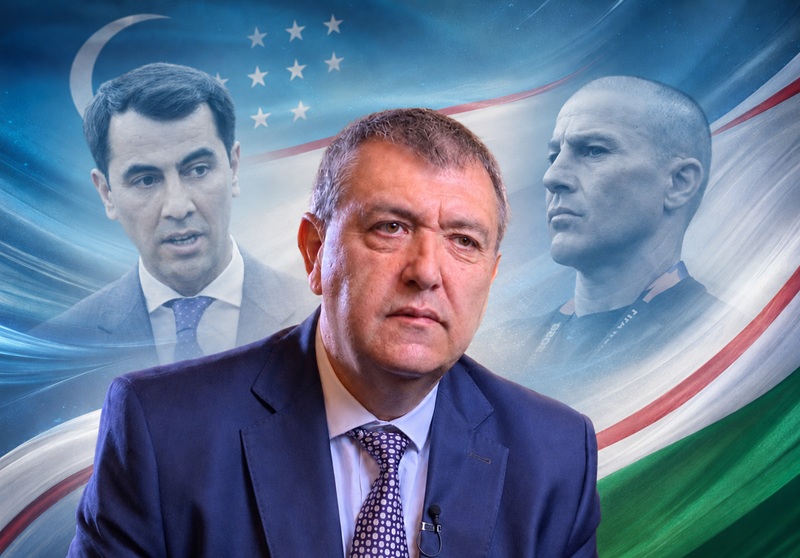
Alisher Aminov, an international expert, legal scholar, economist and author of a comprehensive development program for Uzbek football, believes the national team’s three defeats at the World Cup exposed not only the gap in playing quality, but also deeper structural problems in the country’s football system. In an interview with Fergana, he discusses Fabio Cannavaro’s expensive contract, the shortage of competitive players, the dependence of clubs on state funding, stalled privatization, weak governance, regulatory problems and the reforms he believes Uzbek football urgently needs.
The views expressed in this interview are those of Alisher Aminov.
— Uzbekistan lost all three matches at the World Cup finals. Was this an expected outcome?
— Any other result would have looked not even like a sensation, but like a paradox. I have said more than once that simply reaching the top 48 was already a leap above the country’s current level — an achievement made possible by a number of favorable circumstances. At the same time, of course, this does not mean taking anything away from the players and coaches. They fought at the limit of their ability.
— How can that limit be measured?
— For example, by the obvious shortage of players. In developed football countries, there are three or four candidates of roughly the same high level competing for every position. In our case, at best, there are two — and even then, usually of no more than average quality by international standards. In some positions, such as full-backs, there are almost no truly convincing candidates for the national team. Is this not a direct consequence of the deep structural problems in club football?
Homegrown players who need real senior-level practice at 18 or 19 mostly watch the domestic championship from the bench. This is one of the clearest symptoms of the system’s professional illness.
In the team that won the AFC U-17 Asian Cup in April 2025, there was not a single player with full competitive practice in the domestic league. We have many young talents, but too often they fail to progress inside club academies, stagnate in youth competitions and then simply disappear. In other words, clubs funded by the state are not providing the main return they should provide: the development of competitive footballers.
And here we return once again to the working concept of the Uzbekistan Football Association: rare but bright medals are treated as far more important than systematic work aimed at the long term. The boys won the Asian Cup — what else do you want, what more proof of success do you need? Abdukodir Khusanov rose, in quite remarkable fashion, to the world’s top level — but whose achievement is that? Who worked day and night to produce such a star? Was it the UFA’s first vice-president Ravshan Irmatov? In this system, it often seems that the next task is simply to prepare space on the jacket for new state awards and turn sporting success into political capital.
— After Uzbekistan were eliminated from the World Cup, Fabio Cannavaro said: “This experience will give us great motivation for the future. We made mistakes, but I don’t want to complain about the players. I am proud of them.” It does not sound as if the Italian star intends to resign.
— Let us be realistic. Cannavaro is reportedly one of the highest-paid coaches at the World Cup. His contract is said to be heavier than that of the great Didier Deschamps. Lionel Scaloni, the reigning world champion, reportedly earns noticeably less than our expensive Fabio. Luis de la Fuente, the reigning European champion, is said to earn roughly half as much. Dick Advocaat, who took tiny Curaçao to the world’s top level, reportedly receives around 8,000 euros a month and shares that amount with three assistants. For the cost of Cannavaro’s contract, one could theoretically hire dozens of Advocaats together with their staff.
To be honest, discussing the work of such coaches is not very interesting. In my view, they are stopgap figures whose first interest is usually the number of zeros attached to the offer. There are plenty of such coaches on the market. At the same time, foreign specialists are often surrounded by an aura of infallibility and genius. Cannavaro and his foreign staff were given exceptionally generous financial conditions, and I suspect they may still be surprised by the scale of those conditions. Naturally, the head coach will use every opportunity to paint optimistic pictures and avoid harsh objective assessments. On a human level, this is understandable. He has landed a dream job.
— But Fabio surely understands that Uzbekistan has significant unused potential. Developing that potential should be in his direct interest.
— His interest, in my view, is to prolong a highly favorable contract for as long as possible. If we look at the situation from a football perspective rather than through the lens of “just business, nothing more,” Cannavaro, when signing such a lucrative contract, should have put forward a number of tough conditions to the UFA. These should have included more playing time for young footballers, productive work by key clubs and a strict quality filter for foreign players. He has access to all the tools needed to influence the strategic situation, including direct contact with the federation’s senior leadership.
So his current comments look, to me, like preparation for explaining future failures. Looking serious and saying the right words at the right time is the easiest of all coaching skills.
— How much money does the state spend on football, and what return does it get?
— Over the past year alone, around $150 million was spent on clubs’ current expenses. And we are not talking about investment in infrastructure or other development factors, but about consuming public money rather than building football. Clubs operate without clearly formulated goals, have a huge gap between income and expenditure, and rely almost entirely on state support.
What, in essence, prevents our football decision-makers from introducing restrictive financial regulations, setting salary caps and forcing clubs to live within their means? In 2024, a working group under my leadership drafted such financial regulations. But the UFA board, and Ravshan Irmatov personally, considered that this would “slow down the development of Uzbek football.” As far as I know, the presidential administration and the government are not enthusiastic about such spending either, but too many conflicting forces influence the situation for the vector to change easily. Football has become, in my view, a feeding ground for influence, status and financial benefit — both in a financial sense and in terms of public relations.
— So clubs are fully dependent on state companies and hokimiyats, the regional or city administrations?
— As long as this model dominates, the fate of Uzbek football depends on the mood and plans of officials — both as a general category and as very specific individuals. There are many examples of how such a system can collapse.
Here is one telling example. In Bekabad, the head of the metallurgical plant was appointed to run the club. He struggled with it for a while and then decided to shut the club down. A year later, he left the country while facing criminal prosecution. The actions of one incompetent and, as I see it, highly questionable manager left Bekabad without football for an entire year.
Who now remembers that all of Kyzylkum’s successes were linked to the name of Nikolai Dyakov, the director of the Zarafshan Construction Department? Dyakov left — the club moved to Navoi, and Zarafshan was left without football. FC Zarafshan, which had existed for more than 40 years, simply disappeared.
I have already spoken about Samarkand’s Dinamo, where foreign players have been protesting. I am sure Uzbekistan could soon become a world leader in unpaid financial obligations in football. Only those clubs that bring their expenses into line with their revenues will survive. But not through methods that, as I know, some hokimiyats use: drawing up lists of bank branches that are required to buy ticket quotas under administrative pressure. Voluntary-compulsory survival methods are a direct road to self-destruction.
— You have already mentioned the steps the state is taking to correct the situation. Is that not a way out?
— It is better than nothing. But unfortunately, the presidential decree aimed at club privatization is likely, over time, to create a model that will deter serious investors. Here are the key weaknesses of that document, simply listed in order.
There is no full ownership right. The investor receives the right to manage an asset, but not to own it. He cannot dispose of the club as a business.
There is a mismatch between risk and control. The investor carries the financial risks, but key decisions remain with the state.
The revenue model is unclear. The decree does not establish how and when profit is generated. That makes it impossible to calculate an investment model.
There are restrictions on assets. Assets cannot be freely sold, used as collateral or restructured as part of a business model.
There is a high level of external interference. The state approves plans and controls the investor’s activity, which directly affects management efficiency.
There is no investor protection. There are no guarantees of return on investment or independent arbitration.
There is no clear exit mechanism. The decree does not provide mechanisms for selling a stake or returning capital. Leaving the business without losses becomes almost impossible.
The tender procedure is not transparent enough. Short deadlines and unclear criteria reduce trust in the projects.
There is a conflict in the state’s roles. The state simultaneously regulates, controls and participates in management.
The overall attractiveness is low. The investor risks capital but receives neither control, nor protection, nor a clear path to profit.
Privatization should be a method that promotes and stimulates innovation. But if reforms have been postponed for so long, there is a risk that they will never really begin. In other words, there is a risk that presidential initiatives will simply be blurred and neutralized.
— How should the UFA act, or how can it be influenced?
— Judging by what has happened in recent years, perhaps one should simply understand and forgive. Although in this case, irony is a bitter pill.
I want to be understood correctly: this is not, ultimately, about personalities, but about a system of views and actions. It is not about whether I personally like Cannavaro or Irmatov. What concerns me is the ease with which taxpayers’ money is, in my view, spent without proper responsibility. The idea that “Uzbekistan is a country of fools” is completely unacceptable to me. In the end, if the current management system does not allow the necessary changes to be achieved, perhaps the president of Uzbekistan himself should think about renewing the leadership of the UFA. Uzbek football needs people capable of thinking on a national scale, working for long-term results and placing the interests of the industry above image-making and corporate considerations.
But if we look honestly at reality, this task currently seems extremely difficult. It is easier to find a competent manager for the security structures, for example, than for football. There are plenty of people for the security system, but high-quality sports managers are extremely hard to find. That is why, in my view, football governance has taken on the features of a closed court system, entrusted to a figure closely associated with the country’s security establishment.
— Is the shortage of qualified football administrators a solvable problem?
— It is solvable if one thinks and acts strategically, rather than simply managing the moment. For that, we need a coherent system of professional education. If the UFA had an approved educational program and a licensing system for administrators, decisions would be much more effective. There has long been a need to launch a specialized MBA-level program — an Executive MBA — for top managers of clubs, leagues and the UFA. Its purpose would be to train practitioners capable of making decisions in line with modern trends in the football business. And those trends, I should note, change quite dynamically. The program should be focused on the real needs of the subjects involved: marketing, sponsor relations and the creation of a media product.
— What is the main governance problem for federations?
— It lies in the content of the Law “On Sport” and in the voting system. In the highest governing bodies of public federations, professional leagues and clubs have a minority of votes, while associations of sports subjects and athletes’ unions have no voting rights at all. That is absurd.
— What solutions do you propose?
— It is fundamentally important to change the voting system according to the principle of social partnership. At least one third of the votes should be given to accredited regional federations, at least one third to professional leagues, and at least one third to professional unions of athletes and coaches. In addition, norms regulating social and labor relations should be adopted only with the approval of the trade unions.
It is necessary to develop and approve legislation that applies specifically to the labor relations of athletes and coaches, with corresponding amendments to the relevant chapter of the Labor Code. That would be a huge step forward. A flexible and professionally grounded approach would allow the effective use of norms adapted to such a complex and highly specific field as professional sport.
— Another painful issue is regulations. In your view, how effectively do the PFL and UFA work with calendars and player registration rules?
— In a way that, in my opinion, could more fairly be called a history of legal illiteracy. Take the transfer window, for example. Closing it seven days before the start of the Super League season — what is that? What logic does this algorithm follow? In whose bright mind was it born? In most countries, the transfer period ends after the start of domestic competitions. And that is an understandable and justified model: clubs can register players after analyzing their opening matches and identifying weak areas.
But here, too, there is a paradox. For the Super League, the window closed, while for Pro League clubs, whose championship starts in April, it remained open until March 10. How are clubs that were included in the Pro League only yesterday supposed to build their squads? In addition to formal logic and common sense, this appears to contradict FIFA regulations, which state that registration periods for professional teams within one national association must be uniform.
FIFA regulations allow player registration over a 12-week period. In England, for example, when the window closes in August, it has already opened in May. In Uzbekistan, however, the window opened on December 5, while clubs were still playing the playoff stage, meaning that the transfer period lasted 11 weeks. What prevented it from being opened on December 22, after the final, and giving clubs the legal 12 weeks to complete their squads? Then there would have been no need to invent unlawful exceptions for the Pro League.
One can recall the case when the Players’ Status Committee refused to register free agents for FC Andijan for the AFC Champions League. At that time, the committee was essentially correct: a player is registered only during one of two windows. But today the PFL registers dozens of newcomers, even though the Super League regulations directly prohibit this. It turns out that loopholes are being searched for — and found — for free agents. In my view, such an interpretation of the rules is nothing other than legal nihilism.
— Can labor disputes be resolved fairly in such conditions?
— The problem is that labor disputes in our reality simply cannot be dealt with effectively by ordinary courts. I have said it many times and will repeat it: it is necessary to introduce, by law, specialized arbitration courts in the field of sport. This is a widespread and long-established practice. Around the world, such bodies resolve disputes quickly, professionally, with an understanding of the specific nature of sport and within all relevant regulations. Artificially splitting disputes between different bodies leads to contradictory decisions and violations of athletes’ rights.
— You once met with Sports Minister Adham Ikramov. What was discussed, and what did it lead to?
— Yes, we met. It was quite a long time ago — back when the UFA’s first vice-president, Ravshan Irmatov, was still playing the role of a manager interested in real progress in the sector entrusted to him. The conversation was fairly substantive, but in the end it led nowhere. There has been no movement. The fundamental problems have not been raised properly by the presidential administration, the government, the National Olympic Committee or the UFA.
— You regularly raise the issue of corruption.
— In my view, corruption-related problems have penetrated deeply enough for alarm bells to be rung. Allegations of fixed matches, questionable refereeing, opaque payments and other murky practices are, unfortunately, a serious concern in Uzbek football — one only has to read the Uzbek media. Ideally, information about such episodes should be delivered very quickly to the relevant authorities, especially given the institutional overlap between football governance and the security establishment. But that is in an ideal world. In practice, things often do not move beyond declarations.
In countries that have successfully fought, and continue to fight, corruption in football, one of the key instruments has been the law on operational-search activity. The use of agents inside federations and clubs is a normal practice in many places. But in our case, as so often, the situation is different: law enforcement, in my view, has not shown sufficient independence or consistency in addressing such problems. A real fight against football-related crime requires strong political will backed by real influence — at the level of the country’s top leadership, the Interior Ministry and the prosecutor’s office. I am convinced that many facts deserving serious attention would emerge very quickly. And those facts should be followed by very tough measures. Again, that is the ideal scenario.
— What would you say to those who make and implement key decisions?
— Nothing new. I am ready to repeat what I have been saying for many years: extracting personal or group benefit from a system funded by the public while imitating active work is not only shameful, but deeply damaging and, in my view, unacceptable. The overwhelming majority of people moving within football circles are, as I see it, servants and beneficiaries of a flawed system. Qualified, principled specialists who care about domestic football with their soul rather than their pocket are becoming an endangered species. That is very sad.
If there is no demand for radical change, it will not matter very much what surname the next leader after Irmatov has, or which group of influence places him in that profitable chair. Football is a team sport. Managing the UFA, the league and the clubs requires not only experience and knowledge, but also a high moral standing. The current leadership has serious problems in this regard.
As long as football is perceived by a group of “especially trusted” people as a comfortable source of benefit and a kind of elevator for career advancement, Uzbekistan will continue to limp along the margins. I am absolutely convinced that our potential is far greater than simply being among the 48 nominally strongest football countries in the world. Yet, carried away by self-congratulation, we received a clear “three” in the defeats column, almost a dozen goals conceded — and still continue to celebrate the questionable dividends that such participation has brought us.