
Former Tottenham Hotspur manager Ange Postecoglou reportedly asked for €5m per year to take charge of the Kazakhstan national team, but the Kazakhstan Football Federation turned down the demand.
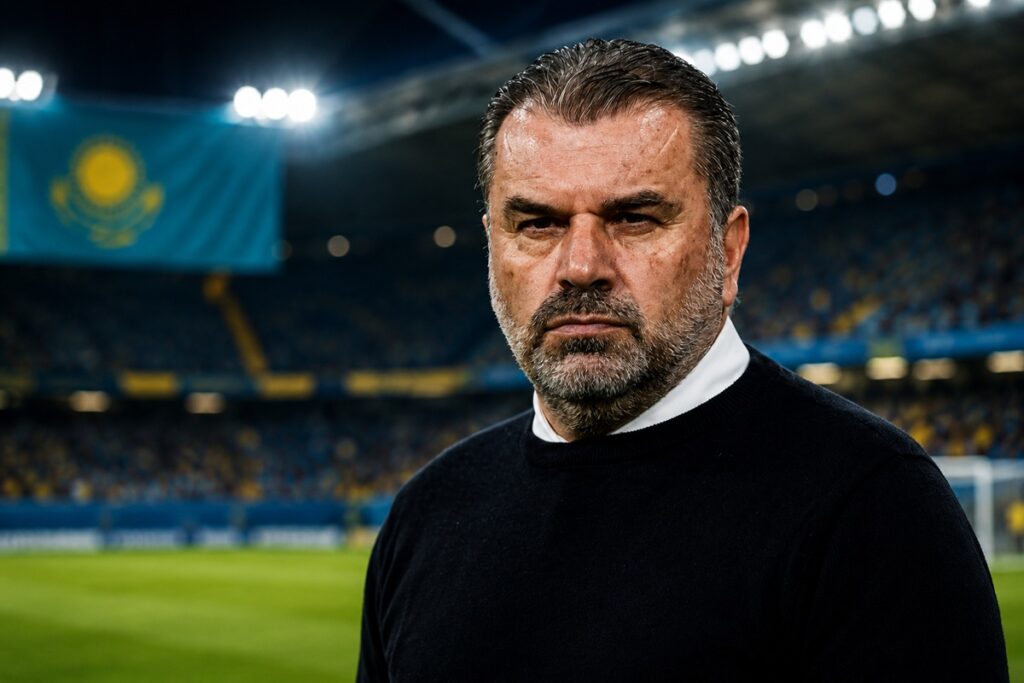
According to the Telegram channel AmanVibe, the Australian coach’s financial expectations were too high for the KFF at this stage.
Had the deal gone through, it could have become a record-breaking contract for Central Asian football. For now, the unofficial benchmark in the region remains Fabio Cannavaro’s reported €4m-a-year agreement with the Uzbekistan national team, although that figure has never been officially confirmed.
The story also fits into a broader context. Eurasia Football previously reported that the KFF could consider dismissing Talgat Baysufinov as head coach of the national team. Such a move would not necessarily be a reaction to poor results, but rather part of a wider management shift under KFF president Marat Omarov.
Baysufinov’s latest spell with Kazakhstan has not been a failure in terms of results. Since returning to the national team in autumn 2025, he has overseen seven matches: three wins, three draws and one defeat, with a goal difference of 10:4. That run included a 4-0 win over Liechtenstein, a 1-1 draw with North Macedonia, a 1-1 draw with Belgium in World Cup qualifying, victories over Namibia and Comoros at the FIFA Series tournament in Astana, and a 1-1 draw with Armenia.
That is why a possible coaching change would not look obvious from a purely sporting point of view. Baysufinov stabilized the team after a difficult period, won a home international tournament and took a point from Belgium — one of Kazakhstan’s most notable results in recent years.
However, the context around the federation is wider. Under Omarov, the KFF has increasingly been leaning toward foreign expertise in key areas. In this configuration, Scott Munn’s role becomes especially important.
In April, the KFF approved the Australian executive as the federation’s new general secretary. Munn previously worked at Tottenham and is expected to officially begin his role at the KFF on July 13.
Against this background, potential interest in Postecoglou looks more logical. Like Munn, Postecoglou comes from the Australian football environment. Both were also connected with Tottenham during the same management cycle: Postecoglou became head coach in the summer of 2023, while Munn joined the club later that year as Chief Football Officer.
Postecoglou’s candidacy would be both ambitious and risky for Kazakhstan. On one hand, he is a coach with European success, Premier League experience and a strong football identity. On the other, his model requires time, trust and a willingness to accept turbulence — something that may be difficult in a national team environment where every major decision quickly becomes a public debate.
For now, the main obstacle appears to be money. A salary of €5m per year would be unprecedented for Kazakhstan and for Central Asian football as a whole. But Munn’s arrival at the KFF may at least keep the channel open for further discussions.