
The Executive Committee of the Kazakhstan Football Federation has approved the appointment of Scott Anthony Munn as the organisation’s new General Secretary.
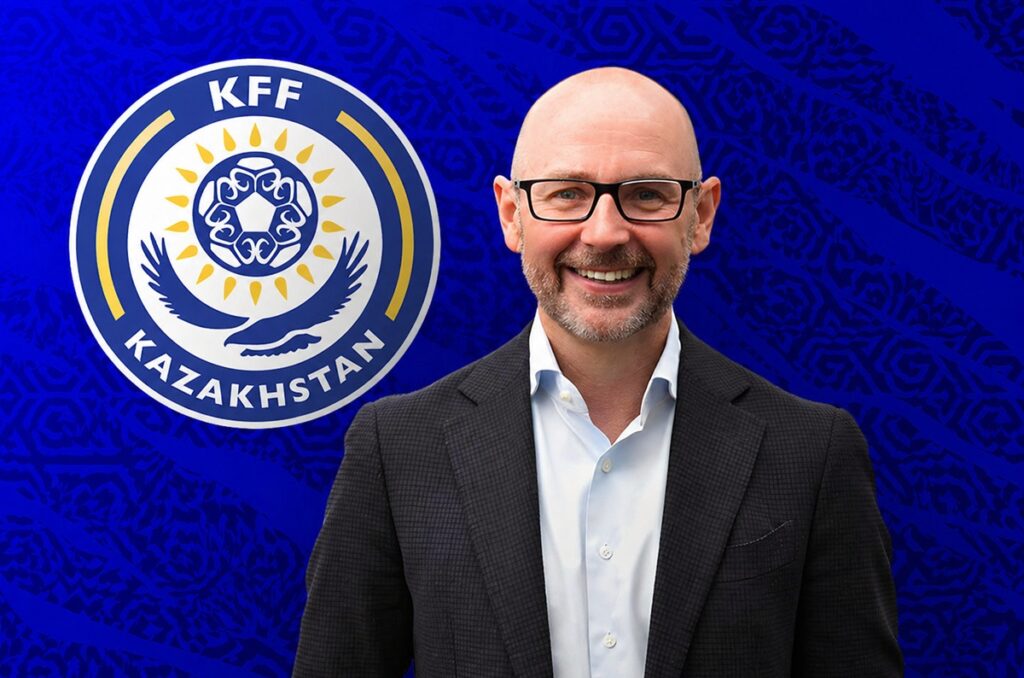
The Australian football executive will officially take office on July 13, 2026. His term will run until July 12, 2030.
Munn arrives at one of the most important administrative positions in Kazakhstani football after a period of reshuffling inside the federation. The role was previously held by David Loria, who was later moved to the position of KFF Vice-President. After Loria’s departure, Aleksandr Keplin served as acting General Secretary.
Inside the federation, Munn’s appointment is being presented as a historic one: for the first time, a senior figure in Kazakhstani football administration will have experience of working in the English Premier League. But the significance of the move goes beyond the Tottenham label. Munn is an executive who has worked across City Football Group, Australian football, CFG’s China operation and, most recently, Tottenham Hotspur.
His profile is not that of a coach, scout or traditional sporting director. Munn is first and foremost a football administrator — someone whose work has focused on operations, club structures, academies, commercial growth, infrastructure and the coordination of football departments.
For the KFF, bringing in a foreign specialist is not an entirely new step. Under its current leadership, the federation has already started relying on international expertise in several key areas. In March 2025, Portugal’s Nuno Alexandre Parreira de Castro was appointed Director of the KFF Refereeing and Inspection Department. In April, Moldovan specialist Gennady Skurtul took charge of the federation’s technical department.
Castro is responsible for the refereeing system, match inspection and the introduction of modern approaches to referee development. Skurtul oversees youth, women’s and grassroots football, the work of Kazakhstan’s youth national teams, coach education and the alignment of technical programmes with FIFA and UEFA standards.
Munn’s appointment represents the next level of that approach. Castro and Skurtul are responsible for specific verticals. The General Secretary, however, sits at the centre of the federation’s administrative system. The role involves coordinating departments, implementing decisions made by the leadership, handling international relations, overseeing organisational processes and monitoring the delivery of reforms.
That is why Munn’s arrival should not be seen simply as a high-profile appointment. It looks more like part of a wider attempt to rebuild the Kazakhstan Football Federation according to international standards.
A major part of Munn’s career was spent at Melbourne City. He worked for ten years as the Australian club’s chief executive and was involved in its transformation after it became part of City Football Group. During his time there, the club won its first men’s trophy — the 2016 FFA Cup — while also developing its women’s team, academy, infrastructure, commercial operations and fan engagement.
Still, Munn’s Australian chapter was not flawless. English-language media noted that Melbourne City’s men’s team did not reach the A-League Grand Final during his time in charge, while average attendances remained below 10,000. For Kazakhstan, this is an important caveat: Munn’s experience in club-building is serious, but it does not automatically answer the question of how quickly management reforms can be turned into real fan engagement and commercial growth.
After Melbourne City, Munn moved on to lead City Football Group’s China operation. He became Chief Executive of City Football Group China and was responsible for the group’s activities in the region. During that period, CFG acquired Chinese club Sichuan Jiuniu, giving Munn experience in a market where football required not only club development, but broader institutional restructuring.
The next major stage of his career was Tottenham Hotspur. In 2023, the London club appointed Munn to the newly created role of Chief Football Officer. The idea was to create a unified football structure: the men’s and women’s teams, academy, football operations and internal football departments were all meant to operate within one management framework.
During that period, Tottenham were coached by Ange Postecoglou. Under Postecoglou, Spurs won the 2024/25 UEFA Europa League — their first trophy in 17 years. On paper, that strengthens Munn’s CV: he worked inside the football structure of a club that returned to European success.
But there is an important qualification. Winning the Europa League was the result of the work of the team, coaching staff and the entire club system. It would be misleading to present it as a personal achievement of one administrator.
Munn’s time at Tottenham was also not without problems. In the summer of 2025, British media reported a major restructuring of the club’s management following the arrival of new CEO Vinai Venkatesham. As part of that reset, the positions of several executives came under scrutiny, including Munn’s. English media linked the changes to a broader restructuring of the football department, a disappointing Premier League season and internal problems at the club, including a serious injury crisis.
At the same time, there is no public evidence of any disciplinary or reputational scandal involving Munn personally. His departure from Tottenham looked more like part of a wider management shake-up. But it remains an important detail when assessing his move to Kazakhstan: his last major project did not end on a triumphant note.
That is why Munn’s appointment looks both strong and risky. On the one hand, the KFF is getting an executive with experience of City Football Group, the English Premier League, club-building, commercial development and international football administration. On the other, a high-profile CV alone does not guarantee success — especially in a system where results depend not only on professional competence, but also on real authority, political backing and the willingness of the club environment to change.
Munn has been tasked with continuing the reform course launched by the current KFF leadership. The key areas include refereeing reform, academy and infrastructure development, higher standards of club management and licensing, the creation of a more sustainable commercial and media base, and deeper cooperation with UEFA and FIFA.
“The federation is at a defining stage. We are building the foundation that will determine the future of football in our country. To achieve strong results, we need people with experience and discipline. Scott Munn brings invaluable practical experience that will directly serve the development of Kazakh football. His candidacy meets all the requirements of this position, and I am confident that he will deliver the results Kazakh football deserves,” said KFF President Marat Omarov.
Munn also said he was joining the federation at an important moment.
“I am delighted to be joining the Kazakhstan Football Federation at such a key moment. I have been impressed by the vision set out by President Omarov and by the significant work already carried out by the federation. I look forward to engaging with all stakeholders in the football community, both at club and international level, to support the development of football in the country,” Munn said.
One separate question that may now arise is whether Munn’s arrival could eventually influence the future coaching strategy of the Kazakhstan national team. At Tottenham, he worked during the same period as Ange Postecoglou. The two share more than just their time in London: both have deep roots in Australian football. Postecoglou made his name as a coach in the A-League and with the Australian national team, while Munn built his reputation as an executive at Melbourne City and later inside City Football Group. Postecoglou also arrived at Tottenham just a couple of months after Munn’s appointment had been announced.
Kazakhstan’s national team is currently coached by Talgat Baysufinov. For now, there is no public evidence of any talks between the KFF and Postecoglou, and it would be incorrect to present such a scenario as anything more than speculation. But Munn’s arrival may naturally fuel discussion about whether Kazakhstan could eventually look at a coach with a profile similar to Postecoglou — a manager with experience in both club football and the international game.
For Kazakh football, however, Munn’s appointment is not only a test of one executive. It is also a test of the KFF’s new course — and of whether ambitious words can be matched by real decisions.
If Munn is given genuine authority, access to decision-making and support inside the federation, his experience could become a tool for systemic reform. If not, a Premier League name may remain little more than an impressive but ultimately cosmetic label.