
Kazakhstan may be approaching a major decision over the future of its national team — not because Talgat Baysufinov has clearly failed, but because the arrival of Scott Munn could open the door to a new foreign-led project inside the Kazakhstan Football Federation.
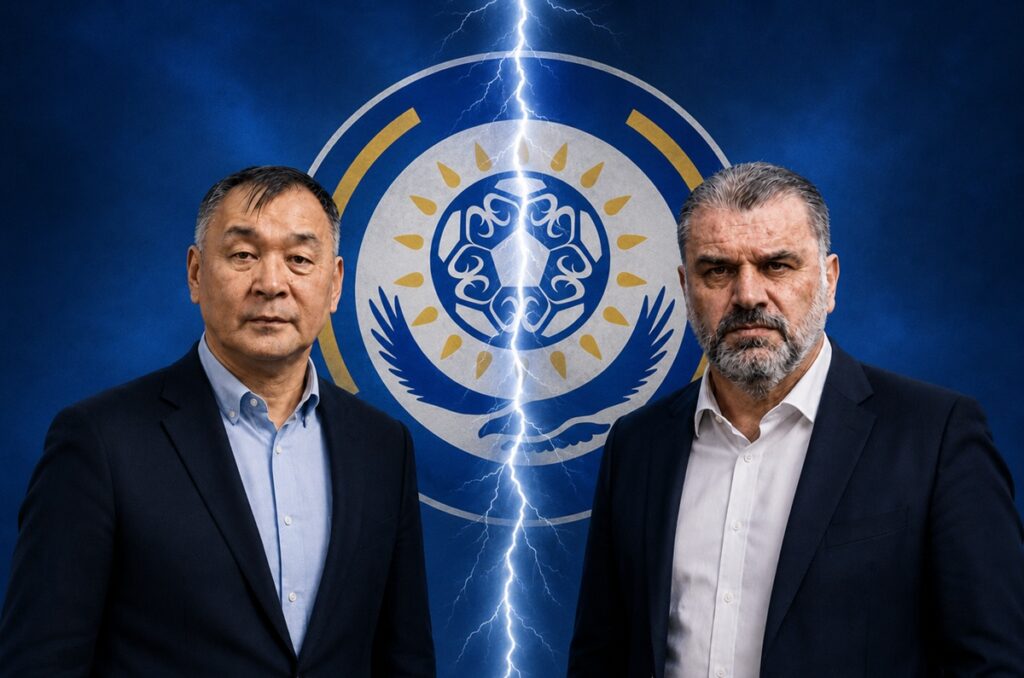
According to Eurasia Football, the KFF is considering the possible dismissal of Baysufinov as head coach of the national team. A decision could be made after Kazakhstan’s friendly against Hungary.
One of the possible names in the background is Ange Postecoglou. His candidacy would immediately draw attention because of his Tottenham Hotspur connection with Munn, who was approved in April as the KFF’s new general secretary and is expected to officially begin work on 13 July.
Baysufinov returned to the national team in autumn 2025 after the resignation of Ali Aliyev. Since then, Kazakhstan have played seven matches under him, winning three, drawing three and losing only once.
The run included a home FIFA Series title in Astana, wins over Namibia and Comoros, and a 1-1 draw with Belgium in 2026 World Cup qualifying — one of Kazakhstan’s most notable results in recent years. The only defeat came in a friendly against the Faroe Islands.
That is why a possible dismissal of Baysufinov does not look obvious from a purely sporting perspective. He stabilised the national team after a difficult period and produced results that are difficult to present as a clear failure.
The wider context, however, points to a different logic. Under KFF president Marat Omarov, the federation has increasingly relied on foreign specialists in key areas. One example is Portuguese official Nuno Alexandre Parreira de Castro, who was appointed director of the refereeing and inspection department.
Even after clubs from the Kazakhstan Premier League and First League publicly called for Castro’s resignation, the federation did not abandon its chosen line and effectively backed the current leadership of the refereeing department.
This matters because it shows a broader pattern. The KFF appears ready to defend foreign-led appointments even when they cause resistance within Kazakhstan’s football environment. A possible change of Baysufinov may therefore not be an isolated personnel decision, but part of the same management logic.
In this configuration, Munn becomes a central figure. The Australian executive previously worked at Tottenham as chief football officer. Postecoglou, like Munn, comes from the Australian football environment, and their time at Tottenham formed part of the same management cycle.
Postecoglou became Tottenham head coach in the summer of 2023, while Munn officially began working at the club in the autumn of the same year. Under that configuration, Tottenham won the Europa League — the club’s first trophy in 17 years.
At the same time, the season was deeply controversial. Despite the European success, Tottenham struggled badly in the Premier League, and Postecoglou was dismissed soon after. Munn’s period in the club’s structure also ended almost at the same time.
According to EF, Postecoglou may now be considered as one of the possible options for the Kazakhstan national team. If so, it would not simply be about appointing a foreign coach with a big name. It could be an attempt by the new management block inside the KFF to build its own project through a specialist from a familiar football ecosystem.
Postecoglou’s candidacy would be both ambitious and risky. On one hand, he is a coach who has won in Europe and worked in the Premier League. On the other, his model requires time, trust and a willingness to tolerate turbulence. For Kazakhstan, where major football decisions quickly become part of public debate, such a move would not be straightforward.
Kazakh football blogger “Total Football” considers a possible dismissal of Baysufinov a risky step. In his view, if the KFF removes the coach now, it is unlikely to be calmly accepted by the football community. Such a decision could trigger a new wave of criticism against the federation and become another reputational setback for the KFF.
However, the situation with Nuno Castro has already shown that the KFF is prepared to defend its own personnel decisions even when they cause open discontent within Kazakhstan’s football environment.
If the federation decides to part ways with Baysufinov, it will have to explain not only the choice of a new coach, but also the reason for dismissing the current one — especially given that his latest spell does not provide an obvious sporting argument for removal.
The main question, then, is no longer only what happens after the Hungary match. It is whether the KFF, with Munn entering the system, is ready to sharply change the national team’s coaching direction — and whether Kazakhstan’s football community is ready to accept Baysufinov’s dismissal while his results remain difficult to call a failure.