
Before Abdukodir Khusanov became Manchester City’s first Uzbek player, his career took an unexpected turn at youth level.
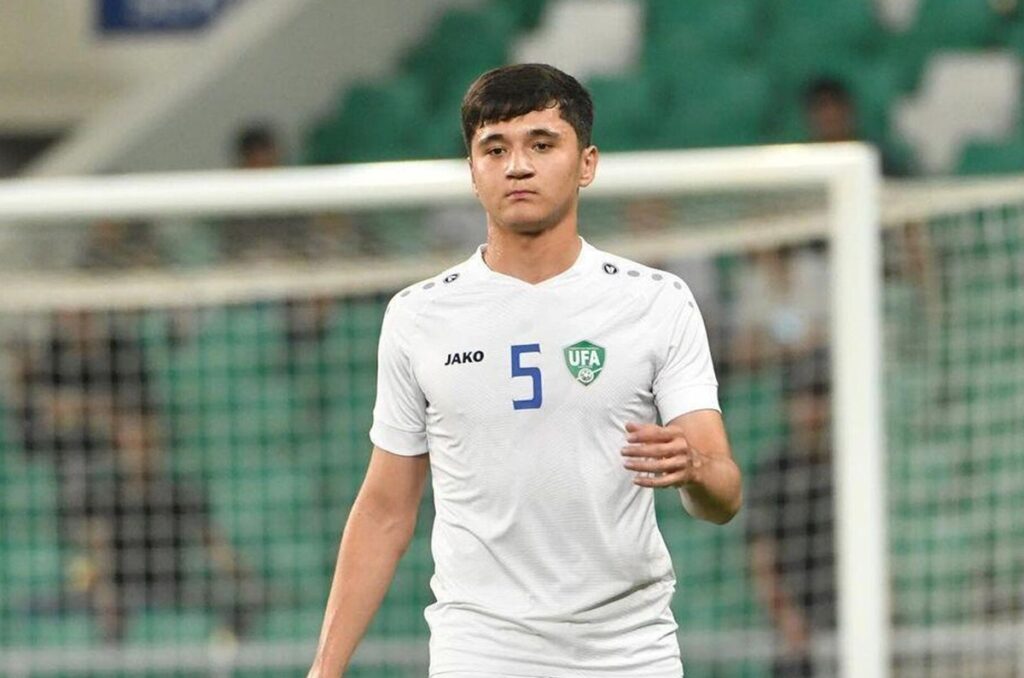
At 15, Khusanov had to step away from Uzbekistan’s youth national team for several months because of Osgood-Schlatter disease — a growth-related knee condition common among young athletes.
At the time, he was not yet a centre-back. According to Uzbek football legend and youth coach Azamat Abduraimov, Khusanov played in midfield, had a good long pass and was an important member of the starting line-up. But he lacked height — before a rapid growth spurt changed both his body and his role.
“At 15 he started growing quickly, which led to Osgood-Schlatter disease,” Abduraimov told Fergana. “As a result, in agreement with his father Hikmat Khashimov, we decided not to call him up to the national team for several months.”
When Khusanov returned, Abduraimov saw a different player.
The coach said he brought him back into the team in 2019 while preparing for a tournament in Minsk. By then, Khusanov had grown physically, become stronger and gained speed.
“I returned him to the team, made him captain and moved him into defence,” Abduraimov said. “He had grown, become strong, and had good speed.”
Abduraimov later studied Khusanov’s physical testing data from the ages of 14, 15 and 16 and described the progress as remarkable. In particular, he said Khusanov was among the best players of his age in terms of distance speed, although his acceleration was less impressive — something the coach linked to the player’s size.
The positional switch became one of the key decisions of Khusanov’s youth career. A player who had started in midfield moved into central defence, where his reading of the game, physical development and pace eventually formed the basis of his professional path.
Khusanov later left Uzbekistan without playing in the domestic top division, joined Energetik-BGU in Belarus, moved to Lens in France and then became the first Uzbek player to sign for Manchester City.
Abduraimov also stressed that Khusanov’s development was strongly influenced by his father, former Uzbekistan international Hikmat Khashimov, as well as by the experience he gained in Uzbekistan’s youth and junior national teams.
For English-speaking fans, Khusanov is often seen mainly through the lens of his Premier League move. But his youth coach’s account shows that one setback in adolescence helped shape the position, profile and mentality of one of Central Asia’s most important football exports.