
Player withdrawals, a camp walkout and renewed allegations of interference have exposed the unresolved conflict between Afghanistan’s internationals and the country’s football federation.
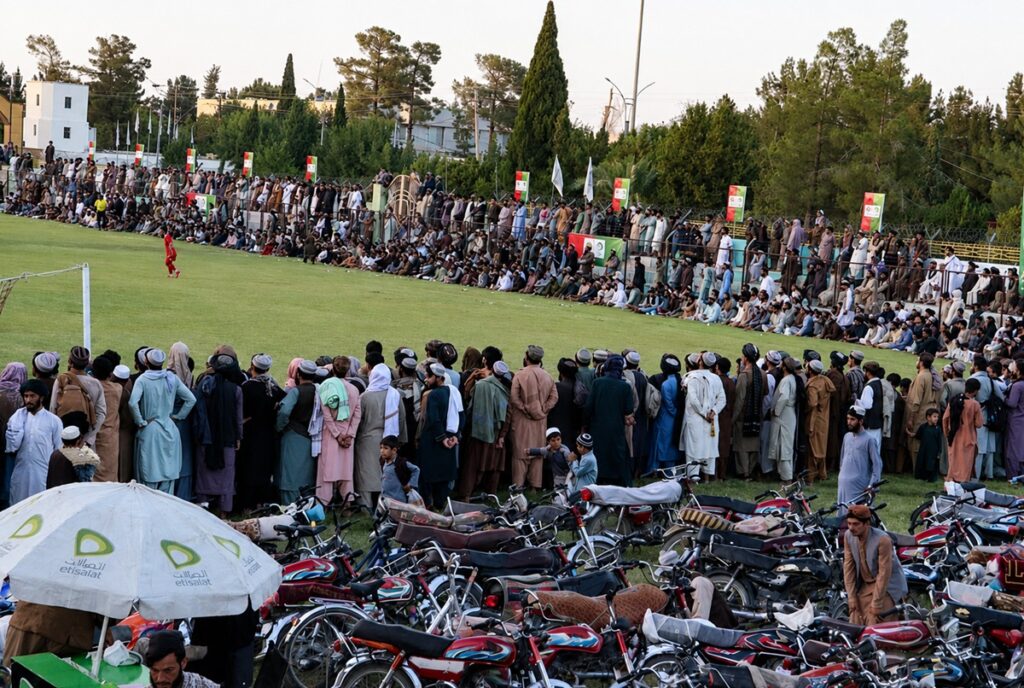
Afghanistan’s national football team travelled to the Maldives hoping to find stability under a new head coach. It returned with two 2–0 defeats to Pakistan, a disrupted camp and a fresh wave of accusations against senior officials at the Afghanistan Football Federation.
Several foreign-based internationals had already declined call-ups earlier in the year. During the Diamond Jubilee International Football Tournament, midfielder Rahmat Akbari left the camp before the final and accused team manager Samir Homayouni of interfering in sporting decisions.
The AFF treated Akbari’s departure as a disciplinary matter. His accusations, however, revived a conflict that has followed the national team for several years.
Current and former players have repeatedly raised concerns about financial transparency, travel arrangements, unpaid allowances, team selection and the influence of federation officials. The AFF and its president, Mohammad Yousef Kargar, deny allegations of corruption and insist that the federation operates independently under FIFA and AFC regulations.
A new coach, familiar problems
The Afghanistan Football Federation appointed Brazilian José Antonio Nogueira in February 2026, giving him a one-year contract.
The federation presented Nogueira as an experienced international coach who had previously worked with the national teams of Pakistan, Sierra Leone and Guinea-Bissau. His immediate responsibilities included completing the 2027 Asian Cup qualifying campaign and preparing Afghanistan for the next World Cup cycle and the CAFA Nations Cup, according to TOLOnews.
Nogueira succeeded Italian coach Vincenzo Annese. Afghanistan’s final two qualifiers under Annese ended in draws against Pakistan, 0–0 and 1–1, leaving both teams with only two points after four matches. Nukta reported on the second draw and Afghanistan’s fading qualification hopes.
The AFF subsequently changed coaches, although it did not publicly identify the results against Pakistan as the sole reason for Annese’s departure.
Nogueira immediately encountered a problem that had troubled previous Afghanistan coaches. A large group of foreign-based players declined invitations for the Asian Cup qualifiers against Myanmar and Syria.
The absentees included established internationals with experience outside Afghanistan: Habibullah Askar, Owais Azizi, Abdanjam Haidari, Mohammad Naeem Rahimi, Jabbar Sharza, Faisal Ahmad Hamidi, Jamshid Aachakzai, Omid Arzo, Tawfiq Sekandari and Ramin Safi.
The federation cited family circumstances, security concerns, injuries and club commitments. It also said that some players had initially confirmed their availability before withdrawing shortly before the matches, as reported by Ariana News.
Nogueira responded by placing greater emphasis on footballers from Afghanistan’s domestic league. He said the national team needed players who were motivated, available and prepared to accept call-ups.
The approach gave the coaching staff a more manageable group, but the team lost much of its international experience. Foreign-based players have traditionally formed the core of Afghanistan’s strongest line-ups.
The results reflected the difficulties. Afghanistan lost 2–1 to Myanmar and 5–1 to Syria, ending the qualifying campaign with two points. The Asian Football Confederation covered the defeat to Myanmar, while the AFC also reported on the 5–1 loss to Syria.
Pakistan as the breaking point
The tournament in the Maldives gave Nogueira another opportunity to work with the squad and compete against opponents of a comparable level.
Several prominent footballers returned, including Rahmat Akbari and Maziar Kouhyar. The squad also featured younger players, among them 18-year-old Watford academy footballer Amin Nabizada. Watford confirmed that Nabizada made his senior international debut during the tournament.
Afghanistan began with a 1–0 victory over the Maldives and then drew with a Bangladesh under-23 selection.
The momentum did not last. Afghanistan lost 2–0 to Pakistan in the group stage and suffered another 2–0 defeat against the same opponents in the final. Pajhwok Afghan News published Afghanistan’s squad and details of the competition, while TOLOnews covered the first defeat to Pakistan.
The results carried considerable symbolic weight.
Pakistan entered the tournament without a functioning national professional league and after years of institutional instability. Football remains far behind cricket in the country’s sporting hierarchy, while infrastructure and player development remain limited.
Pakistan head coach Nolberto Solano has publicly described the need to establish a professional league and rebuild the national-team structure. In an interview with The Guardian, he said the country needed stable domestic competition, better facilities and a coherent development system.
Afghanistan had been much closer to reaching the third round of World Cup qualification only two years earlier.
The team collected four points from two matches against India and later held Asian champions Qatar to a goalless draw. Before the final round of fixtures, Afghanistan still had a realistic chance of progressing.
India lost 2–1 to Qatar in the parallel match, meaning a draw against Kuwait would have been enough for Afghanistan. Kuwait won 1–0 and advanced instead.
The Asian Football Confederation covered Afghanistan’s first match against India. The AFC also reported on the 2–1 victory in Guwahati and the subsequent goalless draw with Qatar. The outcome of the final round was reported by Kuwait Times.
Against that background, two defeats to Pakistan provoked an angry reaction among Afghan supporters and placed the federation under renewed scrutiny.
Akbari leaves the camp
Rahmat Akbari left the national-team camp after the first defeat to Pakistan and did not take part in the final.
The Australia-based midfielder later accused team manager Samir Homayouni of interfering in sporting decisions and described the situation inside the national team as deeply dysfunctional.
In a statement sent directly to Afghan journalist Firooz Mashoof, Akbari said his main reason for leaving was what he described as corruption involving Homayouni.
“He thinks he is the president, the coach, the captain and everything else in the national team,” Akbari said.
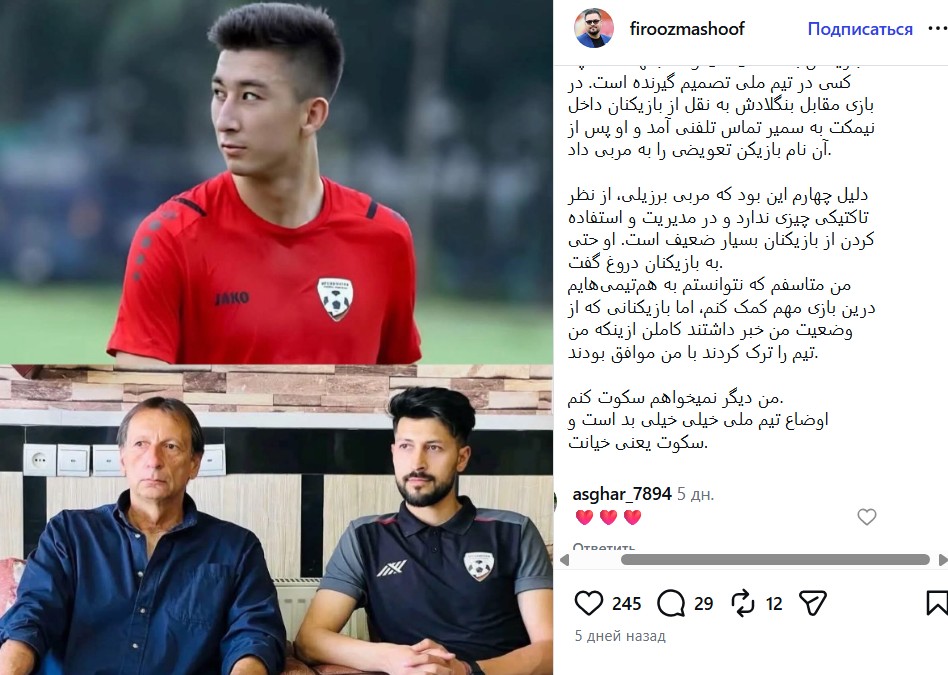
According to the midfielder, Homayouni was effectively making decisions for the coaching staff.
“He tells Nogueira whom to substitute. The players can barely understand who is making the decisions in the national team,” Akbari said.
He claimed that during the match against Bangladesh, Homayouni received a telephone call and then passed the name of a player to the head coach for a substitution.
Akbari also criticised Nogueira’s tactical work, team management and use of players. He accused the Brazilian of lying to the squad.
“The coach is tactically very weak. He is also very weak in managing the team and using the players. He even lied to the players,” Akbari said.
The midfielder said he had joined the squad despite suffering from a hamstring injury because he wanted to help the national team.
He apologised for being unable to support his teammates in the final and said the players who knew about his circumstances understood his decision.
“I do not want to remain silent any longer. The situation in the national team is very, very bad. Silence would be a betrayal,” he said.
The federation presented a different version of events. Officials treated Akbari’s departure as a breach of discipline and said he had left without coordinating his decision with the AFF. The Kabul Tribune reported that his case was expected to be referred to the federation’s disciplinary committee.
Akbari has been involved in similar disputes before. He was among the internationals who challenged the AFF during the major player protest of 2023.
His departure from the Maldives camp therefore became another episode in a continuing confrontation between senior players and the federation’s leadership.
The first major revolt
The conflict entered an open phase in the autumn of 2023.
Former captain Faisal Shayesta and several other internationals announced that they would no longer represent Afghanistan under the existing federation leadership.
Zulfiqar Nazari, Yama Sherzad, Najm Haidari, Omid Popalzay and Imran Haidari were among the players who joined the protest. They accused federation officials of corruption and called for structural reform. Hasht-e Subh documented the initial boycott.
The dispute expanded before Afghanistan’s World Cup qualifier against Qatar. Eighteen players refused to participate, according to The Guardian.
The players sent a letter to FIFA and the AFC outlining complaints about travel arrangements, hotel conditions, unpaid allowances and the suspected misuse of money allocated to the national team and football development.
England-based midfielder Noor Husin said the group wanted meaningful change and believed that resources intended for Afghan football were being managed improperly.
Shayesta accused a small group within the federation of benefiting personally from FIFA and AFC funding. Inside World Football also reported on the letter and the players’ allegations.
The federation denied wrongdoing.
The immediate confrontation gradually subsided, and a reconstructed national team went on to produce one of Afghanistan’s strongest World Cup qualifying campaigns.
The questions surrounding governance, financial transparency and relations between the federation and foreign-based players remained unresolved.
The events of 2026 have brought them back into view.
Football under Taliban rule
Afghan football has operated in an exceptionally unstable environment since the Taliban returned to power in 2021.
Women’s football inside the country became effectively impossible. Many players left Afghanistan, while Taliban restrictions prevented the domestic federation from maintaining a functioning pathway for a women’s national team.
FIFA later established a separate programme for Afghan women living in exile.
In April 2026, FIFA and the AFC approved a special governance framework allowing Afghan women to represent their country in official competitions without requiring approval from the federation operating inside Afghanistan. FIFA described the decision as a landmark reform designed to address Afghanistan’s exceptional circumstances.
The men’s game faces a different set of pressures. Current and former internationals have repeatedly questioned the AFF’s financial transparency, internal decision-making and relationship with Afghanistan’s de facto authorities.
Federation president Mohammad Yousef Kargar rejects those accusations. He has insisted that the AFF remains independent and operates in accordance with FIFA and AFC regulations.
Kargar has also said that the Taliban authorities provided a formal letter supporting football activities in Afghanistan and that the document was forwarded to FIFA and the AFC. His response to the wider allegations was reported by The Guardian.
Further controversy emerged in September 2025, when The Guardian published a report about leaked recordings in which Kargar appeared to discuss a payment of $10,000 in connection with a player seeking access to the national-team setup.
Kargar confirmed that the voice in the recording was his but denied requesting a bribe. He said the conversation concerned possible sponsorship and maintained that player selection remained the responsibility of the coaching staff.
Signs of life at club level
Afghanistan’s domestic football system continues to operate despite the wider instability.
The Afghanistan Champions League has become the country’s principal club competition. Matches are broadcast nationally, and Ariana Television Network secured production and broadcasting rights for several seasons. Ariana News announced an agreement covering the fifth, sixth and seventh editions of the competition.
Afghan clubs have also returned to continental tournaments.
Attack Energy faced Kyrgyz club Abdysh-Ata in qualifying for the 2024 AFC Challenge League. Abu Muslim represented Afghanistan the following year and lost 1–0 to Bhutanese club Paro. The Asian Football Confederation published the match report.
Abu Muslim subsequently received a licence to represent Afghanistan in the 2026–27 AFC Challenge League, as reported by Eurasia Football.
Domestic competition has also produced its own governance disputes.
Attack Energy, then one of the strongest clubs in Afghanistan, was dissolved in 2025 following controversy over Abu Muslim’s 8–0 victory against Adalat Farah.
Attack Energy and several other clubs alleged that the match had been manipulated and demanded an investigation. The federation found insufficient grounds to overturn the result, leaving Abu Muslim as champion.
Attack Energy’s owners subsequently announced that they saw no reason to continue without greater transparency. The Guardian investigated the allegations and the club’s dissolution.
Zohib Islam Amiri, one of Afghanistan’s most respected footballers, also expressed doubts about the result despite playing for Abu Muslim. He later issued a broader criticism of the AFF and Kargar’s leadership.
“The motivation is no longer there,” Amiri told The Guardian.
Amiri said he had spent two decades hoping to help improve Afghan football for the next generation but had gradually lost confidence as the situation continued to deteriorate.
Kargar denied all allegations of financial misconduct.
Kargar remains in charge
Despite the player boycotts, internal disputes and repeated allegations of corruption, Kargar remains president of the Afghanistan Football Federation.
FIFA continues to list him as the head of the AFF. The federation also announced in late 2025 that Kargar had been appointed to FIFA’s Technical Development Committee.
Neither FIFA nor the AFC has publicly announced sanctions against the current AFF leadership or an intervention in the federation’s administration.
Their approach appears focused on keeping Afghanistan within international football’s structures while avoiding further complications in relations with the country’s de facto authorities. Kargar’s appointment to a FIFA committee further underlines the federation’s continued standing within international football.
Afghanistan’s players have now delivered the same warning twice.
The boycott of 2023 exposed deep mistrust between senior internationals and the federation. The call-up withdrawals and Akbari’s departure in 2026 show that the conflict remains active.
The two defeats to Pakistan did not create the crisis. They exposed its depth.