
Astana’s financial crisis has escalated into an open conflict. The first-team players have sent a collective appeal to the club management and its founder, the Sport Qory Tourism and Sports Industry Support Fund, demanding payment of at least three months’ outstanding wages. Until the debt is settled, the players say they are not prepared to take part in the remaining matches of the Kazakhstan Premier League season.
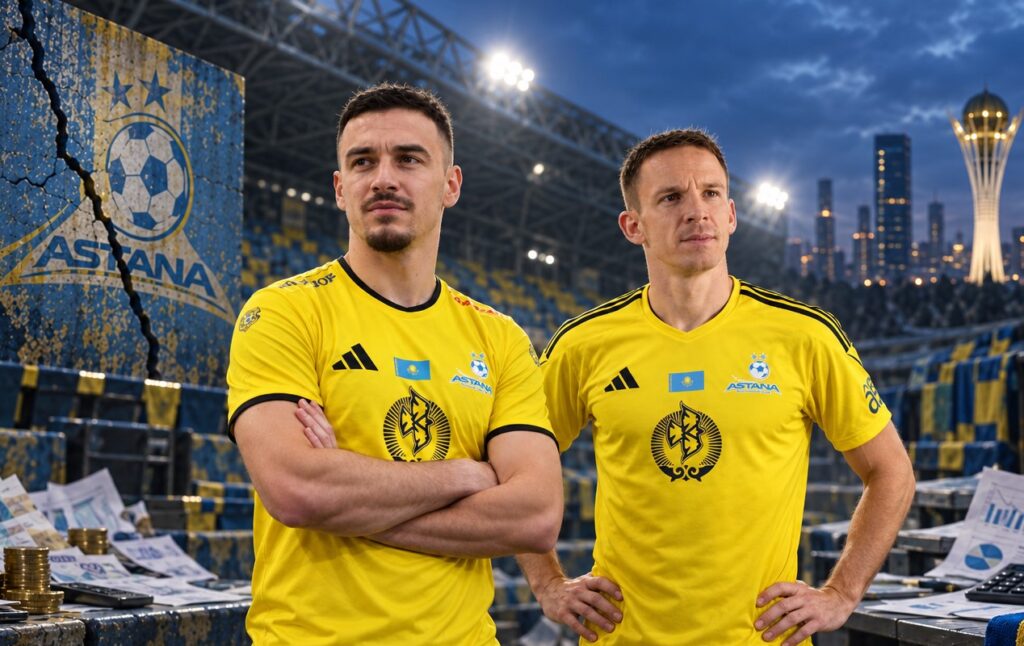
According to insider Eldar Amanbayev, Astana owe their players around 700 million tenge ($1.56 million). He claims the club may have to field youth and First League players in upcoming matches against Ordabasy and Kairat if the first-team squad maintains its position. Astana themselves have not confirmed the 700 million tenge figure.
The club has, however, officially acknowledged “outstanding obligations under certain contracts to a number of first-team players”. Astana stressed that they have no intention of withdrawing from the championship and will complete the season, while the management and Sport Qory are working to resolve the situation.
The circumstances surrounding some of Astana’s leading players are particularly striking.
Earlier this year, journalist Yermukhamed Maulen reported that the club had encountered serious problems registering players before the start of the season. With only two days remaining before the league kicked off, Astana had registered just 12 players.
According to Maulen, Croatian veteran Marin Tomasov and Bosnia and Herzegovina international Ivan Bašić were eventually registered on official monthly salaries of just 100,000 tenge (around $220).
In Maulen’s original report, Bašić was mistakenly referred to as “Enver Bašić”. The player in question was Ivan Bašić, the Astana midfielder and Bosnia and Herzegovina international.
In Tomasov’s case, the symbolic club salary has also been confirmed by the player himself. In July, the Croatian was directly asked whether he was really earning 100,000 tenge from Astana.
“Yes, that’s true. One hundred percent,” Tomasov replied.
Tomasov explained his decision to remain at the club by saying Kazakhstan had become his second home.
Maulen, however, also claimed that Tomasov receives additional compensation from another source, reportedly with funds provided by Astana general director Sayan Khamitzhanov. The 100,000-tenge figure therefore represents Tomasov’s official club salary rather than necessarily his total income.
Kazakhstan’s minimum monthly wage in 2026 is 85,000 tenge (around $190). The official salaries on which Tomasov and Bašić were registered are therefore only 15,000 tenge (around $33) above the national minimum.
Kazakh journalist Vladimir Zharkov has highlighted just how long the team has tolerated the situation. According to him, Tomasov and Bašić are not the only experienced players to have accepted major financial concessions. Kazakhstan internationals Bauyrzhan Islamkhan, Abzal Beysebekov and Dmitry Shomko, as well as members of the coaching staff, have also continued working on symbolic terms.
Zharkov noted that the financial problems have persisted for months, yet the players continued training and competing without taking the dispute public. In his view, the current ultimatum is the result of a prolonged situation in which the club failed to meet its financial obligations while the players continued to fulfil theirs.
The timing is particularly striking.
On September 6, just before the dispute became public, Astana produced one of their most convincing performances of the season, thrashing Elimai 4–0. Bašić scored twice, while Tomasov also found the net.
Despite the financial crisis, Astana remain in contention for the medals. After 23 matches, the club have 45 points and sit third in the Kazakhstan Premier League. Kairat lead with 57 points, followed by Ordabasy on 55.
Astana are due to face Ordabasy away in Shymkent on September 12.
The crisis has unfolded against the backdrop of a drastic reduction in the club’s funding.
Former Astana general director Kaisar Bekenov said in the summer that the club’s budget for the 2026 season was around 3 billion tenge ($6.67 million). According to him, Astana previously operated with an annual budget of approximately 10–11 billion tenge ($22.2–24.4 million), meaning funding has been cut by roughly three to four times.
Kazakhstan’s Ministry of Tourism and Sports also confirmed that Sport Qory provided Astana with 3 billion tenge ($6.67 million) in charitable assistance in 2026.
At the same time, negotiations over the possible transfer of the club to a private investor are continuing. The identity of the potential buyer has not been disclosed.
Back in May, Astana general director Sayan Khamitzhanov said the club did not yet have a confirmed investor, although talks were taking place with several potential partners.
Astana’s financial problems have also attracted UEFA’s attention. In June, the Club Financial Control Body found the club in breach of the football earnings rule for the financial years 2023–2025.
The breach was classified as minor, and Astana were fined €100,000. A year earlier, UEFA had also fined the club €50,000 over overdue payables.
The players’ collective appeal has therefore become the culmination of a crisis that has followed Astana throughout most of the season: a sharply reduced budget, difficulties registering the squad, symbolic official salaries for key players, unpaid contractual obligations and a prolonged search for a private investor.
Yet on the pitch, Astana remain competitive and continue to fight for the championship medals.
The immediate question is whether the club and Sport Qory can settle at least part of the debt before the match against Ordabasy — or whether one of Kazakhstan’s biggest clubs will enter the decisive stage of the season without its first-team squad.