
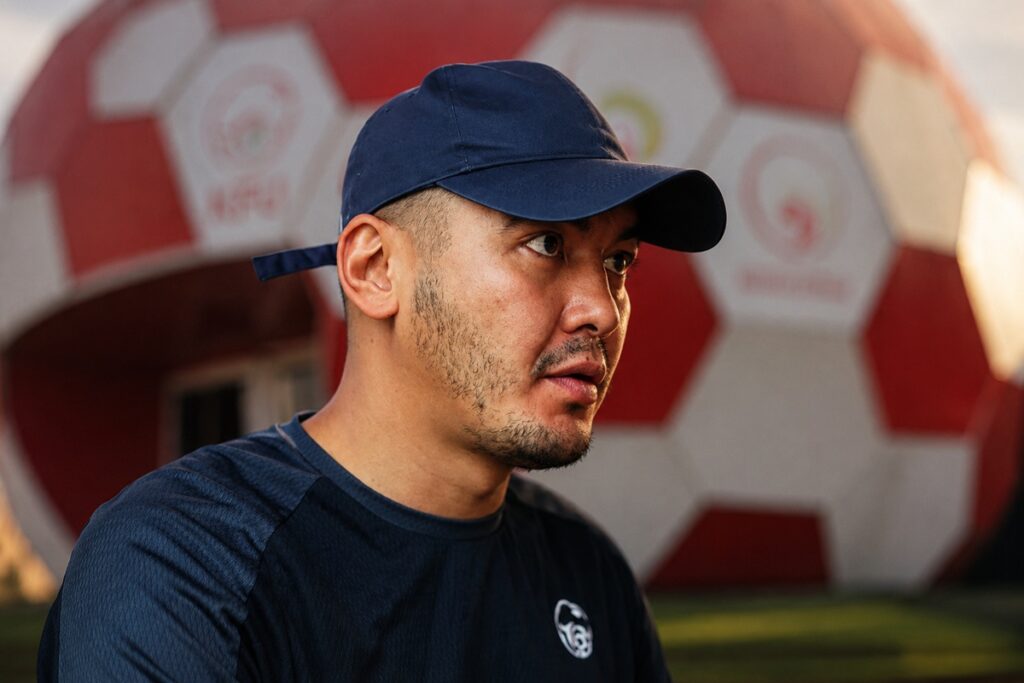
Azamat Baymatov is one of the most recognisable figures in Kyrgyz football: a former national team captain who now works as a senior coach at the Asylbek Momunov Academy (AFiM) in Osh. In an interview with Eurasia Football, he explains why Kyrgyz football must start developing players much earlier, why the country still lacks centre-backs, and why his reference point in youth development is Diego Simeone’s Atlético Madrid — intensity, discipline and passion rather than “tiki-taka”.
The contrast matters. In Kyrgyz youth football, the Barcelona philosophy has become increasingly visible, especially through academy-level projects and a growing emphasis on technical, possession-based football. Baymatov does not reject that direction, but he believes Kyrgyz players are physically and mentally closer to a different model: aggressive pressing, defensive organisation, individual work, intensity and the ability to adapt during a match.
In Osh, the Momunov Academy is trying to turn that approach into a system. The academy has almost a thousand players, elite groups, invited specialists and a clear ambition: not just to win youth tournaments, but to prepare players for Kyrgyzstan’s youth and senior national teams.
“Two years in a row we missed Asia — and that means we missed the world”
— Many people expected you to continue working in senior football. But you moved into an academy. Why did you make that decision?
— Last season I worked in the Kyrgyz Premier League, at Talant, as a defensive coach. I think we did good work there. Several defensive players were called up to the Olympic and senior national teams, and for me that was a sign that the work was not done for nothing.
But I decided to come here because for two years in a row our youth national teams failed. The 2009 team performed badly in Bishkek and lost to Pakistan. Before that, the 2008 team lost to Yemen and Myanmar in Vietnam.
For two years in a row we missed Asia — and that means we missed the world.
— So for you, working in the academy is not a step down, but an attempt to solve a systemic problem?
— Of course. Now the 2010 generation will play. At the moment we have two national team players, but we are working to add more boys by November.
Until our players at youth level reach the Asian Cup, fight for the quarter-finals and qualify for the World Cup, it will be very difficult for us. That is why I am now most concerned about the 2010 generation and younger age groups. We need to develop a new generation of players.
How the Momunov Academy works
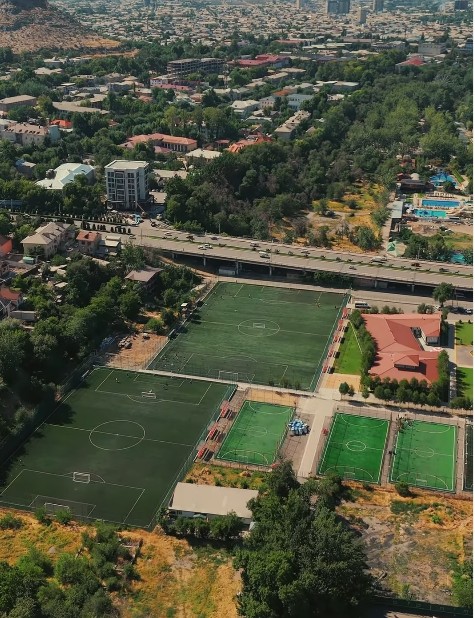
— How is the Momunov Academy organised now? How many children train there?
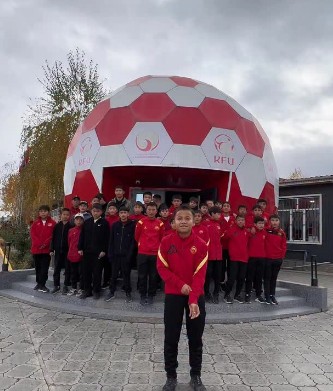
— Today the academy has 948 footballers. Before I came, there were 17 coaches here, not counting me. Now, with invited specialists, a physical coach and other staff, there are around 23 of us.
There are five elite groups. The oldest is U-18, born in 2009. Then come U-17/U-16, U-15, U-14 and U-13. There are around 20 players in each elite group, around 100 footballers in total.
The other children train in paid groups. Each age group has several teams. If a boy is not yet ready for the elite group, he goes into the second or third group. And then he has motivation — to get into the elite.
If a footballer gets into the elite group, he moves onto the budget. There is another level of requirements there: academy tournaments, trips, training camps. This is already paid for by the federation.
— How competitive is the Momunov Academy at national level now?
— The technical director of the Kyrgyz Football Union is Danis Kazakevich from Latvia. He proposed a format of quarterly tournaments to assess the situation across the country. Four academies take part: the National Academy, the Republican Academy in Bishkek, the Barcelona Academy and the Momunov Academy.
At the last U-16 tournament, where I was head coach, we finished second. The National Academy finished first. That team is very strong: most of the players had recently played at the CAFA tournament in Tashkent, and they also play in the U-19 youth league against older opponents.
That tournament showed the picture: the National Academy is at the top, we are close, and then there is a sharp gap. In the 2010 and 2011 generations, today only our academy could compete with the National Academy.
— Where are the academy’s problem age groups now?
— U-13 and U-14. We have a gap there, so before the second quarterly tournament at Issyk-Kul, we are strengthening those age groups.
For U-13, the management invited a specialist from Latvia, Aleksandr Solovyov. For the last four years, he worked specifically with that age group and won a national tournament in Riga. In U-14, the coach is Shahrukh Maratovich Ishanov from Uzbekistan. He has also achieved results in youth football.
So two teams are led by local specialists and two by invited coaches.
— What about accommodation? Are there players from other regions at the academy?
— Only invited players from the elite group who passed selection live here. These are boys we brought from other regions. They live and eat here for free.
But we do not yet have the same opportunities as the National Academy, Barcelona or the Republican Academy, where there is full accommodation, food, school and all the infrastructure. We are still working in different conditions.
At the same time, we are very determined. Under these conditions, we finished second at the last tournament. That shows how strong our desire is.
“If we demand more movement and more duels, we have to think about recovery”
— How do you compensate for the difference in conditions?
— Through organisation. We try to use modern approaches: we film training sessions, analyse them, work by lines, use drones, GPS sensors and additional equipment. In some areas the academy helps, in others the parents help, and sometimes partners provide discounts for group purchases.
We pay a lot of attention to nutrition and recovery. We started increasing the intensity and understood: if we demand more movement, more pressing and more duels from the players, we have to feed them properly and organise recovery properly.
The academy helps with hot meals, and the parents help with vitamins and additional nutrition. It is not some huge amount of money, but it is important for preparation.
— Why has nutrition become such an important issue for you?
— Because without it, you cannot demand intense football. We have a physical coach, Nikolai Primak. He worked in the Russian Premier League — at Akhmat, Krasnodar and Fakel — and also with the Kyrgyzstan national team. He helps us build this part of the work.
The point is simple: if we increase the workload, we have to think about recovery.
We saw that it works. After we organised nutrition and recovery, the players were able to handle a larger volume. In April we played nine matches — basically two games a week.
— Nine matches in one month for a youth team — was that a deliberate step?
— Yes. One game a week was not enough for us. If we want to prepare footballers for a serious level, we have to raise the requirements.
In April we had official matches, trips to Andijan and the elite academy tournament. We won eight of nine games. We only lost to the National Academy.
— You mentioned GPS sensors. What did they show?
— For one official match, we borrowed sensors from Premier League team Ozgon and carried out a comparative analysis.
We saw that our full-backs cover good volume, but compared with senior-level players, we are about two times behind in overall volume and in several other criteria. For us, this is not a reason to be upset, but a reference point: we understand where we have to move.
— Do you work with ready-made players, or do you scout them yourself?
— We brought the boys from other regions ourselves through selection. We watched them at tournaments, travelled to Bishkek and selected them.
There are no foreigners yet — only Kyrgyz boys. But in the future we plan to invite foreign players. The regulations allow three foreigners, and this is needed to create artificial competition.
In the first mesocycle, the boys thought they were irreplaceable. For us, it was important to create competition and the principle that “the strong train with the strong”. Now it is already working: someone plays 60 minutes, someone comes off the bench, and the intensity is growing.
“We do not have a unified methodology for teaching defenders”
— What is your methodology based on?
— First of all, intensity. This matches what Danis Kazakevich proposes. The tempo of the game, high pressing, speed of decision-making, especially in the final third. When a team wins the ball and goes into attack, timing, the first decision and quick finishing are very important.
Second, defending. We have a big problem with this. I think not only in Kyrgyzstan, but in Central Asia in general. We do not have a unified methodology for teaching defenders: how to play with three defenders, how to play with four defenders, how to work as a line.
Everyone coaches the way he himself was taught. If we speak about Central Asia — Kyrgyzstan, Tajikistan, Turkmenistan, Uzbekistan — all coaches have different schools, different instructors and different approaches. And then everyone brings into his work what he was taught in his own country.
We often gather goalkeeping coaches, teach them and give them information. So why not do the same for coaches who work with defenders? If the whole country says Kyrgyzstan does not have centre-backs, then we need to provide more information in this direction.
— In the national team, the older generation of centre-backs is gradually leaving. Is the problem really so serious?
— We understood this a long time ago. That is why I am concerned about the 2010 generation and younger. We need to start earlier.
The current 2010 group has many details that, for different reasons, were not fully addressed when they were 13. For two years we were working on infrastructure, we did not have enough pitches, we did not have all the conditions, and there were many organisational factors. Because of that, it was not always possible to fully work on individual player development.
That is why we are now starting with the 2013 generation. We are not waiting. This is exactly why we invited Aleksandr Solovyov and appointed him head coach of the 2013 team: so that by the age of 16 we already have a more prepared player.
— So a player for the national team has to be shaped from the age of 13?
— Yes. From the age of 13, you need to work on physical qualities, coordination, understanding of the game, tactical and technical aspects. The 2013 team will have a serious regime: nutrition, match preparation, training camps, a physical coach, a goalkeeping coach, a head coach from Latvia and an assistant.
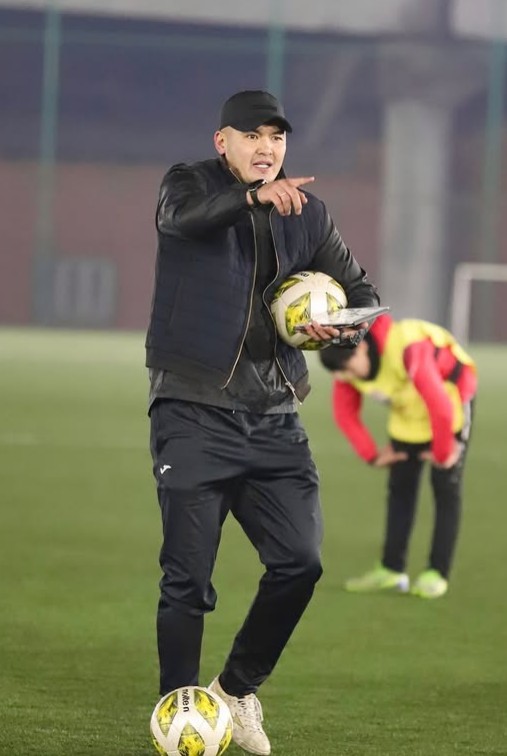
As senior coach, I oversee the direction and look at planning. All training sessions are filmed and then analysed. There is work by lines — both theoretical and practical. Very few academies spend so much time on this.
It is very energy-consuming work. We spend 10–12 hours at the base, almost without a break. But without this, there will be no result.
— At Barcelona, I was told that in two or three years we may see players who will look very bright for the Kyrgyz championship. Not a Lamine Yamal in a global sense, but, let’s say, a Kyrgyz Yamal — a player at Atabaev’s level at 16. Can we expect such a footballer from the Momunov Academy?
— If we speak about the 2013 generation, then by the age of 16 we can count on that. I cannot say 100 percent, but we are counting on it.
But a talented player needs to work a lot physically, on understanding the game, on tactical and technical aspects, and on social, mental and psychological aspects. All of this has to start at 13, so that at 16 he does not have the problems I now face with the older players.
“Our reference point is passion, intensity and discipline”
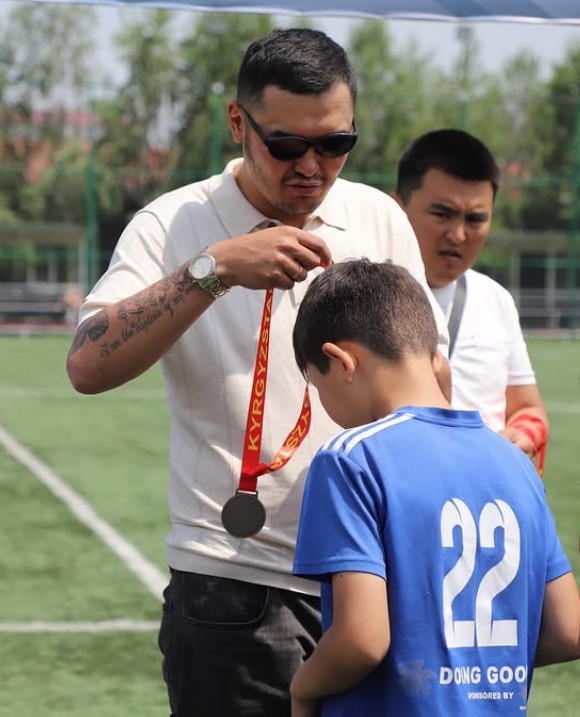
— Are you continuing your own education? Are you planning to get a Pro licence?
— Yes, I am planning to get the Pro licence. We are waiting in Tashkent.
— Who is your coaching reference point?
— In recent years, Diego Simeone and Atlético Madrid. High pressing, passion, desire, ambition, a lot of work. A lot of individual work — both in defence and attack.
In April we had 12 individual sessions. For example, one of our players is right-footed, and his left foot was weak. We stayed after training with him, recorded exercises and worked. Then in an official match he scored from outside the box with his left foot. That is a live example of what we are doing.
— Are Kyrgyz footballers closer to Simeone’s football than to tiki-taka?
— In terms of physicality and covering distance — yes, this is closer to us. We play 4-4-2, but at the same time we shift into three defenders in the second phase. It is a hybrid system: it is important to understand where and when to balance.
At youth level, matches are played in an adult format: two halves of 45 minutes, three substitution windows, seven substitutions. You need to understand who can last 90 minutes, how to use the bench, when to shift into the second zone, when to change the system, how to play according to the score.
We are already doing this. We did it in the match against Andijan, and we did it in other games. It works.
Football itself shows the direction. If Simeone’s team reaches the semi-finals, if it is one of the four best teams in Europe, then there is meaning in this approach. For us, this is a reference point: passion, intensity, discipline, individual work and the ability to adapt.