
Professional football was far from the family’s thoughts when the Heydaris arrived in Switzerland as Afghan refugees. But for Mostafa and his three brothers, the game soon became a crucial part of adapting to their new home.
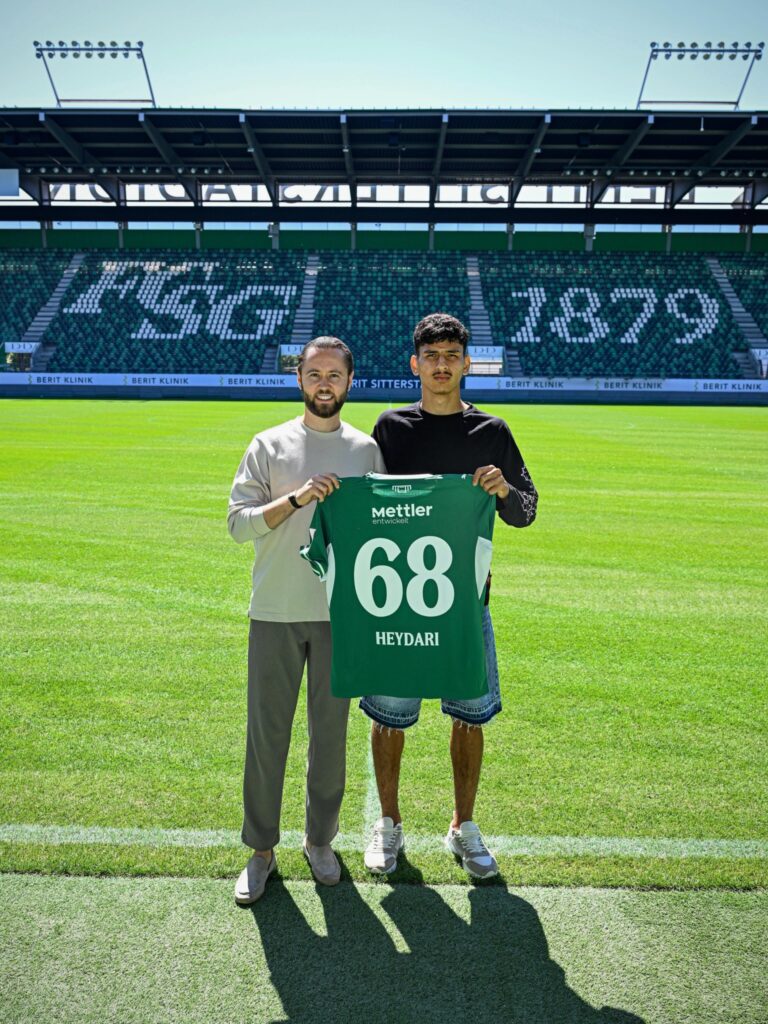
All four began playing for local club Montlingen after their school helped introduce them to organised football. Ten years later, one of them is on the fringes of St Gallen’s first team.
At just 19, Mostafa Heydari spent pre-season training with the senior squad, was registered for European competition and travelled to Lisbon for St Gallen’s Europa League qualifier against Benfica.
He is still waiting for his competitive first-team debut, but his journey already stands out even within football’s growing Afghan diaspora.
Fleeing Afghanistan
The Heydari family’s story first became public in 2017, when Montlingen featured them in a matchday programme. Mostafa’s older brother, Reza, spoke about the family’s journey to Switzerland.
According to Reza, the family were forced to leave Afghanistan after conflict with the Taliban cost them their home. They fled to Iran, where they spent around nine years, before problems with their documentation forced them to move again.
Their journey took them through Turkey to the Greek island of Lesbos and eventually further into Europe. Along the way, the family became separated.
Reza was just 14 when he continued alone through the Balkans. He was detained for several days in Hungary before travelling through Austria and eventually reaching Switzerland. The family were later reunited and settled in the small town of Montlingen in spring 2016.
Football soon became an important part of their new life. Brothers Tagi, Hossein, Mostafa and Reza all joined local club Montlingen, an opportunity Reza said they had never had while living in Iran. The club later presented their story as an example of how football could help refugees integrate into their new community.
Mostafa’s rise through Swiss football
It was Mostafa who progressed furthest.
After leaving Montlingen, he progressed through regional youth football in eastern Switzerland before spending three seasons in Wil’s academy. In the summer of 2025, the defender joined St Gallen.
Heydari quickly became an important player for the U19s and has captained the side, primarily playing as a left-sided centre-back. He even demonstrated his threat at the other end of the pitch in March 2026, scoring twice inside the opening 20 minutes of a 5-1 victory over Winterthur.
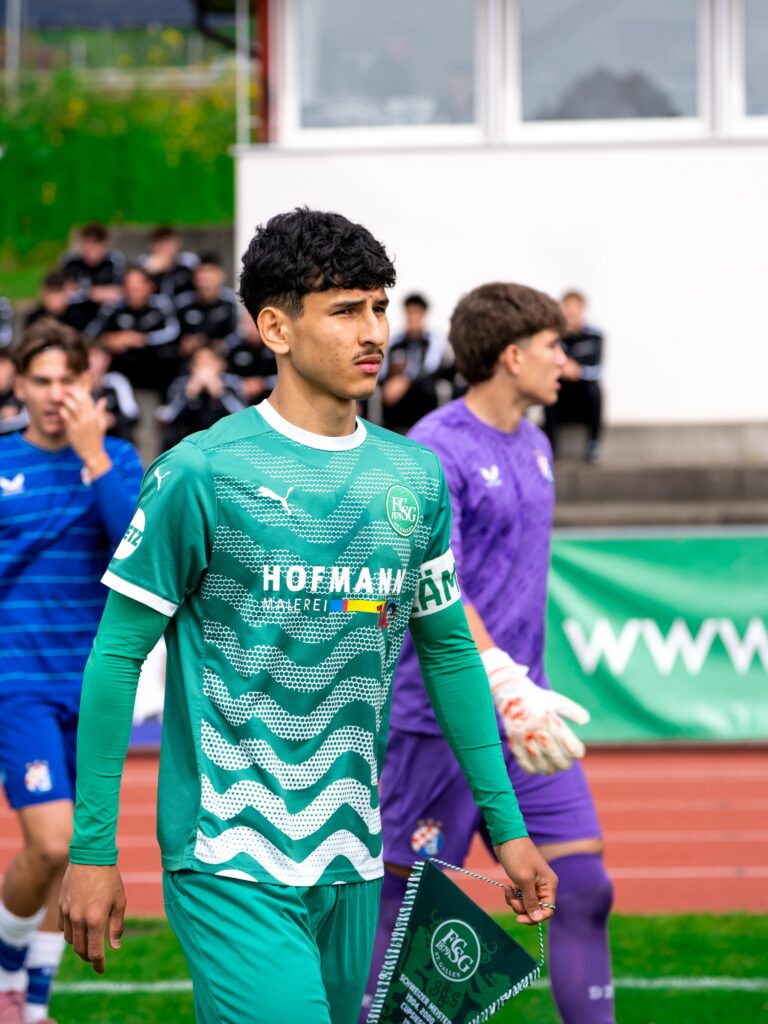
Standing at 6ft 3in (190cm) and naturally left-footed, Heydari began training with St Gallen’s first team during the summer.
His development will inevitably attract interest from Afghanistan. A young, Swiss-developed, left-footed centre-back already training with a Swiss Super League first team would represent a rare profile for the national side.
However, Heydari has yet to publicly discuss his international future and has never represented Afghanistan at any level. For now, any suggestion that he will play for the national team remains premature.
Afghanistan’s diaspora talent is reaching a new level
Players raised outside Afghanistan have formed a significant part of the national team for decades. Germany, the Netherlands, Scandinavia, Australia and other countries have long provided a large part of Afghanistan’s player pool.
The diaspora itself is therefore nothing new. What is beginning to change is the calibre and background of some of the young players emerging from it. Increasingly, Afghanistan can call upon players developed within established professional academies.
Amin Nabizada – Watford
Born in England, he spent time with Brentford before joining Watford’s academy and progressing into the first team. He made his Championship debut aged 18 against Leeds United in February 2025, playing the final 18 minutes of a 4-0 defeat.
Nabizada represented England at U18 level later that year, but switched his international allegiance and made his senior Afghanistan debut in 2026. His development at Watford has continued too, with the youngster scoring for the first team against Southampton earlier this month after an impressive solo run.
Elias Mansor – Millwall
Born in Kabul but developed almost entirely in England, he joined Millwall’s academy at the age of eight and signed his first professional contract in the summer of 2025. Just weeks later, he made his Afghanistan debut at the CAFA Nations Cup, featuring against Iran and Tajikistan.
Mansor had actively wanted to represent Afghanistan and previously spoke about making several attempts to contact the national team. His opportunity eventually arrived after establishing himself within Millwall’s system.
He remained involved in 2026 and was called up again for Afghanistan’s Asian Cup qualifiers in March.
What makes Nabizada and Mansor particularly significant is the level at which they have developed. Both have come through the systems of Championship clubs in Watford and Millwall.
Afghanistan has long drawn upon a diverse overseas player pool, including many footballers from Europe’s lower and semi-professional leagues. Now, however, a younger generation is beginning to emerge from more competitive professional academy systems.
Heydari could eventually become part of that group. St Gallen compete in Switzerland’s top flight and are involved in European competition this summer, while the 19-year-old defender has already progressed to the fringes of their first team.
A complicated backdrop
The Heydari family left Afghanistan many years ago following conflict with the Taliban. Today, the Taliban are once again in control of the country.
Despite that political backdrop, Afghanistan’s men’s national team continues to compete internationally, while the Afghanistan Football Federation remains a member of FIFA and the AFC.
The flow of diaspora players into the national team has continued too. Mansor became a regular squad member in 2025 and 2026, while Nabizada made his senior debut after previously representing England at U18 level.
For diaspora players, choosing to represent Afghanistan should not therefore be interpreted as an endorsement of the country’s current rulers. The national team can instead provide a connection to their country of origin, the same motivation that has drawn generations of Afghan players raised abroad to represent the country.
In Heydari’s case, however, that decision remains for the future. His immediate challenge is much simpler: turning his potential into a place in St Gallen’s senior team.
Captaining the U19s, training with the first team and travelling for European fixtures are all encouraging signs, but his professional career is only just beginning.
Ten years ago, Mostafa Heydari and his three brothers were given their first opportunity to play organised football regularly at a small club in Switzerland. Today, he stands within touching distance of his professional debut.
If he makes that final step, Afghanistan could have another member of an emerging generation developed within established European football systems. Alongside Mansor and Nabizada, Heydari could eventually form part of a promising young core for the national team.