
In an exclusive interview with Eurasia Football, Furkatzhon Akhmedzhanov explains why Tajikistan, Uzbekistan and Kyrgyzstan remain committed to hosting the Asian Cup, how Igor Angelovski was appointed, and where Tajik football’s next stadiums and academies will be built.
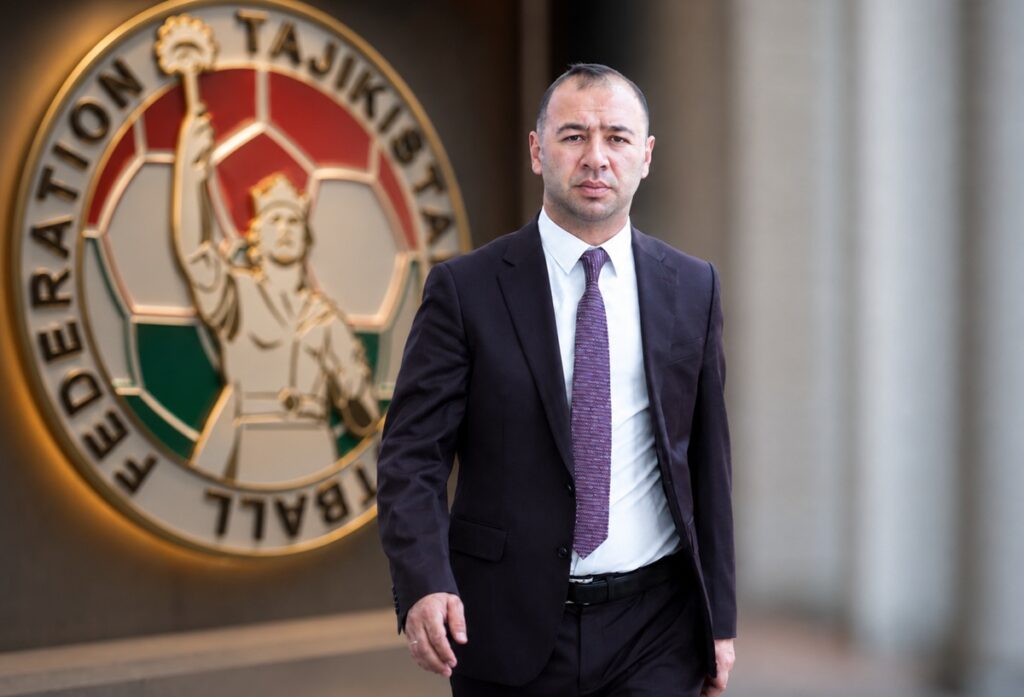
Tajikistan, Uzbekistan and Kyrgyzstan are prepared to resubmit their joint bid to host the AFC Asian Cup when the Asian Football Confederation launches a new selection process.
“The bidding process may have been discontinued, but we will submit our bid again. All the documents are ready, and the state is interested in the project,” Tajikistan Football Federation General Secretary Furkatzhon Akhmedzhanov told Eurasia Football.
The three Central Asian countries had submitted a joint bid for the 2031 tournament. In March 2026, however, the AFC discontinued the bidding processes for the 2031 and 2035 editions following discussions with FIFA over a possible move of future Asian Cups to even-numbered years.
In this extensive interview, Akhmedzhanov discusses the region’s Asian Cup ambitions, the appointment of Igor Angelovski as Tajikistan head coach, the construction of a new national stadium and the development of the Varzob Technical Centre.
He also explains why the top division will not be expanded for now, how the federation supports private football schools, and why every region of Tajikistan should eventually have its own residential academy.
Akhmedzhanov is the General Secretary of the Tajikistan Football Federation and a member of FIFA’s Stadium and Security Committee.
Varzob, regional pitches and a new national stadium
— Tajikistan is building a new stadium, while a technical centre is being developed in Varzob. What is the purpose of these projects, and how interested is the state in football development?
— Infrastructure development is one of the Tajikistan Football Federation’s main priorities. Without infrastructure, there can be no competitions and no players. That is why we are now focused on building both international-standard pitches and training facilities.
At the initiative of the federation president, we are working in this area together with FIFA, the AFC and local authorities. The state is also very interested in developing football.
Several facilities are expected to open this year. We also have a number of other strategic projects, although it is still too early to discuss them publicly.
— What will the technical centre in Varzob offer?
— The Varzob Technical Centre is currently our biggest and most important project. Two international-standard pitches have already been built there: one artificial and one hybrid. We are planning to add a third.
Eventually, the centre will have three pitches, a hotel, a swimming pool and everything required for national teams to train and hold camps. However, it will not be used exclusively by the national teams.
We also plan to establish a TFF academy there. The centre already has a gym, a sauna and conference rooms. All the main facilities are in place.
— What is the state of football infrastructure in the regions, particularly in Badakhshan and other border areas?
— We cannot yet speak about international-standard infrastructure in the regions, but we are actively building smaller pitches for children.
Together with the International Organization for Migration, we are planning to construct small pitches in Ishkashim, a border district in the Gorno-Badakhshan Autonomous Region. We are also planning another pitch in the Sughd Region.
There is also a stadium in another border district that requires renovation following the recent clashes. We want to restore it.
The main objective is to ensure that football develops not only in the capital but also in remote border areas. There are many talented children there. We do not want to lose them. We want them to play football and eventually have an opportunity to represent the national team.
— Tajikistan’s youth national teams play their matches in Hisor. Would attendance be higher if the games were held in Dushanbe?
— I agree. There would be more supporters in the capital. However, when we stage higher-profile matches, such as games involving the Olympic team, we arrange shuttle buses so that supporters can travel to the stadium and return home more easily.
We currently play in Hisor because it has the best hybrid pitch in the country. Player safety is our main priority, and artificial surfaces can pose a greater risk.
— Are there plans to replace the pitch at the Central Republican Stadium in Dushanbe?
— There is no official information at the moment. It may be easier to wait for the new stadium. The existing arena’s layout is also not entirely suitable for major international matches.
Modern stadiums usually have open space around their entrances to help manage the flow of spectators. Here, the stadium begins almost immediately after the entrance.
When a high-profile opponent comes to Dushanbe, there is a risk of overcrowding. Safety is therefore another important consideration.
— Will the new stadium become Tajikistan’s main national arena?
— Yes.
— Are smaller pitches also planned in towns and districts for children and amateur football?
— Secondary schools have football pitches, but there is currently not enough funding to renovate all of them.
We are working on a joint project with the Ministry of Education. The idea is to secure funding, renovate the pitches and then share their use: schools would use them during the day, and the federation would use them afterwards.
Regional academies and private football schools
— Pitches alone are not enough to develop players. Strong academies and football schools are also required. What are the federation’s plans in this area?
— A strong academy is essential for professional football and success at international level.
We already have a joint project with FIFA under its Talent Development Scheme. Talented children have been brought together at an academy where they study, eat, train and play football.
We also plan to establish similar centres in every region. We have started with Bokhtar, where we want to build an academy.
In the long term, every region should have its own fully professional centre where young players can live, study and train.
— How does the federation approach the education of youth coaches?
— We have a coach education system in place. Coaches complete courses and receive licences. Last year, we conducted our first licence renewal programme.
This is a very important part of our work. We intend to increase the number of technical courses in the future.
— What support can the federation provide to private investors who want to open a football school or academy?
— We always support such initiatives. We can send official letters and help resolve issues involving land and local authorities.
There was a recent case involving a private academy that was successfully operating at a stadium. We then received a letter saying that the stadium was going to be demolished and replaced by a residential building.
We prepared an official appeal, met with the regional authorities and resolved the issue.
There are now many private football schools. We are not a regulatory authority; we are a public organisation that can offer recommendations on how they should operate. Nevertheless, we monitor the training process to ensure that everything is organised properly.
One problem faced by private schools was the lack of regular competitions. Tournaments were held, but not consistently.
We therefore recently launched a Sunday League for children aged six to 12. They now have regular opportunities to play competitive matches.
The teams gather at one full-sized pitch, which we divide into four smaller areas. Four matches can then be played simultaneously. Referees, coaches and parents are all present, creating a full day of football for the children.
— Could private football schools from different countries in the Fergana Valley organise international youth tournaments involving teams from Tajikistan, Uzbekistan and Kyrgyzstan?
— We have held similar events for several years in Kayrakkum, on the shore of the reservoir.
The infrastructure there is suitable for such tournaments. It has a pleasant atmosphere and facilities for both children and their parents.
Teams from several countries, including Kazakhstan and the United States, have taken part. We plan to develop more projects of this kind, where children can play football while their parents also have an opportunity to relax.
Tajikistan’s national team and Igor Angelovski’s appointment
— Why did Goran Stevanović not continue as Tajikistan head coach?
— To be honest, we had a contract, and until the very end we were not entirely sure whether we would continue working together.
We met in his office and had a very positive conversation. He then returned home.
He simply decided that he did not want to extend his contract. To be honest, I still do not fully understand why.
There were no proposed changes to the coaching staff. The same staff members who worked with him have remained in place. Had he wanted to add anyone, we would have accommodated that request.
He later wrote to us and said that he did not want to renew the contract. We remain on good terms and are still in contact.
— So the decision was not related to finances or the team’s results?
— That is correct.
— How did the federation identify North Macedonian coach Igor Angelovski as his replacement?
— The terms were broadly similar. We were looking for a coach who could continue the work started under Goran.
Our technical director established contact with Angelovski. He is an experienced professional with extensive international connections.
The new head coach made a very positive impression on us. We also spoke with members of his staff, who are highly qualified specialists.
Why Tajikistan will not expand its top division
— Uzbekistan and Kyrgyzstan are expanding their domestic championships. Tajikistan currently has 12 teams in its top division. Are there plans to change the format of the league?
— At the moment, we are not planning to expand the league. We first want to improve the structure of every club.
Each club should have not only a senior men’s team but also a women’s team and teams in every youth age category.
It is very difficult to develop women’s football or youth football separately. A systematic approach within each club is far more effective.
— How can this model be introduced in practice?
— We want to follow an approach similar to FIFA’s by allocating funding to specific projects.
For example, a club could submit a proposal to develop women’s football. We would assess the project and provide funding.
Even if a project is designed to run for two years, the federation can help launch it. During that period, the club can formally approve the project, establish its budget and appoint the people responsible for it, allowing the work to continue independently afterwards.
— Does the federation help clubs find sponsors?
— Of course. Before every season, we discuss the situation at each club during meetings of the Executive Committee.
We help clubs look for sponsors and organise marketing seminars. Marketing is an extremely important part of a football club’s work.
Central Asia’s Asian Cup bid
— How closely does the TFF cooperate with football federations in neighbouring countries? Are there any joint projects?
— We have very close, almost brotherly relations.
CAFA plays an important role because it organises competitions throughout Central Asia.
As for joint projects, Tajikistan, Uzbekistan and Kyrgyzstan submitted a joint bid to host the AFC Asian Cup. We want to organise a major football celebration for the entire region.
— The AFC has discontinued the bidding processes for the 2031 and 2035 Asian Cups. Will the Central Asian project remain in place if a new selection process is launched?
— The bidding process may have been discontinued, but we will submit our bid again. All the materials and documents are ready, and the state is interested in the project.
— CAFA has previously discussed launching a club competition. Has there been any progress?
— There have been discussions. We also want to see more international club competitions.
They would give players who are not yet involved with the national team an opportunity to demonstrate their ability.
A national-team squad has a limited number of places, while there are many talented players. An official international competition at club level would allow them to gain that experience.
— Could a senior CAFA Nations Cup be held this year?
— It would be better to confirm the details directly with them.
Should the tournament take place, Tajikistan is ready to host it.
We want to organise as many competitions as possible in our country because they significantly increase public interest in football.
Cooperation with embassies and international organisations
— Does the federation cooperate with partners from outside the region?
— We work actively with embassies and international organisations.
We organised a girls’ tournament together with UN Women as part of the Orange Day initiative.
We have also been cooperating with the US Embassy for around ten years. One previous project enabled us to send girls to the United States.
We are now implementing a project in the opposite direction. Two former United States internationals have come to Tajikistan to take part in discussions and conduct coaching clinics.
In recent years, the Tajikistan Football Federation has expanded its international work. This includes FIFA’s Football for Schools programme, cooperation with the International Organization for Migration and the UEFA Foundation for Children on projects in border regions, work with UNICEF in women’s football and Tajikistan’s involvement in promoting World Football Day at the United Nations.