
Ahead of the 35th anniversary of independence, Uzbekistan once again found itself in the focus of international media attention. Just a few weeks earlier, major global outlets had been following the national team’s historic debut at the FIFA World Cup. By the end of August, journalists, media executives and experts from nearly 50 countries had arrived in Uzbekistan itself for the International Media Forum “Islamic Civilization: A New Perspective — New Discoveries.”
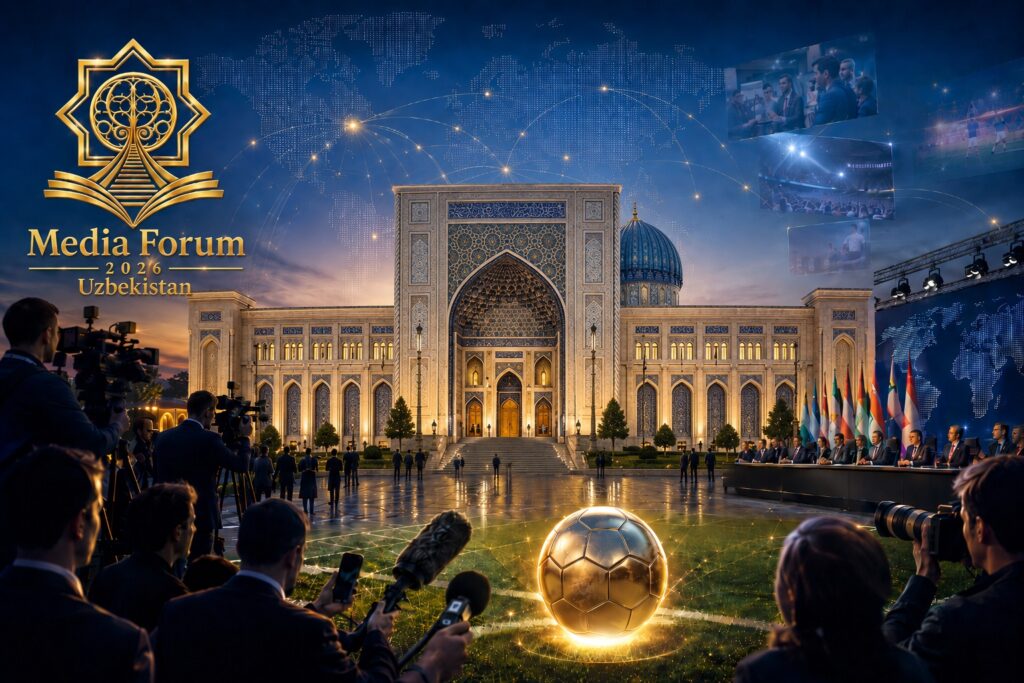
Around 300 guests explored the country’s history and contemporary life in Tashkent and Samarkand. The Center of Islamic Civilization became the forum’s main venue, while CNN and Euronews served as general media partners. Representatives of BBC Studios, TRT World, Report.az, Aju News Corporation, Musavat TV and other international media organizations also took part.
The two major stories came together naturally. Many of the same international media brands had been covering Uzbekistan’s national team only weeks earlier. Euronews produced reports on the team and on how the country was preparing for its historic World Cup debut, CNN followed Uzbekistan before and during the tournament, BBC Sport published a dedicated guide to the newcomers, while TRT World, Report.az, Aju News and Musavat covered the team’s matches.
A few weeks later, those same media brands were represented in Tashkent. Their journalists and executives were walking through the halls of the Center of Islamic Civilization, meeting Uzbek colleagues and working in Samarkand. They were now seeing firsthand the country that had recently entered the global spotlight through football.
Football remained part of the conversation. Uzbekistan’s first World Cup was discussed on the sidelines of the forum, while the sporting achievements of modern Uzbekistan also found their place in the Center’s broader presentation of the country.
Only weeks earlier, they were covering the World Cup
For Uzbekistan, the World Cup became one of the country’s biggest international media moments in recent years. The national team’s first appearance at the tournament placed Uzbek football on the world’s biggest sporting stage and kept the country’s name in the global football news cycle for weeks.
Euronews provided one of the clearest examples. Before the tournament, it published an extensive interview with head coach Fabio Cannavaro. Ahead of Uzbekistan’s opening match, the broadcaster also reported on the atmosphere across the country as people prepared to watch their national team play at a World Cup for the first time.
CNN followed Uzbekistan around the tournament, while BBC Sport introduced the debutants to its audience in a dedicated feature. TRT World covered the team’s campaign, as did Report.az, South Korea’s Aju News and Azerbaijan’s Musavat.
The sequence was striking. International audiences first encountered Uzbekistan through the football pitch. Weeks later, representatives of those media organizations arrived in the country and discovered a much broader story — its history, cities, people, culture and ambitions.
This is one of football’s most valuable qualities for a country seeking greater international visibility. A World Cup match requires almost no introduction. Millions of viewers see the name, the flag and the team at once. Curiosity can begin with 90 minutes of football and continue long after the final whistle.
Football as part of a country’s shared memory
Football in Uzbekistan has long meant more than results. It is packed stadiums, generations of supporters, neighborhood pitches, family memories and matches experienced collectively across the country.
The first World Cup has already become part of that shared memory. Players and coaches will change, new tournaments will follow, but the summer of 2026 will always remain the moment Uzbekistan first appeared at football’s biggest event.
That idea also fits naturally into the concept of the Center of Islamic Civilization.
Its exhibitions take visitors through a vast historical landscape — great scholars and thinkers, manuscripts, scientific achievements, architecture, art and different periods in the development of the region — before reaching present-day Uzbekistan. The section devoted to the New Uzbekistan also reflects the country’s recent achievements, including sport and the historic qualification for the World Cup.
Cultural heritage continues to grow with each generation. For millions of people, Uzbekistan’s first World Cup is already connected to personal memories: where they watched the games, who they watched them with and what they felt when the team finally stepped onto the world stage.
Football gives those memories an international dimension. A supporter in Europe, Asia or the Middle East may know little about Central Asian history, yet a World Cup match can provide an immediate introduction to Uzbekistan. From there, interest can move toward Samarkand, Bukhara, Tashkent, the country’s history and its contemporary life.
Seeing the country firsthand
The International Media Forum followed a similarly simple idea: invite international journalists to Uzbekistan and let them see the country for themselves.
In Tashkent, participants explored the Center of Islamic Civilization, its collections, manuscripts, research projects and digital technologies. They met Uzbek journalists, experts and students. The program later continued in Samarkand, where guests visited historic sites, including the renovated Imam Bukhari complex, conducted interviews and gathered material for their own outlets.
That direct experience gives such events their value. A journalist arrives with a certain image of a country and leaves with personal impressions, contacts, photographs, video and ideas for future stories.
The involvement of CNN and Euronews gave the forum particular international weight. Both became general media partners, while their representatives took part in the program and discussions on future cooperation. Euronews General and Editorial Director Klaus Strunz also proposed making the forum an annual event.
For a football publication, the connection is especially revealing. Only weeks earlier, CNN and Euronews had been introducing international audiences to footballing Uzbekistan. Now their representatives were in Tashkent as part of a much wider conversation about the country.
The football story had opened one door. The forum offered many more.
A broader picture of the New Uzbekistan
Uzbekistan has become increasingly visible internationally in recent years. The country hosts major events, develops new cultural and tourism projects, expands cooperation with international organizations and media, and welcomes more foreign journalists and visitors.
The World Cup added another powerful element to that process.
For an international audience, the image of a country is built gradually. Someone may first notice Uzbekistan during a football match. The next encounter may come through Samarkand or Bukhara, a report on the Center of Islamic Civilization, the legacy of Al-Khwarizmi or Imam Bukhari, a story from modern Tashkent, or another major international event.
Each encounter adds something new.
That is why football felt entirely at home within the broader conversation at the media forum. Participants had come to discuss Uzbekistan’s history, culture and the ways those stories can be presented to the world. Many of them had been watching one of the most important chapters in the country’s recent history only weeks earlier — its first World Cup.
Now they were seeing the country behind the team.
Ahead of the 35th anniversary of independence, the forum became another opportunity to present the New Uzbekistan to a global audience: a country with a deep historical legacy, growing international ambitions and a stronger presence on the world stage.
The World Cup brought millions of new eyes to Uzbekistan.
The media forum gave international journalists a reason to keep looking.
Now they have much more to tell.