
The new AFC club season has not started yet, but Kyrgyzstan already has a storyline.
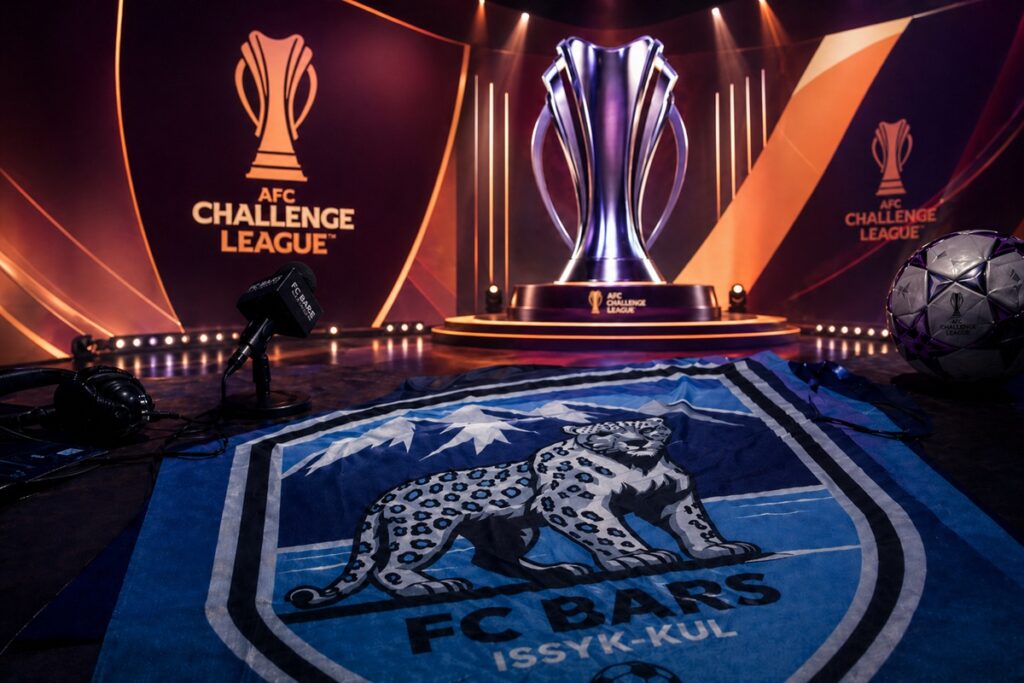
After Muras United reached the semi-finals of the AFC Challenge League, expectations around Kyrgyz clubs on the continental stage have grown. The country’s next representative should now be Bars from Karakol — the new Kyrgyz Zhogorku League champion, a club that went from a newly launched project to a national title in just one season. But its possible participation in the 2026/27 AFC Challenge League may depend not only on results on the pitch, but also on regulations.
This is not only a football story. In Kyrgyzstan, the game has become one of the most visible public projects of recent years. President Sadyr Japarov regularly appears at football events, has attended national team matches and even plays in the traditional Muras tournament himself. Kamchybek Tashiev, one of the country’s most powerful political figures, has also publicly promised that Kyrgyzstan would become a “football country”.
That is why Bars is not seen only as a sporting newcomer. The Karakol club is widely viewed through a presidential lens: supporters associate it with Japarov, while Karakol represents the Issyk-Kul region closely linked to the president. Japarov was born in the village of Ken-Suu in the Tyup district of Issyk-Kul region, according to his official biography.
The comparison with Turkmenistan’s Arkadag is therefore difficult to avoid. Arkadag was also a new club with an obvious political dimension: connected to the city of Arkadag and the figure of Gurbanguly Berdimuhamedov, it quickly entered the elite, won the Turkmen championship, was admitted to AFC competitions and later won the AFC Challenge League.
The question now is whether Bars can follow a similar route. The club has a sporting basis to claim Kyrgyzstan’s place in the 2026/27 AFC Challenge League. But a domestic title alone is not enough. Bars must pass AFC licensing, where the key issue may be the two-year rule.
A fast project in a football-obsessed political environment
The first reports that Kyrgyzstan would receive four new clubs, including Bars, appeared in late 2024. The Karakol team was built quickly. Well-known futsal specialist Kanymet Aralbaev and former Kyrgyzstan national team head coach Aleksandr Krestinin were involved in the project.
Within a few months, Bars assembled a competitive squad. Several prominent Kyrgyz footballers joined the club, including Valery Kichin, Mirlan Murzaev, Magomed Uzdenov, Farkhad Musabekov, Kairat Zhyrgalbek uulu and others. Krestinin left the team in the spring, after which Aralbaev effectively took charge and eventually led Bars to the title.
There was also an internal Kyrgyz football subplot. Bars finished ahead of Muras United — the club that had carried Kyrgyz hopes in the previous AFC Challenge League campaign and reached the semi-finals. That made Bars’ title not only a rapid domestic success, but also a symbolic change at the top of Kyrgyz football.
This is where the parallel with Arkadag becomes especially clear. In Turkmenistan, the new club was not simply a football team either. It was perceived as a political and administrative showcase: a new city, a new club, personal involvement from Berdimuhamedov, a strong squad, a winning streak and an image of immediate dominance.
The situation with Bars is not identical. But the logic is similar: a new club, strong political background, rapid squad-building, instant domestic success — and now the question of how such a project will pass international admission.
What is the AFC problem?
From a sporting point of view, the logic is simple: the national champion should be the main candidate for Kyrgyzstan’s place in an AFC club competition.
According to the published slot allocation for the 2026/27 season, Kyrgyzstan currently has one place in the AFC Challenge League. It is not a direct group-stage place, but an indirect slot, meaning a route through the preliminary stage. The allocation still has to be approved by the AFC Executive Committee.
But in the case of Bars, the sporting result runs into a legal issue: the AFC club licensing two-year rule.
Under Article 12 of the AFC Club Licensing Regulations, the licence applicant must be a legal entity fully responsible for the football team participating in national and international competitions. It may be either a registered member of the national association or a football company with a contractual relationship with such a member.
At the start of the licence season, that membership or contractual relationship must have lasted for at least two consecutive years. In addition, the applicant must have participated in official national competitions for at least two consecutive seasons.
If this rule is read literally, Bars has a problem. The club appeared in late 2024 and won the Kyrgyz championship in its first season. As a new football brand, it does not seem to have enough time to complete the classic two-year path before the 2026/27 season.
However, the AFC regulation is not simply about the age of a club’s name. The key concept is the licence applicant — and that distinction matters.
The question is not only when the name Bars appeared. The question is which legal entity will be presented in the licensing process, when it became connected to the Kyrgyz Football Union, whether it participated in official competitions and what documents will be submitted to the AFC.
In theory, the club could pass this filter through legal continuity. For example, if the new project is backed by a structure that existed earlier, was already part of Kyrgyzstan’s football system, participated in official competitions or had a contractual relationship with a registered member of the association. In such a case, the AFC may assess not only the public launch date of the team, but also the history of the applicant itself.
But this does not mean that any new club can simply be “repackaged” under an older legal entity. The same Article 12 includes an important restriction: changes to legal form, structure, name, colours, headquarters or the transfer of football activity to another entity, if made to obtain a licence or sporting qualification, may be considered an interruption of the two-year period. In other words, a formal scheme created only to gain access to the tournament should not automatically solve the problem.
There is also another procedural mechanism — an extraordinary application. Article 15 of the AFC regulations allows a national licensor to apply to the AFC if a club has obtained the sporting right to participate in a competition but has not gone through the standard licensing process, or has gone through a lower-level process. In that case, the AFC may take a separate decision for a specific club and a specific season. The final decision remains with the AFC body responsible for club admission control.
Why the Arkadag example matters
The Arkadag case matters for Bars not as a ready-made legal instruction, but as an administrative precedent.
The Turkmen club emerged as a new project, quickly entered the top division, won the national championship and appeared in AFC competitions. Yet no public explanation has been given as to how exactly Arkadag passed the two-year rule. There is no published AFC decision explaining whether legal continuity was accepted, whether an extraordinary application was used, or whether another argument was approved.
The choice of international route is also notable. For the 2024/25 season, Turkmenistan had two AFC club competition places: one in AFC Champions League Two through the preliminary stage and one in the AFC Challenge League. Arkadag, despite being Turkmen champion, ended up in the Challenge League — although as champion it looked like a natural candidate for the higher-tier competition.
No official explanation of that allocation was published. Therefore, this can only be discussed as an interpretation: the AFC Challenge League looked like a more convenient international route for Arkadag. It was a weaker tournament than AFC Champions League Two and therefore offered a better chance to preserve the image of a dominant project.
The first AFC campaign also showed that outside the Turkmen domestic system, Arkadag was no longer invulnerable. In the AFC Challenge League, the club lost to Kuwait’s Al-Arabi in the group stage and then lost to the same opponent in the first leg of the semi-final. But Arkadag still reached the final and won the tournament.
That is why the example matters for Kyrgyzstan. It shows that a new Central Asian club project can be admitted to an AFC tournament faster than a literal reading of the two-year rule might suggest. But the exact mechanism has not been publicly disclosed.
What options does Bars have?
There are several possible scenarios for Bars.
The first is standard licensing. In this case, the club must be presented as an applicant that meets Article 12: the required connection to the national association and two seasons of official participation. For a new project, this is the most difficult route unless there is convincing legal continuity.
The second is registration through an existing structure. If Bars has a legal applicant that existed before the public launch of the team and was already inside Kyrgyzstan’s football system, that could become a basis for passing the two-year filter. But the decisive documents would be: who exactly the applicant is, when it was registered, when it entered the Kyrgyz Football Union system and which competitions are counted.
The third is an extraordinary application. This does not cancel the regulation, but it leaves room for a separate AFC decision. If the club has a sporting basis as national champion, but its regular licensing raises questions, the national licensor may try to submit the case through this special procedure. The final outcome would still depend on whether the AFC accepts the argument.
Institutional backing does not formally replace AFC regulations. Its role is different: helping assemble a legal and licensing structure, take it through the national licensing body and make it acceptable to the confederation. In the case of Arkadag, this appears to have been the key point: not a public cancellation of the rules, but a structure that the AFC accepted. For Bars, the question will be the same — whether the Kyrgyz Football Union can present a construction the AFC considers valid.
Who plays if Bars does not pass?
There is another important layer: slot allocation.
For now, Kyrgyzstan has one indirect slot in the 2026/27 AFC Challenge League. If this allocation does not change, the main candidate should be the national champion — Bars. But if the AFC does not admit the club because of licensing or the two-year rule, the place does not necessarily disappear automatically.
In that case, the Kyrgyz Football Union would have to decide whom to nominate instead of the champion: the Kyrgyz Cup winner Dordoi or another club that meets AFC requirements. Dordoi won the Kyrgyz Cup in 2025, so it looks like a natural replacement candidate if the champion does not pass admission.
A wider scenario is also possible. In the 2025/26 season, Kyrgyzstan received two indirect AFC Challenge League places. This happened because of slot redistribution: some places were not used by other associations, and additional indirect slots were transferred to several countries, including Kyrgyzstan. As a result, Kyrgyzstan was represented by Abdysh-Ata and Muras United.
If a similar situation happens again in 2026/27, Kyrgyzstan could theoretically receive a second slot. In that case, both Bars and Dordoi could enter the Challenge League, with Dordoi as cup winner. If Bars does not pass admission, Muras United could also be among the possible candidates — provided the club remains licensing-ready and meets AFC criteria.
But it is important not to jump ahead. At the moment, Kyrgyzstan officially has one indirect slot in the published 2026/27 allocation. Additional places appear not by the federation’s wish, but only through withdrawals, licensing failures or AFC redistribution. So a two-club Kyrgyz scenario is possible, but not guaranteed.
Bottom line
Bars has already won the championship and gained a sporting basis to aim for an international tournament. But for the AFC, that is not enough. The club must pass licensing, close the two-year rule issue and prove that its applicant meets confederation requirements.
So it is too early to say that Bars will definitely play in the AFC Challenge League. But it is also wrong to say that the Kyrgyz champion automatically has no right to participate. The regulation leaves room for legal interpretation, a special decision and slot redistribution.
Arkadag showed that a new club with political weight can move quickly from creation to an international trophy. Bars is still at the first stage of that route. It has already won the championship. Now comes the second part of the story — licensing. And that will show whether the Karakol club can become the new Arkadag for the AFC.