
Neftchi Academy’s Latvian technical director on Fergana’s new youth project, coach education and Central Asia’s growing football potential.
Last season, Neftchi Fergana ended a 24-year wait to become champions of Uzbekistan. This season, the club has remained among the main talking points of the Uzbek Super League — and in Fergana, attention is now turning to the next stage of the project: the club’s own academy.
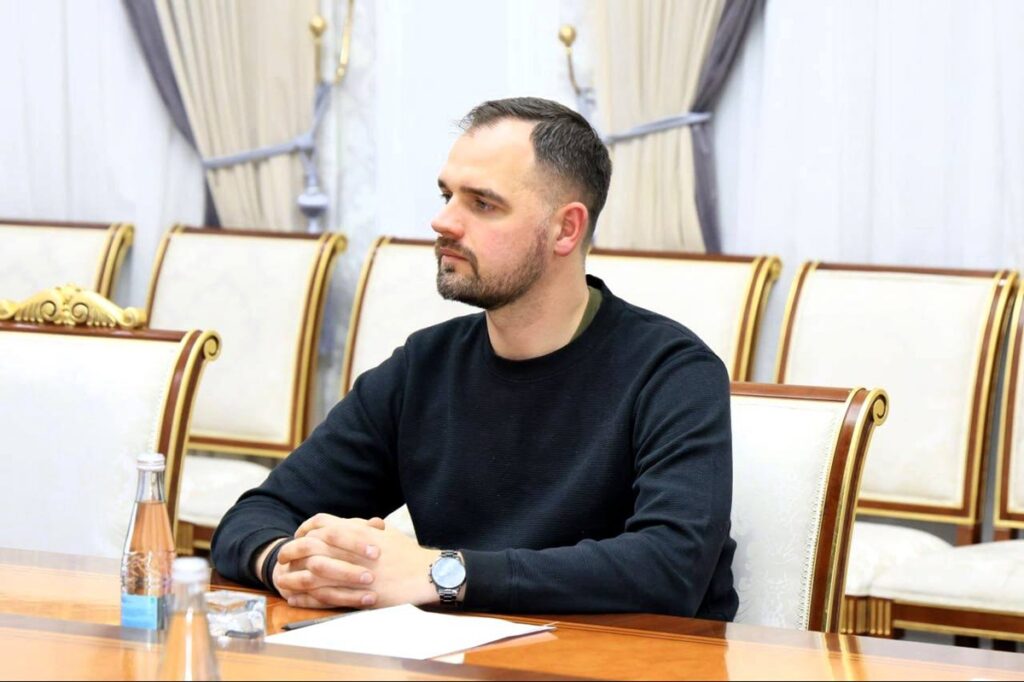
As part of its Central Asia expedition, Eurasia Football visited Neftchi’s new academy and spoke to its technical director, Latvian specialist Edgars Klenausks, about his move to Uzbekistan, the role of Ihor Khimich, his links with Kyrgyz football, the development of young players in Fergana, and why Uzbekistan may be able to make better use of its World Cup moment than Latvia did after EURO 2004.
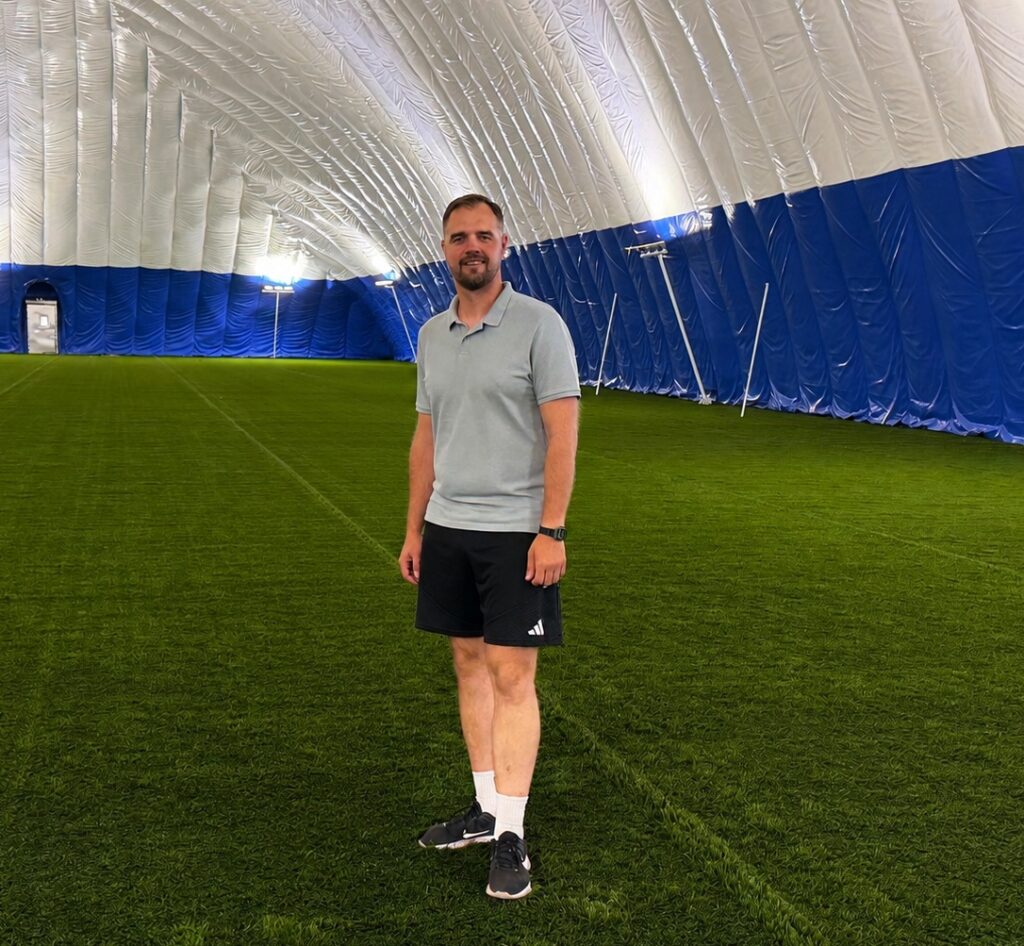
Neftchi’s new academy complex was officially opened in 2025. It covers more than 4.5 hectares and is designed for more than 150 young players. The complex includes full-size and small-sided pitches, a physiotherapy department, and an indoor football arena with artificial turf. The academy also has accommodation, catering facilities, a sauna and a swimming pool.
It is already being positioned as one of the most ambitious youth development projects in Uzbek and Central Asian football.
— Edgars, how did you end up in Fergana?
— I came here at the invitation of Ukrainian specialist Ihor Khimich, who is now the director of our academy. We met while working in Latvia, at FC Jelgava. At the time, we had a Ukrainian coach, Anatoliy Sydenko, who had studied under Khimich. That created an opportunity to invite him to our club for three or four months.
At first, his work was mainly connected with the first team: planning, the weekly cycle, and the organisation of the training process. He was also an experienced voice for our coaching staff. The head coach was experienced, but there were many young local specialists around him, including myself. For us, that was very useful.
He also helped with the academy. The youth club was quite large — around 600 children — so it was a very good experience.
When Khimich was invited to Fergana, we started discussing whether I would also be interested in trying something new. I wanted to change my daily routine, my environment and my culture, and to gain experience in another country.
The region itself also looks very promising to me. There is a much larger youth base here, many children play football, and the talent pool is wider than in Latvia. That is now a major issue for us: fewer children are being born every year, and football is one of the first sports to feel it. We have fewer players to choose from.
In Uzbekistan, I see great potential. The national team has qualified for the World Cup, which is also a very good signal. Earlier, my first coach from Jelgava, Dainis Kazakevics, was appointed technical director in Kyrgyz football. So I think Central Asia is becoming an interesting destination for specialists from our part of Europe. You can gain new experience here and also share your knowledge.
— Did you speak with Kazakevics before moving?
— Yes, I called him. He was my first coach. I trained at the club he created. Later, I became academy director and sporting director at that same club. I also worked for a period at the federation.
So I called him for advice — as a manager, as a teacher, as a football person. Not because I expected him to tell me whether to go or not. The decision still had to be mine. But I trust his opinion.
I told him what I was thinking and asked how he viewed the opportunity — what the arguments were for and against it. After that, I decided to try.
— Did you visit Uzbekistan before making the final decision?
— No, there was no trial visit, although I did want to come in advance. But what I liked was that from October onwards we were constantly in contact with Khimich. Every week we had two or three calls. He told me what was happening here, and we discussed different issues.
So when I arrived on January 16, I already had a certain understanding of what was going on in Fergana.
What I had heard from Khimich matched what I saw myself: there is a real desire here to develop football. As I understand it, Neftchi did not previously have its own academy in this form. There was a city academy, but not a school directly attached to the club. Now there is a desire to develop one. I find that both interesting and right.
In Europe, the bigger football countries went through this process 10 or 15 years ago. In Latvia, Dainis Kazakevics was also involved in building an academy system. Even in a small country like ours, you can see how important that step is. Once a system appears, it gives the whole football ecosystem more stability.
The club becomes more sustainable. If needed, it has a base of its own graduates who can play for the first team or in Latvia’s top division.
— What impressed you most about Uzbekistan from a football point of view?
— There is a large youth base here, and football is clearly the country’s number one sport. Everyone wants to be involved in football, everyone wants to try. That is a very important factor.
You always want to work in an environment where children want to become footballers, where they are ready to come, to try, and to sacrifice something for football.
I often said the same thing when I worked in academies before: we want to get something from football, but to do that we have to sacrifice something. It is not only about money. It is about lifestyle, discipline and daily habits. Everyone looks at Cristiano Ronaldo — the way he looks after himself, trains and makes choices. Young players have to understand that football also demands sacrifice.
Sometimes a footballer has to sacrifice time with friends and family. Sometimes he cannot attend a relative’s birthday because he has a match. If you want to get something from football, you must be ready to give something to it.
— You mentioned the level of interest in football in Uzbekistan. How much of that is connected to the national team qualifying for the World Cup? Can you compare it with Latvia in 2004, when Aleksandrs Starkovs took the national team to the EURO?
— I think World Cup qualification is a very serious factor and it increases interest even more.
In Latvia, I was not yet working at a club as a coach or executive at that time, but I remember very well that after the national team qualified for EURO 2004, there was also a surge of interest. If you compare attendances in the Latvian league, after that success some matches attracted five or six thousand spectators. Everyone’s interest in football increased.
But in my opinion, we did not fully use that moment. I do not want to criticise anyone, but we could have approached it better and gained more significant benefits from the national team’s qualification for the EURO.
— In Uzbekistan, do you think this potential can be used better?
— I think the potential here is greater. It is still difficult for me to say exactly what will improve, because I have only been here for three months. But I see great interest both in the city and across the country.
I think the outcome here could be better because the level of interest in football is higher. In Latvia, football is probably also the most popular sport in terms of the number of children playing it. But we also have basketball and ice hockey, which are very attractive both for spectators and for children.
Uzbekistan also has other sports, for example wrestling. But my feeling is that football has a special place here. It is something more historical and broader. I see that in training sessions, in the work with coaches and teams, in the children’s desire, and in the way they are ready to absorb information.
— If you compare Latvian and Uzbek children, are there noticeable differences in physique, mentality or attitude to football?
— In general, children are children. Of course, their interests can differ. In Latvia, I think there are already more problems with phones, computers and other things that are not connected to football. Here those things exist too, but from what I have seen so far, they are much less of an issue.
In terms of physique, Uzbek boys are perhaps a little smaller. In Latvia, players are generally taller. But I would not say that this is either a plus or a minus. You have to look at the football context.
Everyone has their own strengths. Uzbekistan, for me at the moment, is associated with players who may be smaller, but are more technical and more inclined towards non-standard decisions.
If you compare them with an average player from Latvia, we are probably more disciplined and more structured. But perhaps we lose something in terms of creativity. Here I see creativity as a quality that can be used.
At the same time, the level of organisation, desire and discipline here is also good. The boys have a strong desire. In my work and on the pitch, I see that they are ready, they trust the coaches and the management, and they are ready to do what is required of them.
Now the question is for us, the specialists: what do we give them, what do we ask from them, how do we evaluate what they do well or badly, and how do we help them correct mistakes?
— After three months, what have you managed to change? What did you notice immediately? What needs to be improved first?
— I work as a technical director, and one of my main goals is to work with coaches. I think this is a difficult area in many countries — not only here, not only in our region, and not only in Europe.
We often say that a club wants to develop a national team player, a player for one of the top five European leagues, or a Ballon d’Or winner. Most football specialists would say that.
But in my opinion, to develop a national team player or a Ballon d’Or winner, you need strong staff. The development of national-team-level players must go in parallel with the development of coaching and support staff at the same level. It cannot work any other way.
That is why coaching methodology, the organisation of the training process, preparation for training, analysis before and after the session, and understanding what worked and what did not work are all important for me.
This is the area I am interested in developing. I would like us, in two, three or five years, to have specialists who will work here in Fergana, some perhaps in the first team, some perhaps in Uzbekistan’s youth national teams, or even in the senior national team as assistants or coaches. For me, that would be a very important result.
— Is your approach similar to what Dainis Kazakevics is now building in Kyrgyzstan?
— To be honest, I have not studied his methodology in detail yet. After I arrived, Khimich proposed his own version. We are working with it now and trying to develop it further, to add new elements.
I started in January, so not much time has passed, but some information has already been collected. Now we are trying to prepare a methodology that is better suited to our conditions.
— Barcelona Academy technical director Alex Roca told me that not all local coaches immediately accepted the new methods. Rafael Muslimov, who came through the Spartak school, said he had to completely rebuild himself. Is the situation similar here with the coaches?
— Of course, there are many discussions. Coaches ask questions. Sometimes I help, sometimes Khimich explains his system. It is clear that they have to work differently.
But I would not say that anyone here needs to be broken. In my opinion, there is no single perfect methodology. Everything depends on the coach: his understanding of football, his vision of the game, his idea of the player, and his understanding of the players’ capabilities.
It is important to develop a strong, educated coach with a broad outlook. He must be able to find solutions in a specific situation, not just blindly follow a methodology.
We have a framework for the weekly cycle, with many details written down. But Khimich and I say that we do not want to reduce the coach’s work to simply following points A, B, C and D. In his own way, a coach is an artist.
We understand where we want to go, but the path can be slightly different. For example, if we want to develop speed, that does not mean it can only be developed with one specific exercise. The exercise can be different, but it must be methodologically correct and must serve the task.
For us, the most important thing is that the coach does not just blindly follow what is written, but thinks, develops and proposes his own ideas.
— What are the main ideas you have brought? What, in your view, was most important to change? For example, at the Barcelona Academy, the focus is on the ball, small spaces and interaction in tight areas, while full 11-a-side games are not used very often. Do you have something equally fundamental?
— It is difficult for me to single out one specific element. Probably the main thing is the systematic nature of learning. Football, like everything in life, requires education.
In what I have seen before, and in what I sometimes see in other teams, there is often a lack of learning and understanding. We may know the basic things, but we do not always understand why they are needed. Or we understand what needs to be done, but not why in that specific situation.
At the first coaches’ meeting, when we had just met, I said that my task was not to come in and say that everything was bad, that I was good, and that everyone should only listen to me. My task is to create communication between us, the coaching staff and the management.
It is important that we discuss football. We should not simply take an exercise out of context. We have to understand it: why this exercise, why on this day, why in this situation.
If there is no such understanding, training becomes just a set of exercises that are not connected to each other.
— How many children are currently at the academy, what age groups are there, and how are training, accommodation and meals organised?
— I probably will not speak about exact financial figures. At the moment, only the A groups have been launched. The oldest group is the 2010 age group, followed by 2011, 2012, 2013, 2014, 2015 and 2016. So there are seven age groups.
There is also the U19 team, which is considered part of the academy. These players live on the academy site and are part of our structure. The total capacity is around 140, or roughly 150, places for boys who live and eat here.
There is now a desire and an understanding that we need to launch the B-group project. But as you can see, the pitches are still being built. The infrastructure is already good, but there are conditions that still limit us. We are not yet using the natural grass pitches. They have only recently been seeded and look good, but we want the root system to become stronger. Most likely, we will start using them only in the autumn.
Our indoor pitch is also being prepared. I think it will be ready very soon, and then we will be able to move there. For now, we still have a small artificial pitch and a small sand-based artificial pitch. This is also a factor that slightly delays the launch of the second groups. But in any case, they will appear in the near future.
— Will players from the B groups be able to move up to the A groups?
— Yes, that is exactly the idea. Players from the B groups will be able to compete for promotion. We have discussed holding testing twice a year. We need to understand who is better, who is behind, and then rotate players between the groups.
We can make mistakes too. We also said this at the parents’ meetings. There is always a chance that a talented footballer was missed during selection for some reason. Maybe it was not his day, or maybe he simply did not catch anyone’s eye.
But potentially, this could be a player who in six months or a year is close to the first team. So there must be a system that allows such boys to enter the B group and then compete for a place in the A group.
The important thing is to keep the pathway open. If a boy has potential, the system must give him another chance.