
The Uzbekistan defender has revealed why he chose Lugano over a route through City Football Group, recalled the injury that nearly cost him the World Cup and defended Fabio Cannavaro after criticism of the national team coach.
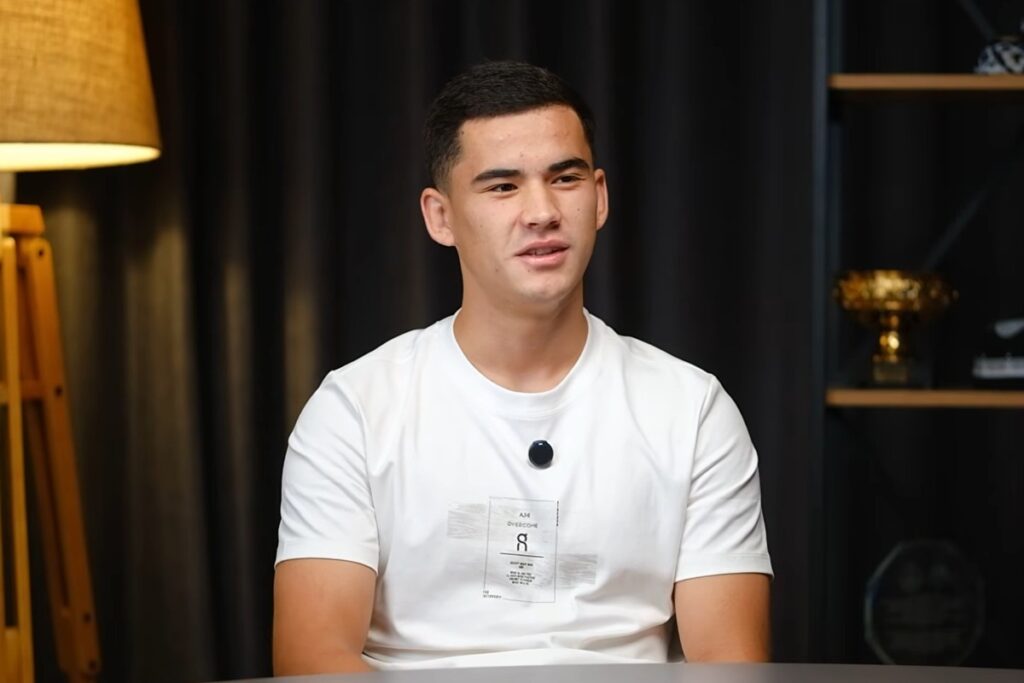
Uzbekistan defender Behruz Karimov has opened up about the most important months of his young career, from suffering a fracture shortly before the World Cup to earning Fabio Cannavaro’s trust and then choosing Swiss side Lugano for the first European move of his career.
In a wide-ranging interview with Championat.asia, the 19-year-old revealed that one proposed City Football Group pathway would have seen him continue his development with Belgian side Lommel or French club Troyes.
Karimov, however, says he deliberately avoided choosing the biggest name available. His main concern was playing time and where the move could take his career over the next two years.
That approach was strongly influenced by his father, who still works in construction in Kazakhstan and repeatedly told his son not to chase immediate money.
“I cried, but I didn’t show anyone”
Only weeks before the World Cup, Karimov’s participation in the tournament was in serious doubt.
He suffered a foot fracture while playing for Surkhon in April. The injury happened without contact with an opponent: Karimov landed awkwardly and immediately felt pain.
At first, he did not realise how serious the problem was.
He continued playing for around two more minutes, believing he had simply twisted his foot or suffered a heavy knock. The pain, however, kept increasing.
Tests later confirmed a fracture.
Karimov’s agent had previously spoken publicly about the injury, surgery and accelerated rehabilitation programme. In the interview, however, the defender described the emotional impact of hearing the diagnosis with the World Cup approaching.
“It was very difficult. I cried, but I didn’t show anyone. I switched off my phone,” Karimov recalled.
After consultations with doctors, surgery was chosen as the best option.
From that point, Karimov says, almost everything in his life was directed towards one objective: recovering quickly enough to make the World Cup.
Within days of the operation he had begun rehabilitation work. He followed a strict routine, paying close attention to treatment, nutrition, medication and every part of his recovery programme.
There was still no guarantee he would be ready.
Even after rejoining the national team, Uzbekistan’s coaching staff were careful with him in warm-up matches because they did not want to risk another injury.
Cannavaro nevertheless kept faith with the teenager.
Karimov eventually started against Colombia at the World Cup and completed the full 90 minutes, even coming close to scoring a spectacular long-range goal when his shot struck the crossbar.
His greatest concern before the match was not the reputation of the opposition but his own physical condition.
After such a long period without competitive football, Karimov was unsure whether he could last the entire game.
He did.
Karimov later described completing those 90 minutes and feeling physically strong at the end as one of the moments that convinced him the injury was finally behind him.
He then started again against Portugal.
Karimov backs Cannavaro
Karimov also defended Uzbekistan head coach Fabio Cannavaro following criticism of the Italian after the national team’s World Cup campaign.
He described Cannavaro positively both as a coach and as a person, praising his training sessions, pre-match talks and ability to make changes during games.
Karimov was particularly critical of how quickly public opinion shifted.
Before the World Cup, he said, Cannavaro had been widely praised. Once Uzbekistan suffered disappointing results, the tone changed almost immediately.
Karimov believes that assessment ignores an important factor: many Uzbekistan players had rarely, if ever, faced opposition of that level.
For him, matches against some of world football’s strongest teams were not only about the scoreline but also about gaining experience that Uzbekistan had previously lacked.
He expects that experience to become valuable at the next Asian Cup and in the national team’s attempt to qualify for another World Cup.
Cannavaro’s trust also had personal significance for Karimov. The Italian was willing to start an inexperienced teenager at the World Cup shortly after a serious injury, at a point when Karimov himself still had doubts over whether his body was ready for 90 minutes.
“You think about football. I’ll work”
That willingness to take the longer view is also central to how Karimov describes his transfer decisions.
His father still works in construction in Kazakhstan, while his mother is a teacher.
Even as Karimov began receiving lucrative offers, his father continued to tell him not to make decisions based primarily on money.
Karimov recalled the message in simple terms: his father would continue working, while his son should concentrate on football and on building the strongest possible career.
The reasoning was that there would be time to earn more later if Karimov developed properly now.
It is a striking detail given how quickly his career has progressed.
Karimov is already a senior Uzbekistan international, has played at a World Cup and has now moved to Europe. Yet his father has continued working abroad rather than treating his son’s early success as financial security for the family.
When the interviewer asked Karimov when he had last told his father that he loved him, the defender admitted that he found it difficult to say such things face to face.
He then addressed his father directly through the camera, thanking him for years of support and recalling the first football boots he had bought him as a child.
Karimov said he now hopes the roles can gradually be reversed: after years in which his father provided everything possible for his football career, he wants to be able to give something back.
The City Football Group option
Karimov says he received numerous offers following the World Cup.
Among them was a proposed pathway through City Football Group, the multi-club network whose flagship team is Manchester City.
According to Karimov, the plan could have involved continuing his development with Belgian side Lommel or French club Troyes.
For a young player from Uzbekistan, the City Football Group name alone would have been attractive.
Karimov, however, says he and his representatives deliberately avoided rushing.
His main question was not where he could sign immediately, but where he might be in two years.
He did not want to join a larger structure, spend an extended period on the bench or lose valuable playing time simply because the organisation around him had a bigger name.
At one stage, his decision effectively came down to the City Football Group pathway and a move to Switzerland.
Karimov chose Lugano.
Why Lugano?
The Swiss league appealed to him for several reasons.
He liked the tactical level of the competition, the opportunities available to younger players and the fact that Lugano compete in European tournaments.
Most importantly, he believes there is a realistic pathway to playing time.
That does not mean he expects a guaranteed place in the starting XI.
Karimov repeatedly stressed that he is comfortable with competition.
If another player beats him to the position, he says, then he must accept it and improve.
What matters to him is that the competition is genuine and that performances can change a player’s position within the team.
That distinction appears to have been decisive.
Karimov wanted his first move to Europe to be somewhere he could fight for minutes, make mistakes, develop and play — rather than simply attach his name to a more prestigious football structure.
His decision therefore reflects exactly the advice he says he has received from his father: do not chase the biggest money available today if a different move can create a stronger career tomorrow.
From centre-back to right-back
Karimov’s career has already been shaped by another decision that initially took him away from the obvious path.
He began as a central defender.
His coaches later moved him to the right side of defence, a switch Karimov now views as crucial to his development.
On the flank, his speed, willingness to attack and powerful shooting could be used much more effectively.
He gradually began working more specifically on the attacking side of his game and eventually established himself as a right-back.
Karimov credits his long-range shooting to repetition rather than natural talent alone.
As a child, he would remain on the pitch after training and repeatedly strike the ball at goal, collecting it himself and starting again.
That work almost produced one of Uzbekistan’s most memorable World Cup goals.
Against Colombia, Karimov struck the crossbar from distance.
The moment reminded him of Benjamin Pavard, whose spectacular goal for France he had watched as a child.
Karimov says he used to wonder whether he might one day score a similar goal on the biggest stage.
When the opportunity arrived at the World Cup, he did not hesitate.
The ball stayed out.
Karimov admits that watching the chance back still hurts a little.
But his conclusion is straightforward: if the same opportunity comes again, he will shoot again.
England remains the dream
Lugano is not the final destination Karimov has in mind.
Asked where he would like to be in several years, he mentioned Manchester City, Manchester United and Chelsea.
England particularly appeals to him because of the speed and intensity of its football, qualities he believes would suit his own game.
His childhood club, however, was Real Madrid.
Among players in his position, he particularly admires Achraf Hakimi and Trent Alexander-Arnold, whose passing he studied closely during his years at Liverpool.
For now, those ambitions remain in the future.
Karimov’s immediate challenge is to establish himself in Switzerland after a year in which his career has accelerated dramatically: from Surkhon to the Uzbekistan national team, from a fracture that left him crying with his phone switched off to 90 minutes at the World Cup, and from multiple European options to a carefully chosen first move abroad.
His father is still working construction in Kazakhstan.
And the principle behind that decision remains the same:
Think about football first. The money can come later.