
On August 25, Fergana published an extensive interview with analyst, lawyer, economist and former Russian Football Union presidential candidate Alisher Aminov about what he described as FIFA’s biggest crisis in years. At the time, he warned: “Only the first chapters of this detective story have been written.” He proved right.
Subsequent events reinforced that assessment. On August 27, UEFA received written assurances from FIFA that the controversial FIFA Forward Enterprise (FFE) project, which envisaged bringing private investors into the organisation’s commercial business, had been “irrevocably and definitively withdrawn” and would not reappear under another name or in another form. European associations then suspended their threat to boycott FIFA competitions.
At the same time, representatives of European football instructed UEFA’s leadership to use all available legal, political and institutional mechanisms to reform world football’s governing body, saying that trust in Gianni Infantino had been lost.
The conflict also moved into the legal arena. UEFA applied to a US federal court for documents and witness testimony as it prepares a possible criminal complaint against Infantino in Switzerland. On August 30, the Royal Dutch Football Association proposed an international summit on FIFA’s future and said the organisation needed not only a new president but a complete overhaul of its governance system.
And on September 1, Joshua Kushner, one of the key potential investors in FFE, acknowledged that his company Thrive would not have taken part in the project had it understood in advance the consequences it would trigger.
Fergana continued its conversation with Alisher Aminov — this time about what may follow the first stage of the crisis and what FIFA could look like once it is over.
— In our previous conversation, you suggested that FIFA and UEFA would reach a temporary truce so that international tournaments would not be disrupted. That is exactly what happened. Does this mean the most dangerous stage of the conflict has passed?
— Quite the opposite.
I did indeed expect the two sides to reach an agreement on the specific issue of European national teams taking part in the nearest competitions. Otherwise, youth internationals who had absolutely nothing to do with this political confrontation would have become hostages to a much larger power struggle.
That tactical truce was reached on August 27. FIFA gave written guarantees that FFE had been definitively and irrevocably abandoned, after which UEFA suspended its boycott.
I would emphasise the word “suspended”. UEFA did not abandon that instrument forever. It temporarily took it off the table and explicitly reserved the right to reconsider the decision at any time.
But something else is much more important. In the same statement, the Europeans effectively delivered a political vote of no confidence in Infantino. It says in black and white that lost trust cannot be restored simply by withdrawing one project, offering assurances or promising reforms. And if the incumbent president stands for election again, they intend to put forward a genuine alternative candidate.
So the war is not over. The threat of taking teams off the pitch has simply been replaced by legal, institutional and electoral tools.
This is the next chapter.
— The legal front has expanded considerably in recent days. How serious is UEFA’s action in the US courts?
— It represents a fundamentally new level of confrontation.
Until now, the conflict had largely been political: statements, letters, boycotts of meetings, threats to boycott competitions and the search for an alternative presidential candidate.
Now UEFA has gone to a US federal court seeking permission to obtain documents and testimony from FIFA-linked entities and participants in the FFE project. The material is intended to be used in preparing a possible criminal complaint in Switzerland.
And here, even the ultimate legal outcome is not the main point. We do not know whether criminal proceedings will be opened, let alone how they might end.
What matters is that a political dispute is being translated into the language of documents, correspondence, minutes, financial models and decision-making procedures.
UEFA is asking a simple question: how did a project of this scale reach the stage of being announced when the biggest confederations, national associations, clubs and, judging by the reaction, even many officials inside FIFA itself knew nothing about it?
The issue is no longer the idea of attracting investors as such. Investment is a perfectly normal instrument.
The questions concern procedure, authority and a potential conflict of interest.
— In your original interview, you specifically mentioned the links between potential investors and the family of US President Donald Trump. Has anything new emerged?
— Yes.
Joshua Kushner has now commented on the situation in some detail for the first time. He continues to defend the basic philosophy behind the project, explaining that the aim was to direct more money towards developing football in less wealthy countries.
But at the same time, he acknowledged that Thrive had underestimated the political realities of world football and would not have participated had it understood beforehand what the project would lead to.
That is a very revealing statement.
At the same time, the American political dimension has not disappeared.
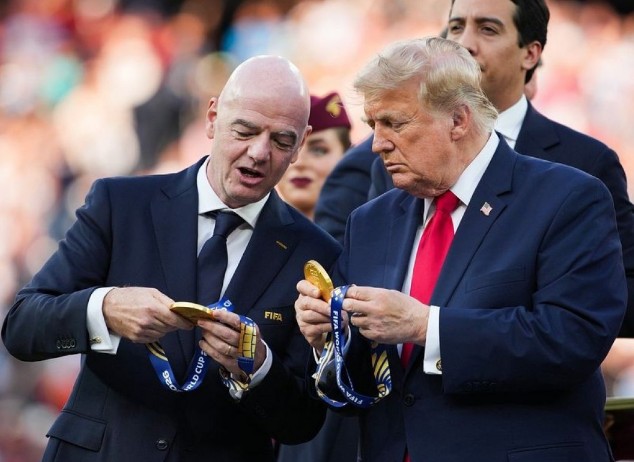
Back in July, Congressman Jamie Raskin, the ranking Democrat on the House Judiciary Committee, launched an investigation into FIFA’s relationship with the Trump administration.
He requested documents concerning gifts, payments or other benefits to Trump and people connected with him, material on FIFA’s contacts with US officials, and called on Infantino to testify before the committee.
So Infantino now finds himself in a rather uncomfortable position: on one side, a united European football bloc; on another, the prospect of criminal proceedings in Switzerland; and on a third, domestic US politics/
Of course, allegations must be clearly distinguished from proven facts. The mere existence of a parliamentary inquiry or UEFA’s application to a court does not automatically make anyone a criminal.
But the number of risks surrounding the FIFA president is growing.
— You previously spoke about Saudi Arabia distancing itself from Infantino. But on August 27, the Saudi federation publicly backed him. Does that change the balance?
— Absolutely. Facts have to be acknowledged whether they fit your forecast or not.
After the crisis began, Saudi Arabia did indeed maintain an extremely cautious position for some time, although the AFC’s initial criticism of FFE was, according to reports, also supported by the Saudi federation.
But on August 27, SAFF came out openly in support of Infantino, welcomed his admission of mistakes and the abandonment of the project, and called on the football community to engage in dialogue.
That is an important political asset for the FIFA president.
Saudi Arabia has been awarded the 2034 World Cup, is investing enormous sums in football and has substantial influence within Asia.
But I would not conclude from this that the entire AFC will now automatically fall into line behind Riyadh.
National associations formally vote independently. Besides, the conflict stopped being solely about FFE a long time ago. Even closing that issue completely does not remove the broader complaints about FIFA’s governance system.
That is Infantino’s central problem.
He may gather allies. He may win a particular vote. He may even be re-elected.
But returning to the situation that existed in July, when the president could almost single-handedly determine the agenda, has become considerably more difficult.
— What other levers remain available to Infantino’s opponents? Is the possibility of alternative competitions still real?
— Yes.
And this is no longer merely something being whispered about behind closed doors.
In August, reports emerged that UEFA, Concacaf and the AFC had begun preliminary consultations on alternative competitions in case the confrontation with FIFA’s leadership reached a dead end.
At the same time, the three confederations began working on a policy document outlining a new model for governing world football.
As far as I know, these scenarios were discussed in considerable detail during meetings in Salzburg.
Of course, creating an alternative to the World Cup would be an enormous undertaking.
There are television contracts, sponsors, national federations, players and clubs to consider. FIFA has a huge institutional advantage.
But such ideas are valuable as instruments of pressure.
If three confederations have started even calculating the economics of a separate competition, it means the taboo has been broken.
Six months ago, simply asking whether world football could exist without FIFA in its present form would have seemed marginal.
Now Infantino’s opponents are discussing what kind of organisation could replace the existing model.
— Infantino is surrounded by numerous stories from his past. Does his background affect the struggle for power today?
— Nothing on Earth disappears without a trace.
Infantino’s background — from beginning his career as a clerk in UEFA’s legal department to rising to secretary general of one of the most powerful organisations in world football — can become a very strong card in skilled hands.
Off the top of my head, I would highlight several key episodes.
First, the financing of his 2016 election campaign.
The future president initially declared expenditure of €500,000, although sources within UEFA later claimed that the actual level of support reached €1 million.
FIFA’s Ethics Committee began examining whether his declared campaign expenditure had been understated.
Domenico Scala, who at the time chaired FIFA’s Audit and Compliance Committee, demanded transparency and called on Infantino to disclose the campaign budget.
Scala subsequently resigned, while the leadership of the investigatory and adjudicatory chambers of the Ethics Committee was later replaced.
Questions were also raised about Infantino’s flight to New York in October 2015. Media reports later claimed that UEFA documentation stated a purpose for the trip that did not correspond to what actually happened.
Second, there is a more recent controversy raised by The Telegraph.
It concerns payments made in 2011 to a former UEFA employee whom the newspaper linked personally to Infantino.
According to the paper, the woman received more than £150,000, including funding for an MBA programme. After she left UEFA, attempts were reportedly made to find her employment at another major Swiss sports organisation.
Everyone involved, of course, strongly denies wrongdoing.
Infantino rejects claims of a personal relationship with the former employee and denies any misconduct.
UEFA has confirmed that the payment and MBA funding took place, while stressing that the relevant decisions were made under the rules in force at the time.
In any case, the story retains legal relevance today.
— So is this now less about the fate of one president and more about the fate of the entire system?
— Exactly.
And this is why I found the statement from the Dutch federation particularly interesting.
On August 30, the KNVB formulated the problem absolutely correctly: FIFA needs a new president, but a new president alone is not enough.
First, football needs to decide what kind of FIFA it wants. Only then should it look for a person capable of running that system.
The Dutch are proposing a separate international summit in Amsterdam for precisely that purpose.
To me, this marks the transition from a palace coup to genuine reform.
Replacing Infantino with some hypothetical “Ivantino” is easy enough.
A few years later, you simply end up with the same structure and a different person sitting in the main office.
The crisis has reached the point where the architecture itself has to change.
— What systemic “diseases” of FIFA would you identify?
— I will repeat the point: this crisis now requires not simply a change of president, but a change in the architecture of the organisation.
From my perspective, there are several key “diseases”.
The first is the obvious conflict of interest built into the electoral system.
National associations elect the president, while at the same time receiving enormous financial support from FIFA.
That creates structural dependence: the person who distributes the money has influence over those who elect him.
So the question should not be “who received the money?” but rather: “who decides how that money is distributed, according to what criteria, who monitors expenditure and who is able to conduct an independent audit?”
The second problem is the dual role of the confederations.
All six confederations within FIFA are simultaneously part of its political system while supposedly also acting as a check on it.
But they are, to put it delicately, not independent. As a result, that oversight function is largely formal.
At least, that was the situation until very recently.
The third issue is institutional representation.
Players, professional clubs, national leagues, coaches, referees, supporters and independent experts are completely absent from FIFA’s governance structure.
In other words, the main actors in football — those who play it, organise it, officiate it, analyse it and watch it — do not have proper institutional representation.
— What, then, might a new FIFA look like?
— I see potential in what might be called a four-chamber governance system.
The first chamber would consist of national associations. Nobody is proposing to strip them of their historical status or voting rights.
The second would represent professional football: clubs and leagues.
The third would represent footballers, including FIFPRO and direct player representatives.
The fourth would consist of independent football expertise: auditors, corporate-governance and internal-control specialists, sports lawyers, risk-management experts and sports-medicine professionals.
Under such a system, the president would derive a mandate not from a single group of mutually dependent voters, but from a mechanism in which several key football constituencies provide checks and balances on one another.
At the same time, power needs to be functionally separated.
There is a regulatory function — the rules and structure of the international football system.
There is an executive function — tournaments, commercial operations and development.
And there is an oversight function — audits, ethics and investigations.
At present, all these areas are too tightly intertwined around a single administration.
That is how you end up with a situation in which an organisation is effectively investigating itself.
UEFA is now demanding a fully independent external investigation into FFE with access to all correspondence and documents.
I would go further.
There should be an independent audit of FIFA’s key governance decisions throughout the entire 2016–2026 period.
That should include both completed investigations and cases that, for one reason or another, were closed or never developed into formal proceedings at all.
— Whenever the search for a new FIFA president begins, the names of legendary footballers immediately appear: Beckham, Figo, Drogba, Eto’o. Could a famous name solve the problem?
— It is a very popular, attractive and rather naïve narrative.
Winning the Ballon d’Or and running an international organisation with a multi-billion-dollar budget are completely different professions.
I can certainly imagine an outstanding footballer with an impeccable reputation effectively representing players’ interests within a new system.
But being CEO of a global corporation is a completely different job.
Michel Platini — who went from being a great player to a serious football administrator, led UEFA and became a candidate for the FIFA presidency — is more of an exception that proves the rule.
A presidential candidate should not face a political loyalty test. They should face rigorous professional scrutiny.
The required fields of knowledge and competence command, if not fear, then at least respect: sports law, corporate governance, international finance, anti-corruption legislation, crisis management and so on.
Nor is having millions in personal bank accounts any kind of panacea.
A candidate’s personal wealth may reduce certain corruption risks, but it does not eliminate them, and it certainly does not guarantee management skills.
None of this is new.
Many football legends have long been integrated into FIFA’s system, but their roles are largely ceremonial: “ambassadors”, VIP guests and so on.
It is pleasant, high-profile activity for former stars — and usually well paid — but it has very little to do with actual governance.
Moreover, I think it is a mistake to begin reform by asking: “Who will become president?”
The Dutch are suggesting a much more sensible sequence: determine the model first, and only then find the person suited to that model.
There is another possible approach, promoted for example by UEFA President Aleksander Čeferin: a supervisory-board model in which the presidents of the continental confederations collectively govern FIFA, with the role of first among equals — effectively the presidency — rotating annually.
— Another force capable of influencing reform is Europe’s biggest clubs. Whose side are they on?
— Their own.
As you would expect from major commercial players.
There is no reason to view clubs as selfless fighters for democracy.
They have their own commercial interests: media rights, sponsorship revenue, the calendar, distribution of profits and the structure of international competitions.
But many of their complaints about FIFA overlap with those of the confederations.
European Football Clubs now represents more than 850 clubs and has publicly said that it learned about FFE from the media, despite the fact that decisions of that magnitude directly affected its members.
Moreover, leading European clubs have threatened not to participate in future Club World Cups unless relations with FIFA are rebuilt on a more institutional basis.
Nasser Al-Khelaifi is a particularly important figure here: president of Paris Saint-Germain, chairman of EFC, head of beIN Media Group and an extremely influential figure.
I should refine something I said previously.
Al-Khelaifi has represented EFC on the FIFA Council since October 2025.
But the clubs themselves consider that level of integration insufficient and are demanding genuine participation in decisions affecting professional club football.
So another centre of power is emerging.
National associations can no longer claim a monopoly on speaking for football as a whole.
— Your reform proposal also raises the issue of gender representation. How important is it?
— A modern global organisation simply cannot ignore it.
The FIFA Council consists of 37 people: the president, eight vice-presidents and 28 other members.
Yet among the eight vice-presidents there is currently only one woman — Debbie Hewitt.
The statutes require each confederation to elect at least one female representative, but a numerical imbalance remains, and the imbalance in real decision-making power is even greater.
There is also a financial gap.
At the 2023 Women’s World Cup, $110 million in prize money was distributed among participating teams, while payments to participants at the 2026 men’s World Cup reached $871 million.
A direct comparison requires qualification — the competitions differ in scale and commercial revenue — but the order of magnitude illustrates the distance that remains.
I would not, however, reduce the question to mechanically increasing quotas.
The goal should be a system in which women’s football — like clubs, players, leagues and other key parts of the industry — receives real influence over decisions and the allocation of resources.
— The situation has changed considerably in the space of a week. Has your forecast for Infantino’s future changed as well?
— I would formulate it more precisely today.
Infantino certainly cannot be considered politically finished.
Saudi Arabia has backed him. He retains substantial support in Africa, South America and among many national associations for which FIFA development programmes are extremely important.
The election operates on the principle of one country, one vote.
So writing off an incumbent president on the basis of headlines in European newspapers would be a serious mistake.
But I also consider a return to the previous status quo virtually impossible.
UEFA is officially calling for new leadership. Italy has withdrawn its support for Infantino. The Netherlands is demanding a complete restructuring of FIFA. European Leagues says the current president has no future in the organisation. UEFA has gone to a US court while preparing possible proceedings in Switzerland. Three confederations are working on an alternative governance model.
So even if Infantino remains in office for some time, the model of power he represents has already been called into question.
And that is where the greatest danger appears.
Suppose Infantino leaves tomorrow — because of an election, political pressure, his own decision or legal circumstances.
Everyone celebrates, poses for photographs and announces a new era.
Then someone from the same system takes his place and receives almost exactly the same powers.
Five years later, we are back where we started.
That is why I still believe the opposition’s main task is not simply to remove one particular president.
Its task is to create a system in which the next president simply cannot concentrate the same amount of power in his own hands.
And here, perhaps, we have seen the most important change of recent weeks.
Until recently, FIFA reform was something discussed by individual critics.
Now UEFA, national associations and other influential stakeholders are discussing it as a political programme.
Infantino’s opponents are working on their own model for governing world football, while the Dutch federation is proposing to take that discussion to an international summit.
So I will repeat the thought with which I ended our previous conversation: this crisis is much bigger than one man.
Football is on the brink of a revolution.
The only question is whether it ends with a different surname on the president’s office door — or with the creation of a fundamentally different system of governance.