
World football is facing the biggest political crisis of the Gianni Infantino era. The leadership of UEFA, the Asian Football Confederation and CONCACAF are discussing whether to challenge the FIFA president at an extraordinary congress.
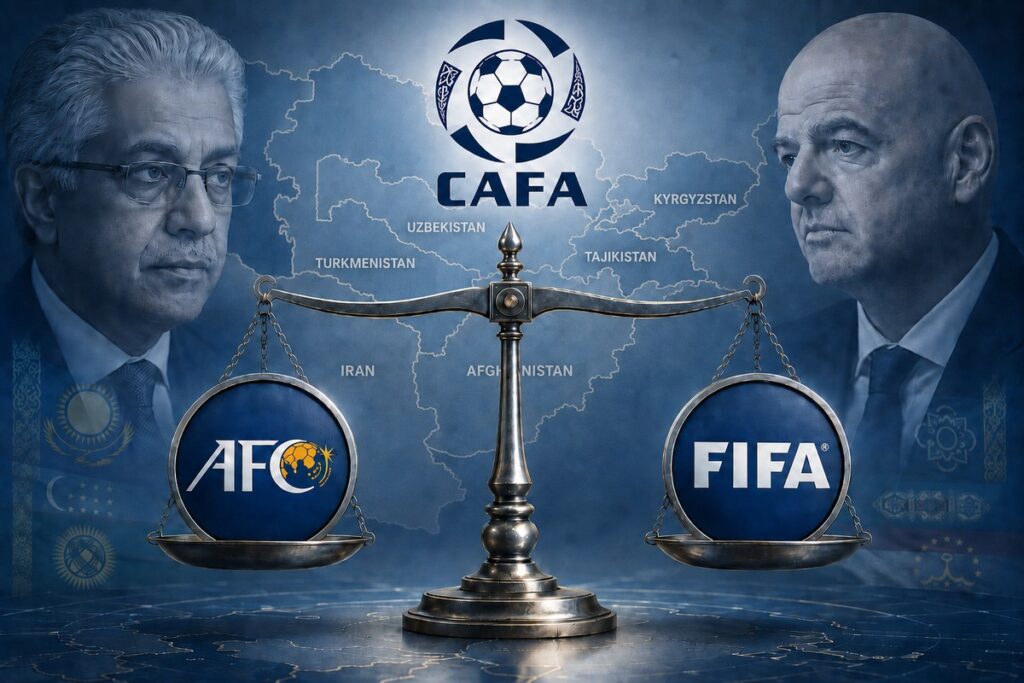
There is no united front against Infantino, however. He retains substantial support in Africa and South America, Oceania has taken a softer line overall, while Asia itself is deeply divided.
All six members of the Central Asian Football Association — Uzbekistan, Tajikistan, Kyrgyzstan, Iran, Turkmenistan and Afghanistan — have yet to show their hand.
And ten years ago, the region faced a choice between the very same men.
Ahead of the FIFA presidential election in February 2016, CAFA officially announced that all six of its members would support AFC president Sheikh Salman bin Ibrahim Al Khalifa. Infantino was the Bahraini’s main rival. In total, 22 associations from Central, East and South Asia publicly backed Salman.
Infantino eventually won the second round 115–88. The ballot was secret, so it is impossible to establish how each individual CAFA association actually voted. But Central Asia’s public position was unambiguous: the region chose Salman over Infantino.
Three years later, all six CAFA members again collectively backed the Bahraini, this time in the AFC presidential election. Their position was announced at the CAFA Congress in Bishkek by the organisation’s then-president, Uzbekistan’s Umid Ahmadjonov.
Salman may now need those same six votes again. But Infantino’s position in Central Asia has changed dramatically over the past decade.
Salman changed course in three months
The differences between Infantino and Salman predate the current crisis.
One of the dividing issues has been CONMEBOL’s proposal to expand the 2030 World Cup from 48 to 64 teams. Infantino did not dismiss the idea and confirmed in the summer of 2026 that FIFA would examine it after the 2026 World Cup.
Salman had already come out firmly against the proposal a year earlier, warning that repeatedly increasing the number of teams could lead to “chaos”. FIFA is now conducting a separate study into the potential impact of such an expansion.
For several Central Asian countries, however, a bigger World Cup could work very much in their favour.
The current crisis itself erupted over FIFA Forward Enterprise. FIFA’s leadership proposed creating a commercial entity valued at around $20 billion and selling a 20% stake to private investors for approximately $4.2 billion. The project involved commercial rights linked to World Cups and other FIFA competitions.
The initiative drew sharp criticism over the lack of prior consultation and questions surrounding transparency. FIFA abandoned the project on July 31, but by then the dispute had developed into a broader crisis of confidence in Infantino himself.
As recently as April 30, Salman was publicly backing Infantino for another term in 2027. Three months later, the AFC president was describing FIFA’s failure to consult the confederations as “completely unacceptable” before joining the leadership of UEFA and CONCACAF in severe criticism of the FIFA president.
On August 20, Reuters reported that the three confederations were exploring the possibility of calling an extraordinary congress and testing Infantino’s support through an unprecedented no-confidence vote.
FIFA’s statutes do not provide for a conventional stand-alone vote of no confidence. An extraordinary congress, however, can be requested by one fifth of FIFA’s 211 member associations — 43 federations. Each association has one vote.
There is another detail that makes Salman’s position particularly intriguing. If the FIFA presidency becomes vacant, the longest-serving vice-president is supposed to take over on an interim basis until a new election.
At present, that man is Salman.
The AFC itself is divided
Salman’s stance does not mean that all 47 AFC members are behind him.
Since the crisis began, a number of Asian associations have publicly backed Infantino, including Qatar, Kuwait, the UAE, Lebanon, Sri Lanka, Indonesia, Bhutan and the Philippines. Saudi Arabia and Bahrain — Salman’s own country — had already endorsed Infantino’s re-election before the dispute erupted.
Saudi Arabia and Qatar are particularly revealing examples.
Under the current AFC structure, Saudi Arabia has become the central venue for the decisive stages of Asian club football. The AFC Champions League Elite finals have been held in the kingdom for the past two seasons and will remain there for another three, through 2028/29.
Al-Ahli of Jeddah won both competitions staged under the new format. In 2025, the Japan Football Association openly described Kawasaki Frontale’s final against Al-Ahli as effectively a fully away fixture.
Yet the Saudi federation itself publicly supported Infantino’s re-election earlier this year.
Qatar has a different logic.
Doha has maintained close ties with FIFA since hosting the 2022 World Cup and continues to stage major FIFA competitions. Support for Infantino from the Qatar Football Association is therefore understandable.
Qatar is also the only AFC member to have gone beyond defending Infantino and directly challenged Salman himself. Doha argued that national associations had not been consulted before the AFC leadership joined the letter criticising the FIFA president.
Salman replied that he had acted in the interests of Asian football. On August 20, Qatar said his explanation remained unsatisfactory.
Other Asian supporters of Infantino have not followed Doha into a direct confrontation with the AFC president.
There is also an opposing camp. Jordan has openly refused to back Infantino. Australia has supported the AFC leadership’s position on transparency and FIFA governance. Japanese officials also strongly criticised FIFA Forward Enterprise, even though Japanese football has simultaneously expressed frustration over the financial dominance of Saudi clubs and the staging of decisive AFC Champions League Elite matches in Jeddah.
Salman himself is hardly free of criticism.
The club competition reform introduced under his leadership increased overall prize money and created a three-tier structure — the AFC Champions League Elite, AFC Champions League Two and AFC Challenge League. But the biggest revenues and the best access remain concentrated among the strongest domestic leagues.
Even after the Champions League Elite was expanded from 24 to 32 clubs, the gap between the opportunities available to Asia’s leading associations and its smaller ones remains enormous.
For most CAFA members, that matters directly. Their clubs are far more likely to find themselves in the second and third tiers of Asian football, where both prize money and commercial opportunities are significantly smaller.
The current dispute therefore cannot be reduced to “Infantino versus a united Asia”.
Neither Infantino nor Salman controls the Asian vote as a whole.
Infantino has spent a decade working on Central Asia
Salman has a powerful historical argument: CAFA already chose him directly over Infantino once and collectively backed him again three years later.
But after winning the 2016 election, Infantino steadily strengthened his relationships across Central Asia.
His tour of the region in spring 2023 was particularly significant. The FIFA president visited several countries and met not only football officials but heads of state. The discussions involved tangible projects — technical centres, academies, stadiums and FIFA Forward funding.
In 2025, FIFA directly supported the CAFA Nations Cup for the first time, providing financial, technical and institutional assistance. Infantino personally travelled to Tashkent for the final between Uzbekistan and Iran.
Today’s CAFA is therefore very different from the bloc that announced its support for Salman in advance in 2016.
Uzbekistan
Tashkent has strong links to both sides.
Uzbekistan was part of the CAFA bloc that officially backed Salman against Infantino in 2016. In 2019, it again joined the six associations that unanimously supported the Bahraini’s re-election as AFC president.
Those institutional ties remain in place today. Ravshan Irmatov, first vice-president of the Uzbekistan Football Association, sits on the AFC Executive Committee as a representative of the Central Zone.
But relations with Infantino have become no less significant.
In 2023, the FIFA president discussed the development of the National Football Centre, academies, school football and FIFA Forward projects in Tashkent.
Uzbekistan subsequently became the first country in Central Asia to host a FIFA World Cup when it staged the 2024 Futsal World Cup.
In September 2025, the relationship moved to an even higher political level. President Shavkat Mirziyoyev awarded Infantino the Order of Friendship for his contribution to the development of Uzbek football. At the same meeting, the two sides discussed opening a FIFA regional office for Central Asia in Tashkent.
FIFA also supported the 2025 CAFA Nations Cup, which ended with Uzbekistan defeating Iran in the final.
There is a wider political context too.
Relations between Tashkent and Washington are currently at a very high level. Mirziyoyev maintains direct dialogue with Donald Trump, while Head of the Presidential Administration Saida Mirziyoyeva works directly with representatives of the US administration.
Trump, meanwhile, has developed an unusually close public relationship with Infantino.
There is, of course, no suggestion that anyone intends — or is in a position — to dictate Uzbekistan’s FIFA vote. Tashkent has far more room for manoeuvre than it did ten years ago.
Its historical and institutional links point towards Salman. Years of cooperation with FIFA and personal ties at the highest level point towards Infantino.
Given Uzbekistan’s multi-vector, friendly but highly pragmatic diplomacy, the choice will be far from straightforward.
Kyrgyzstan
Football in Kyrgyzstan has effectively become part of state policy in recent years.
In 2024, President Sadyr Japarov personally asked Kamchybek Tashiev, then head of the State Committee for National Security, to take charge of the Kyrgyz Football Union.
After major changes in the domestic game, Chairman of the Cabinet of Ministers Adylbek Kasymaliev became KFU president in spring 2026.
A decision on a conflict of this scale is therefore unlikely to be left exclusively to football officials.
Salman nevertheless retains a strong channel inside Kyrgyz football. Dastanbek Konokbaev represents Central Asia on the AFC Executive Committee and remains one of CAFA’s most experienced officials.
Infantino has also worked actively with Bishkek.
During a May 2023 visit, he met Japarov at the Ala-Archa state residence. They discussed a new national stadium, a technical centre, academies and other FIFA Forward projects.
Infantino also opened the KFU’s new headquarters.
And this involved very concrete money: FIFA contributed approximately $1.849 million to the construction of the building. The project later received a gold FIFA Forward Award.
Then there is the Russian factor.
Moscow has an interest in Infantino remaining in office. The FIFA president has publicly called for a reconsideration of the ban on Russian teams from international competitions.
Kyrgyzstan maintains close relations with Russia. This does not mean Bishkek would automatically vote according to Moscow’s wishes, but the position of a key partner is likely to be taken into account.
There is another purely footballing argument.
Kyrgyzstan came closer than ever to reaching a World Cup during the most recent qualifying campaign, advancing to the third round for the first time in its history.
For a country still chasing its first World Cup appearance, a possible expansion to 64 teams could become a serious factor in how Bishkek views the wider dispute.
Tajikistan
CAFA itself is headquartered in Dushanbe, while both the Tajikistan Football Federation and the regional association are headed by Rustam Emomali.
His influence extends well beyond football. Emomali is also chairman of the upper house of Tajikistan’s parliament and mayor of Dushanbe.
If the six associations attempt to develop a common position again, it would be extremely difficult to do so without him.
Dushanbe has developed productive relations with both sides.
Infantino attended the CAFA Congress in Tajikistan in 2023, met President Emomali Rahmon and Rustam Emomali, and inspected football facilities then under construction.
A major technical centre for Tajik national teams was later completed in Varzob. The project received financial and technical support from FIFA, the AFC and local partners.
That cooperation illustrates Tajikistan’s ability to work with both football power centres while avoiding involvement in their external disputes.
There is also a foreign-policy balance to consider, particularly given Rustam Emomali’s position within Tajikistan’s political hierarchy. Any decision he makes will inevitably be viewed as more than simply a sporting one.
China has sharply increased its economic presence in Tajikistan in recent years but has yet to indicate a position on the FIFA conflict. Russia, meanwhile, continues to maintain close ties with Dushanbe and has an interest in Infantino remaining in office.
Waiting is therefore a perfectly rational strategy for Tajikistan.
Emomali must consider not only Tajikistan’s single vote but his position as president of CAFA.
And the proposed expansion of the World Cup should not be overlooked either. A larger tournament would increase Tajikistan’s chances of reaching the global finals for the first time.
Turkmenistan
Infantino has worked directly with Ashgabat as well.
In May 2023, he made his first visit to Turkmenistan and met President Serdar Berdimuhamedov. They discussed the creation of a technical centre and football academy, youth and grassroots development and future FIFA projects.
How far those plans have progressed is difficult to assess given Turkmenistan’s highly closed information environment.
Despite years of engagement with both FIFA and the AFC, there have been few visible signs of greater openness in Turkmen football. There are, however, reasons for cautious optimism. Domestic clubs have made some progress internationally, helping to sustain the authorities’ interest in the game.
The Turkmenistan Football Federation is currently headed by Guvanch Ovekov, who is also a CAFA vice-president. A former Turkmenistan international and coach, he brings considerable experience from inside the game — another potentially positive sign.
Even so, it is difficult to imagine a decision of this magnitude being made independently by the national federation. It will inevitably be considered in the context of the country’s broader foreign-policy interests.
China remains Turkmenistan’s main economic partner and the principal buyer of Turkmen gas.
Beijing has yet to state its position on the FIFA dispute.
There is no basis for saying that Ashgabat is simply waiting for China to decide. But if the conflict reaches an actual vote, the position of Turkmenistan’s largest trading partner would be difficult to ignore.
Afghanistan
Afghanistan’s vote is closely connected to the position of federation president Mohammad Yousuf Kargar, who is also CAFA’s senior vice-president.
His leadership has faced serious criticism inside Afghan football for several years.
In 2023, a large group of national-team players, including footballers who played or grew up in Europe, boycotted the team and called for FIFA intervention over allegations of corruption and possible match-fixing.
In 2025, former captain Zohib Islam Amiri again demanded changes and new elections.
Kargar was later accused of demanding $10,000 in connection with a player’s place in the national team. He acknowledged the authenticity of the recordings being discussed but rejected allegations of bribery, saying the conversation concerned sponsorship.
FIFA, the AFC and CAFA nevertheless continue to recognise Afghanistan’s current football leadership.
For Kargar, that international recognition is particularly valuable. An open conflict with FIFA would therefore appear unlikely to serve his interests.
At the same time, he has long been integrated into the CAFA and AFC system and was already part of the Central Asian bloc that backed Salman against Infantino.
Institutional continuity is therefore likely to weigh heavily in Afghanistan’s calculations.
Iran
Iran has the strongest direct link to the AFC leadership of any of CAFA’s six members.
Football Federation Islamic Republic of Iran president Mehdi Taj is also the AFC vice-president for the Central Zone. He therefore sits directly within Salman’s senior leadership structure.
Iran was also part of the CAFA bloc that backed Salman against Infantino in 2016.
Tehran’s relationship with FIFA has nevertheless remained functional. Infantino has dealt directly with Taj and Iran’s political leadership and, ahead of the 2026 World Cup, supported Iran’s full participation despite political and visa-related complications.
Iran, however, does not have the same dense network of personal and infrastructure ties to Infantino as Uzbekistan or Kyrgyzstan.
Taj, by contrast, is himself part of the AFC leadership.
If the decision were based strictly on football’s institutional structure, Iran would appear the most natural candidate among the six CAFA members to support Salman.
But even Tehran has so far preferred to remain silent.
That is the fundamental difference between 2016 and 2026.
Ten years ago, Central Asia announced in advance that it was choosing Salman over Infantino. A decade later, Salman may once again need those same six votes — but none of his former allies is rushing to promise them.
Nor, however, has anyone in CAFA made a commitment to the opposite camp.
Central Asia knows the value of waiting.