
Croatian coach Ante Miše was not an obvious choice for Turkmenistan. In 2019, he became the first head coach of the national team from outside the post-Soviet space, entering one of Central Asia’s most closed football environments — a country where domestic football had long been difficult to follow from abroad, with limited broadcasts and very few foreign players.
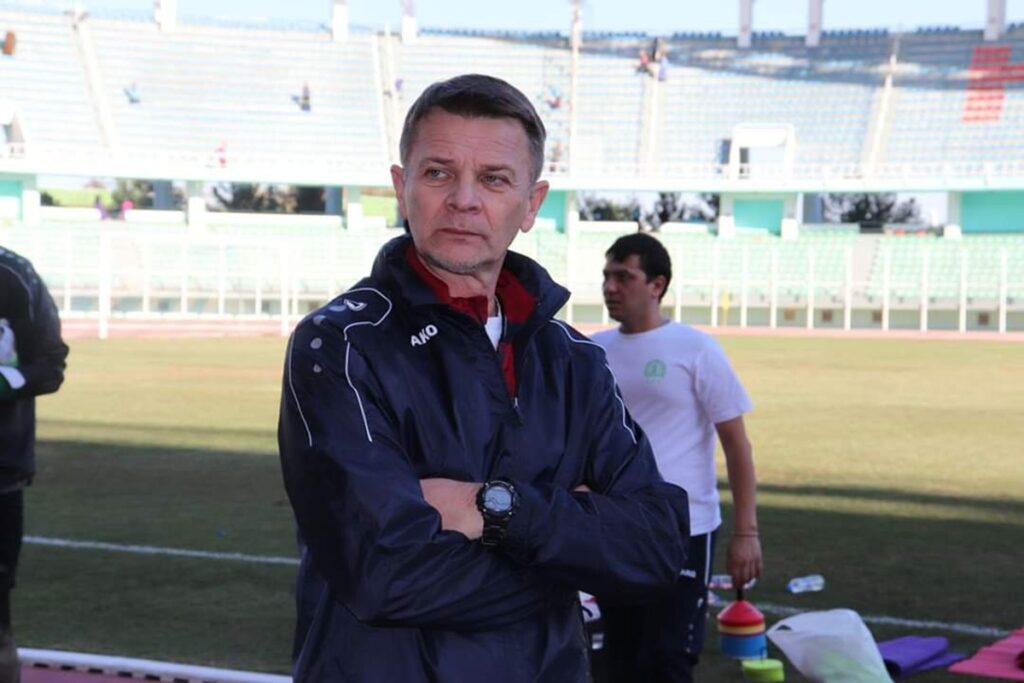
His team beat North Korea in World Cup qualifying, stayed in contention for the next round — and then saw the campaign disrupted by COVID-19.
In a wide-ranging interview with Eurasia Football, Miše spoke about how the appointment happened, why Turkmen players need more exposure, what Ruslan Mingazov could still give the national team, why Balkan coaches are valued in Asia and whether Central Asia can become a scouting market for Europe.
Before moving into coaching, Miše had a strong playing career. He represented Hajduk Split and Vitesse, earned seven caps for Croatia and shared the pitch with players from the country’s golden generation, including Davor Šuker, Zvonimir Boban and Robert Prosinečki.
— You had a strong playing career and shared the pitch with top players at club and national-team level. How much did that experience help you as a coach?
— It helped a lot. Preparing for matches, discussing tactics, analysing games afterwards — all of that became the beginning of my coaching life. My transition into coaching actually started during the final two years of my playing career.
— Your appointment as Turkmenistan head coach looked unusual. You became the first national-team coach from outside the post-Soviet space. How did it happen?
— First of all, I was proud to become the first foreign coach of the Turkmenistan national team. Everything happened very quickly. The general secretary and the board of the Football Federation of Turkmenistan came to Zagreb for a meeting with the Croatian Football Federation. A month later, my candidacy was approved by President Gurbanguly Berdimuhamedow. After that, the Football Federation of Turkmenistan sent me the flight tickets, and I went to start a new challenge in Turkmenistan. The Croatian Football Federation helped a lot at that time.
— Who made the first contact?
— Gennady Khristoforidi from FA Playsport was the person who made the first contact and did everything for this move to happen. I was surprised and saw it as a great opportunity and a step forward in my coaching career.
— What was the most difficult thing when you arrived in Turkmenistan?
— The beginning was difficult. I did not speak Russian, and communication is extremely important. My assistant Sandro Tomić and I needed time to understand how the Federation worked, how the processes were organised, the quality of the players and the infrastructure.
— You said at the time that you wanted to contribute not only to the national team, but also to the development of Turkmen football. What was the main systemic problem?
— In sport, the key factor is always time. That is what you usually need most if you want to implement serious systemic changes. To achieve sustainable progress, you need consistent work over a long period. Unfortunately, my time was limited, and then COVID-19 became an additional challenge that nobody could have predicted.
— Turkmenistan improved quickly under you in the 2022 World Cup qualifiers. What changed?
— The players were good and had potential, but what they needed most was confidence. They got that from me and Sandro. A friendly match against Uganda helped a lot. We drew that game, and the players started to believe in me and in my vision of football.
— The win over North Korea was a major result, although it was later annulled. How do you remember that match?
— It was our best match. A fantastic performance in front of 30,000 fans. We played as one team — in defence, in midfield and in attack. We had a great chance to reach the next round, but the coronavirus destroyed everything.
— How did your time with Turkmenistan end?
— I left Turkmenistan on 20 March 2020. At that time, like many other countries, Turkmenistan closed its borders because of the pandemic. My contract was coming to an end, and we were discussing an extension because the Federation was satisfied with my work. Unfortunately, COVID-19 changed all plans.
— Still, we parted on good and friendly terms. I have warm feelings towards Turkmenistan and the people I worked with there. I made many good friends in the country, and we remain in contact.
— Ruslan Mingazov was not called up for Turkmenistan’s recent Asian Cup qualifier against Thailand. How important is he for the national team?
— To be honest, I did not even know whether he was still playing. What I remember about him is that he was good at dribbling, had an excellent shot and was very strong from free kicks. Why is he not being called up? If he is not injured, he could be very useful.
— How would you describe a Turkmen footballer? What are his strengths, and what does he usually lack?
— A Turkmen footballer is physically well developed, technically decent — although it could be better — always motivated and ready to fight. The weak points are work ethic and discipline.
— Turkmen clubs have had some notable results in Asian competitions despite the league being quite closed. At the same time, domestic football in Turkmenistan has long remained difficult to follow from the outside, with limited broadcasts and very few foreign players. How can football develop in such conditions?
— Turkmen clubs that play in Asian competitions get the chance to compare themselves and compete with foreign teams. That is exactly how the level of football in Turkmenistan improves.
— Could regular broadcasts and foreign players open Turkmen football up and take it to a new level?
— Absolutely. Broadcasts and foreign players would raise the level of Turkmen football. The potential of Turkmen players is huge, but their quality needs to be visible beyond the country — not only through matches being shown, but also through foreign players and coaches who could work with them inside Turkmen clubs and recommend them abroad.
— Which Turkmen players impressed you the most?
— Mostly Arslanmurat Amanov, Altymyrat Annadurdyyev, Mekan Saparov and Serdar Geldiyev. They were key players from my Turkmenistan squad. I never had the opportunity to bring Turkmen players to my later clubs, although I wanted to. But when you work at a club, there are always certain limitations.
— Amanov is now director of FC Arkadag, while Geldiyev is general secretary of the Football Federation of Turkmenistan. What can you say about them?
— The right people in the right positions. Great guys, excellent players, dedicated and honest people. They are the future of Turkmen football.
— What do Turkmen players lack in order to establish themselves abroad, especially in Europe?
— Perhaps the Federation’s rules do not regulate playing abroad clearly enough. The quality and potential are definitely there.
— What potential do you see in Central Asia as a football region?
— Central Asia has great potential. But some countries are still closed.
— Can Central Asia become a new source of players for Europe — perhaps not like the Balkans, but at least a clear scouting direction?
— There are quality players there. The main problem is adaptation.
— Why are Balkan coaches so in demand in Asia?
— First of all, our coaches have knowledge. Our coaching academies are excellent, and we have many specialists all over the world. We adapt easily in Asia, Africa and other regions. That is why we are successful everywhere.
— How is a Central Asian footballer similar to a Balkan player, and what is the main difference?
— In many ways, they are similar. But the huge difference is work ethic. In Europe, in the Balkans, every training session is a fight for survival. There is no time for thinking too much or having fun.
— What should a Croatian, Serbian or Bosnian coach understand before going to work in Central Asia?
— You need patience. Time works differently there, — Miše smiles.
— After Turkmenistan, you worked successfully in Kuwait and Saudi Arabia. What stood out there compared to Turkmenistan?
— In Kuwait, each team can register five foreign players, and many of them are at a really high level. In Saudi Arabia, what stood out was professionalism, work ethic and infrastructure. The demands from management, staff and players were much higher.
— After leaving Turkmenistan, did Asia become your priority?
— My priority is mainly Asia.
— If you received an offer from a club or national team in Central Asia, would you consider it?
— Yes. I would consider offers and assess the ambitions of the club or federation. If I saw that the project was ambitious, I would accept.
— If Turkmenistan offered you the national team job again, would you need much time to think?
— Turkmenistan became a very close country to me and will forever remain in my heart. I am always open to dialogue. If such an offer came, I would certainly be interested in meeting and discussing it with the Federation’s leadership. Especially because today there are professional and competent people working there — people who have gone all the way through football, from youth level to the professional game, including experience abroad.